-
Investing Guides/Market Mechanics
Korea Value-Up Program 2026: What Investors Need to Know
2026. 8. 18.
Table
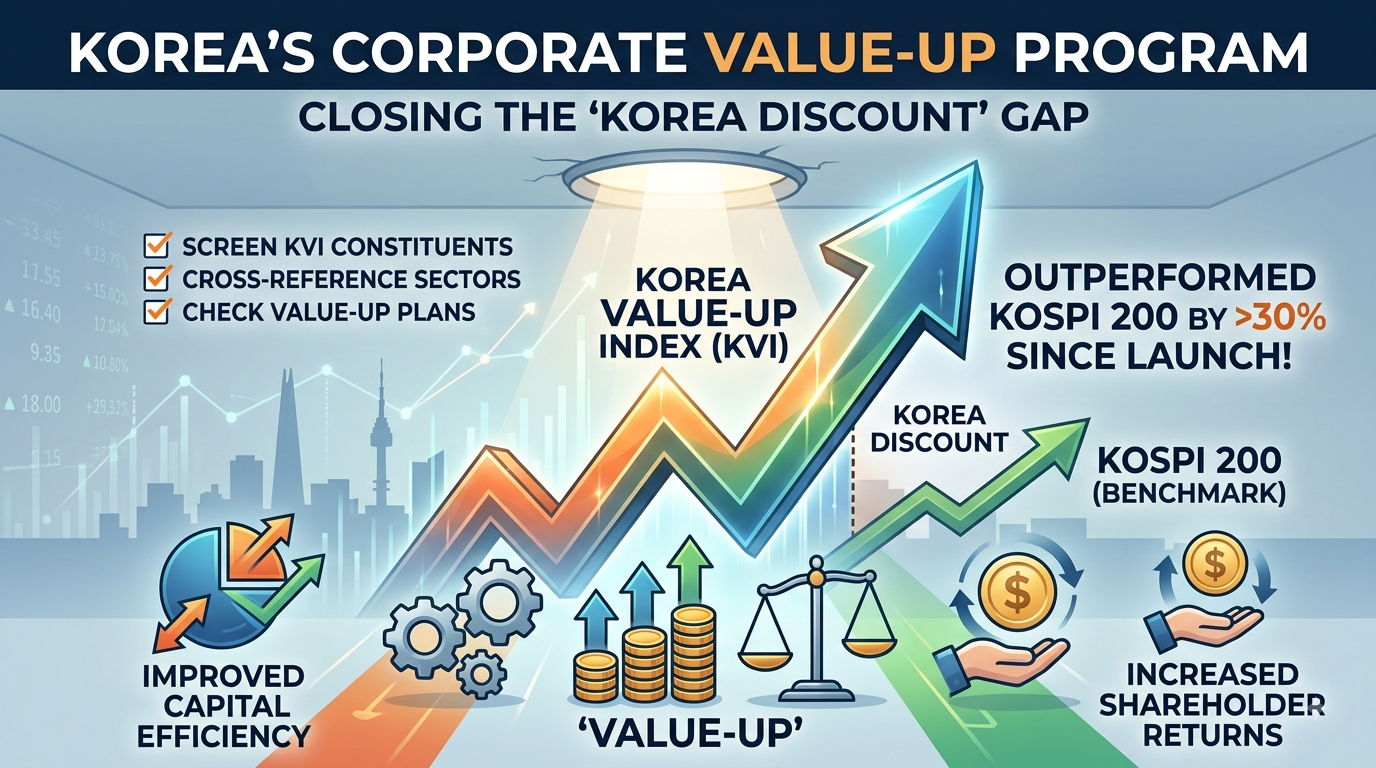
반응형Korea's Corporate Value-Up Program, launched in February 2024, is a government-driven initiative pressuring listed companies to improve capital efficiency and shareholder returns in order to close the "Korea Discount." The associated Korea Value-Up Index has outperformed the broader KOSPI 200 by more than 30% since its September 2024 launch.
Table of Contents
- What Is the "Korea Discount"?
- How Does the Value-Up Program Work?
- What Gives the Program Legal Force?
- What Is the Korea Value-Up Index?
- What Incentives Do Participating Companies Get?
- Has the Program Actually Worked?
- How to Screen Stocks Using the KVI
- FAQ
What Is the "Korea Discount"?
Korean stocks have historically traded at persistently lower valuations than comparable global peers — KOSPI's average price-to-book ratio has hovered near 0.99, versus roughly 1.5x for Japan and 3.4x for Taiwan. Analysts attribute this largely to complex chaebol (family conglomerate) corporate structures, weak minority shareholder protections, and historically low dividend payout ratios — itself partly a product of Korea's steep inheritance tax (up to 50%, and 60% for controlling chaebol families), which has incentivized controlling families to suppress reported company value to minimize tax exposure on succession.
 반응형
반응형How Does the Value-Up Program Work?
Modeled partly on a similar Japanese corporate governance reform push, the FSC's program operates on a voluntary "comply-or-explain" basis: listed companies are encouraged to publish a Value-Up plan detailing capital efficiency and shareholder return targets, and companies choosing not to participate must publicly explain why — creating reputational pressure even on non-participants. Companies with total assets exceeding 500 billion Won face mandatory corporate governance disclosure requirements confirming whether a Value-Up plan has been presented.
What Gives the Program Legal Force?
Initially a voluntary framework, the program gained binding legal weight in 2025 when Korea amended its Commercial Act to explicitly establish that company directors owe a fiduciary duty to all shareholders — not solely to controlling families, as had often been the practical reality. Separately, in February 2026, the government further tightened requirements by amending corporate tax law so that high-dividend companies must disclose Value-Up plans to continue receiving associated tax benefits, closing a gap that had allowed some companies to claim benefits without genuine reform commitment.
What Is the Korea Value-Up Index?
Launched by the Korea Exchange (KRX) in September 2024, the Korea Value-Up Index (KVI) selects constituent companies against five criteria: top-400 market capitalization, two consecutive years of profitability (no losses), consistent shareholder returns via dividends or buybacks, price-to-book ratio in the top half of eligible companies, and strong return on equity. As of early 2026, the index includes roughly 67 KOSPI and 33 KOSDAQ companies.
What Incentives Do Participating Companies Get?
Tax benefits Reduced dividend tax rate — from up to 49.5% to 30% or lower — for companies with payout ratios above 40% Tax audit grace period 1-3 year grace period from routine tax audits for qualifying participants Exemplary taxpayer status Priority selection for favorable tax treatment categories and R&D tax credit evaluation Overseas IR support Government-facilitated international investor relations opportunities Passive capital inflows KVI index membership attracts inflows from ETFs and institutional mandates benchmarked to the index Has the Program Actually Worked?
The evidence is genuinely encouraging, though not without caveats. The KVI has outperformed the KOSPI 200 benchmark by more than 30% since its September 2024 launch. KOSPI itself crossed 5,500 during 2026, aided partly by the ongoing memory chip upcycle benefiting Samsung Electronics and SK Hynix rather than governance reform alone — meaning some of the rally reflects a separate cyclical tailwind, not purely structural improvement. Notably, activist investment firms have begun establishing dedicated Korea coverage in response to the reform momentum, including firms opening Korea offices in 2025, a signal that sophisticated investors view the governance shift as durable rather than a short-term political initiative tied to any single administration.
How to Screen Stocks Using the KVI
- ☐ Start with current KVI constituent lists, published and updated periodically by the Korea Exchange
- ☐ Cross-reference against sector exposure you want (the index spans multiple sectors, not just semiconductors)
- ☐ Check whether each candidate has published a formal Value-Up disclosure plan with specific, measurable targets (rather than a vague statement of intent)
- ☐ Compare dividend payout ratio trends over the past 2-3 years to confirm genuine improvement, not a one-time payout spike
- ☐ Monitor whether the company maintains KVI eligibility at subsequent index rebalancing dates
FAQ
Is the Value-Up Program similar to Japan's corporate governance reforms?
Yes, Korea's program was explicitly inspired by Japan's earlier Tokyo Stock Exchange-led push for improved capital efficiency and shareholder returns, though Korea's version has evolved its own specific mechanisms, including the KVI and targeted tax incentives.
Will the Value-Up Program survive a change in government?
Uncertain, though the 2025 Commercial Act amendment establishing directors' fiduciary duty to all shareholders provides a legal foundation that would be harder to simply reverse via administrative policy change than the original voluntary framework alone.
Does KVI membership guarantee good stock performance?
No. KVI membership reflects governance and shareholder-return criteria, not a guarantee of future price performance, and the index's strong recent showing partly overlaps with an unrelated semiconductor cycle tailwind.
반응형'Investing Guides > Market Mechanics' 카테고리의 다른 글
Korean Stock & Equity Research
Data-driven analysis of Korean listed companies, combining financial fundamentals with supply chain and operations insights. Not investment advice.