-
Investing Guides/Market Mechanics
How Stock Splits and Rights Offerings Work for Foreign KOSPI Investors
2026. 8. 22.
Table
반응형Korean companies raise capital through rights offerings (유상증자, yusang jeungja) more frequently than US peers typically do, and as a foreign shareholder you'll usually be offered the right to buy new shares at a discount to market price — declining to participate can dilute your existing stake. Stock splits work similarly to US markets but require confirming your broker correctly processes the corporate action for foreign-held shares. This article is part of our Ultimate Guide to Investing in South Korean Stocks for Foreigners.
What Is a Korean Rights Offering (유상증자)?
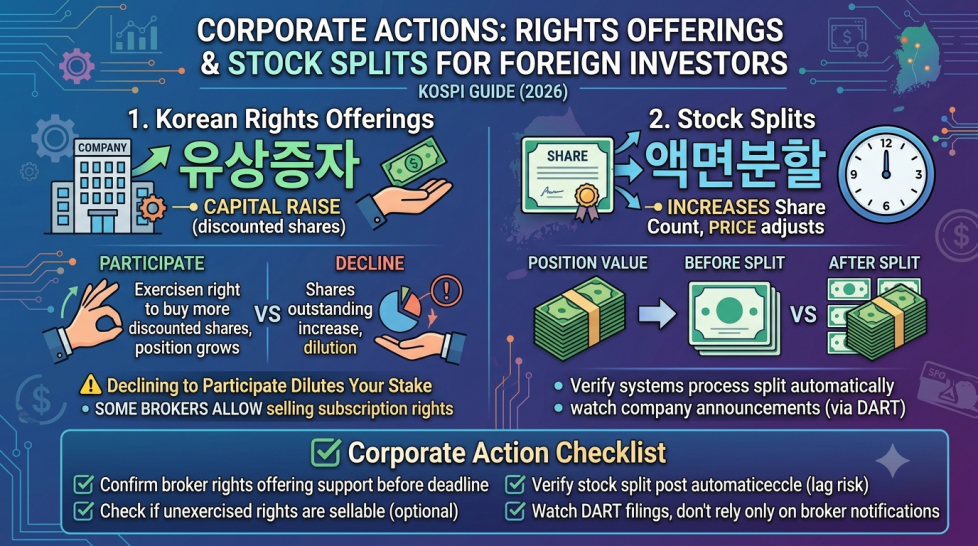
A rights offering is a capital raise in which a company issues new shares, typically offered first to existing shareholders at a discount to the current market price. Korean companies use rights offerings notably more often than US-listed companies, which more commonly raise capital through debt issuance or follow-on public offerings without a shareholder rights component.
 반응형
반응형What Happens If You Don't Participate?
⚠️ Declining to Participate Dilutes Your Stake
If you don't exercise your rights to buy new shares, your percentage ownership in the company decreases as total shares outstanding increases — a dilution effect. Some rights offerings allow selling your subscription rights on the market instead of exercising them, partially offsetting the dilution economically, but this depends on whether your specific broker supports rights trading for foreign accounts.
How Do Stock Splits Work for Foreign Holders?
Korean stock splits (액면분할) function similarly to US stock splits — the number of shares increases while the per-share price adjusts proportionally, leaving total position value unchanged. The main practical consideration for foreign investors is confirming your broker's systems correctly process the split for foreign-held custody positions, since processing timing can occasionally lag for internationally held shares relative to domestic Korean accounts.
✅ Corporate Action Checklist
- Confirm whether your broker supports rights offering participation for foreign accounts before the subscription deadline
- Check whether unexercised rights can be sold on the market as an alternative to full dilution
- Verify stock split adjustments post automatically to your account, or require manual confirmation
- Watch company announcements (via DART) directly, since brokers don't always proactively notify foreign account holders of upcoming corporate actions
Frequently Asked Questions
Q1. Do I automatically receive rights offering notifications as a foreign investor?
A. Not always — some brokers notify proactively, but many foreign investors need to monitor DART filings directly to catch upcoming rights offerings.
Q2. Are Korean rights offerings mandatory to participate in?
A. No, participation is optional, but declining results in ownership dilution unless you sell your subscription rights instead.
Q3. Does a stock split change the total value of my position?
A. No, a stock split proportionally adjusts share count and price, leaving total position value unchanged at the moment of the split.
반응형'Investing Guides > Market Mechanics' 카테고리의 다른 글
Korean Stock & Equity Research
Data-driven analysis of Korean listed companies, combining financial fundamentals with supply chain and operations insights. Not investment advice.