-
Market Structure/Market Psychology & History
The 1997 Asian Financial Crisis: How a Currency Peg Became a Target
2026. 8. 26.
Table
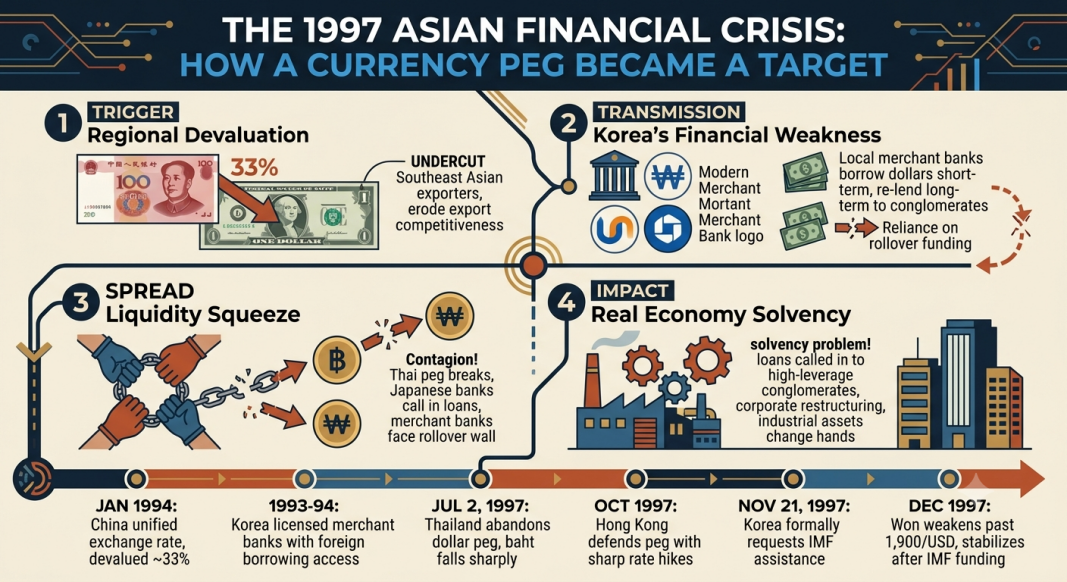
반응형Korea's 1997 currency crisis traces back three years earlier, to a 1994 Chinese devaluation that undercut Southeast Asian exporters, and to a domestic decision to let two dozen thinly-capitalized finance companies borrow dollars short-term and lend them out long-term. When Thailand's peg broke in July 1997, the same structural weakness — foreign-currency liabilities that couldn't be rolled over — spread to Korea within months, ending in an IMF bailout by December.
What Triggered the Regional Currency Pressure in the First Place?
In January 1994, China unified its dual exchange-rate system, moving the official rate from roughly 5.8 to 8.7 yuan per dollar in a single step. The effect was to cut the dollar price of Chinese exports by roughly a third overnight. For Thailand, Malaysia, and Indonesia — economies competing with China in low-cost manufacturing — the shift eroded export competitiveness just as capital inflows from Japan were peaking. Current accounts across the region swung into deficit through the mid-1990s, a slow-building imbalance that set the stage for what followed.
Why Did Korea's Finance Companies Become the Transmission Channel?
Korea's 1993-94 financial liberalization converted roughly two dozen local investment and finance companies into merchant banks (jonggeumsa), giving them access to foreign-currency borrowing for the first time. Many had no prior experience managing currency or maturity risk. Their business model was straightforward and, in retrospect, fragile: borrow dollars offshore at short maturities — often under a year, at low single-digit rates — and re-lend to Korean conglomerates at a spread. As competition among the merchant banks compressed margins, more of them shifted toward shorter and shorter funding to keep costs down, leaving the sector overwhelmingly reliant on rollover.
Date Event Jan 1994 China unifies its exchange rate, devaluing roughly 33% 1993-94 Korea licenses ~24 new merchant banks with foreign-borrowing access Jul 2, 1997 Thailand abandons its dollar peg; the baht floats and falls sharply Oct 1997 Hong Kong raises overnight interbank rates toward 300% to defend its peg Nov 21, 1997 Korea formally requests IMF assistance Dec 1997 Won weakens past 1,900/USD before stabilizing near 1,500 on confirmed IMF funding How Did the Crisis Actually Reach Korea's Real Economy?
When Thailand's peg collapsed, Japanese banks — already under pressure to raise capital ratios after the introduction of BIS requirements following their own exposure to Southeast Asia — began calling in loans rather than rolling them over. Korean merchant banks, whose funding depended on that rollover, faced a wall of maturing foreign debt they could not refinance. They in turn called in loans to Korean conglomerates, many of which carried debt-to-equity ratios well above 300-400%. A liquidity squeeze in the financial sector became a solvency problem in the corporate sector within weeks.
⚠️ What This Means for Reading Today's Balance-Sheet Data
The 1997 sequence is a useful template for stress-testing any economy with a fixed or managed exchange rate: look for (1) a deteriorating current account, (2) a domestic financial sector funding itself with short-term foreign-currency liabilities, and (3) corporate leverage that leaves little room to absorb a credit contraction. None of these factors alone is disqualifying — but together, they describe the conditions under which a currency peg becomes a target rather than a stabilizer.
 반응형
반응형Frequently Asked Questions
Q1. Did Korea repay the IMF loan in full?
A. Yes. The IMF approved a package of roughly $55 billion, of which Korea drew about $19.5 billion. The country repaid its obligations early, formally exiting the IMF program in 2001 — about three years ahead of the original schedule.
Q2. What happened to Korean companies during the restructuring?
A. Several major industrial assets changed hands as part of post-crisis restructuring, including Daewoo Motor (acquired by GM) and various Samsung industrial units. The episode is frequently cited in Korean corporate history as the origin point of more conservative balance-sheet management across the chaebol sector.
Q3. How does this compare to Hong Kong's experience in the same period?
A. Hong Kong defended its US dollar peg through direct intervention — first by sharply raising interbank rates, then, controversially, by having its monetary authority buy equities and futures directly to absorb speculative selling pressure. The peg held, though the Hang Seng Index still fell by roughly 60% from its 1997 peak before recovering.
반응형'Market Structure > Market Psychology & History' 카테고리의 다른 글
SK Hynix's Nasdaq Debut and the Psychology of the Korea Discount (0) 2026.08.26 The 18th-Century Rice Trader Who Invented the Candlestick Chart (0) 2026.08.11 What a Failed 2008 Forecast Teaches Us About Market Panic (0) 2026.08.08
Korean Stock & Equity Research
Data-driven analysis of Korean listed companies, combining financial fundamentals with supply chain and operations insights. Not investment advice.