-
Global Markets/AI & Tech Finance
Are Samsung and SK Hynix Secretly Cutting Chip Supply?
2026. 10. 25.
Table
반응형South Korea's own production data does not support the claim that Samsung Electronics and SK Hynix are secretly throttling chip output to artificially inflate prices. Government production and inventory indices show output rising and stockpiles falling over the past year, and independent fact-checking of the specific analyst behind this claim found several of his supporting figures were either outdated or mischaracterized. The more defensible explanation for today's tight DRAM supply is a structural one: both companies are shifting wafer capacity toward high-bandwidth memory (HBM) for AI chips, which eats up disproportionately more manufacturing capacity per bit than everyday DRAM, squeezing the conventional memory that goes into PCs, phones and servers even as total output climbs.
반응형Did Samsung and SK Hynix Secretly Cut Chip Production?
The claim gained traction after a long-time semiconductor bear set strikingly low fair-value targets for both stocks and argued the companies were engineering a shortage by quietly lowering factory utilization. South Korean financial outlet MTN Today ran its own fact-check of those claims in late October 2026 and found the underlying data did not hold up. The outlet pulled from South Korea's national statistics office, which separately tracks a semiconductor production index, an inventory index and a utilization index, all set to a base of 100 in 2020, and compared them against the analyst's public statements.
The Bear Case Claimed What Korea's Own Data Shows Samsung and SK Hynix are deliberately cutting production to inflate prices National semiconductor production index hit a cycle high of 195.6 in Q3 2025, with no sign of a deliberate pullback Factories are running at roughly 70-80% utilization, which the analyst called "near bankruptcy" levels The statistics office does not publish a chip-specific utilization rate at all; the closest proxy index has held in a much higher range since 2023 Wafer shipments have fallen roughly 20% from pre-2022 levels SEMI's own figures show the 20% gap is between 2024's low and 2022's unusually high peak, not a sustained multi-year decline DRAM prices would fall by September 2026, confirming the glut thesis DDR4 contract prices rose roughly 4% month-over-month in September, and TrendForce raised its Q4 forecast sharply higher in October What Does South Korea's Own Data Actually Show?
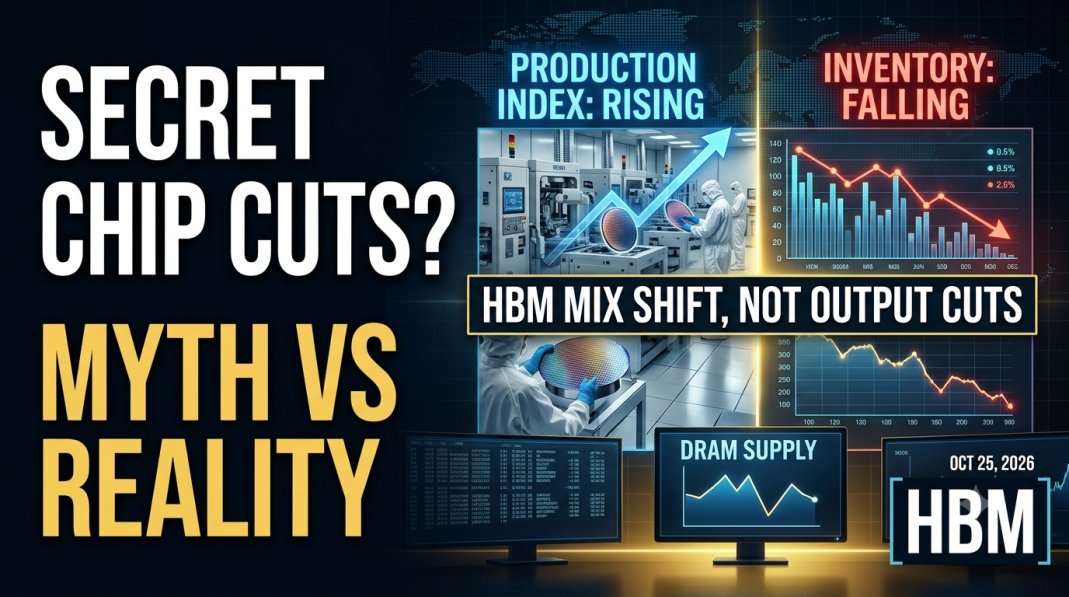
Three separate indices matter here, and conflating them is where a lot of the confusion originates. The production index measures how much is actually being made, and it has been climbing steadily since 2023, reaching its cycle peak in the third quarter of 2025. The inventory index measures how much unsold product is piling up in warehouses, and it has been falling since peaking in the third quarter of 2023, staying below the 2020 baseline since the second quarter of 2025, which is the opposite of what a company deliberately restricting supply to build scarcity would want to see. The utilization index, which the bear case leaned on most heavily, dropped to a cyclical low of 74.2 in the first quarter of 2023 but has stayed in a considerably higher range ever since, nowhere near the 70-80% figure cited as evidence of near-bankruptcy conditions. A national-statistics official quoted in the MTN fact-check cautioned that this index is a rough output-over-capacity ratio and cannot be read directly as a utilization percentage, which undercuts the precision the bear case assigned to it.
South Korea's own production and inventory data point toward tightening supply, not an engineered shortage — the story is which kind of chip is tight, not whether output is being held back.
So Why Is DRAM Still Tight If Nobody Is Cutting Output?
This is the part of the story the "secret cuts" narrative misses entirely, and it comes down to where the wafers are going rather than how many are being made. Micron's own executives have put a number on the trade-off: producing 100 bits worth of HBM3E effectively costs the industry around 300 bits of conventional DDR capacity, because HBM's stacked architecture, wider interconnects and lower yields make it dramatically less efficient per wafer than ordinary DRAM. Micron has said that ratio is expected to worsen to nearly 4-to-1 as the industry moves to HBM4 and HBM4E to feed next-generation AI accelerators. When Samsung and SK Hynix pour more of their fixed wafer capacity into HBM to chase AI demand, every wafer that goes toward a stack of HBM effectively removes several wafers' worth of capacity that would otherwise have gone to the DDR5 and LPDDR chips that end up in laptops, phones and standard servers.
That dynamic is exactly why a company's total output and utilization can look healthy, or even be rising, while the specific category of chip that PC and smartphone makers need gets scarcer and more expensive. It is a mix shift, not a slowdown, and the distinction matters enormously for how an investor should read the current price cycle.
Is SK Hynix Really Doubling Its Conventional DRAM Capacity?
There is a real, verifiable expansion story underneath the mix-shift explanation, and it is almost the inverse of a production cut. Industry trade outlet TheElec reported that SK Hynix's plan for its next-generation 1c DRAM process started at roughly 90,000 wafers per month when it was first outlined in early 2025, climbed to an interim 122,000 wafers per month by August 2025 and 150,000 by October 2025, and has since been revised toward a target in the 170,000-to-200,000-wafer-per-month range by the end of the first quarter of 2027, roughly double the original plan. That capacity is coming from converting existing 1a and 1b production lines at the company's Icheon M16 fab rather than from idling equipment, which is the opposite of what a company trying to engineer a shortage would be doing with its most advanced node.
⚠️ The Bullish Reading Has Real Limits
Debunking the "secret cuts" narrative is not the same as saying the current DRAM price cycle is risk-free for investors. Line conversions, including the 1a-to-1c transition at SK Hynix and Samsung's NAND-to-DRAM conversions, can temporarily reduce total output during the changeover itself, which is one of the explanations offered for why the utilization index looks soft even without deliberate cuts. The HBM-driven mix shift is also a bet on sustained AI capital spending; if AI accelerator demand cools meaningfully, the economics that justify dedicating so much wafer capacity to HBM over conventional DRAM could reverse quickly, and conventional DRAM buyers who are absorbing sharp price increases today have every incentive to pull demand forward or substitute where they can, which can make the next down-cycle sharper than usual.
What About Samsung's NAND-to-DRAM Line Conversions?
A related piece of the puzzle involves Samsung converting part of its Hwaseong Line 12 away from 2D NAND. Industry sourcing reported by TheElec in mid-2026 indicated the conversion could begin as early as March 2026, though this was described as an industry estimate rather than an official company confirmation, and Samsung reportedly notified affected customers of the wind-down in advance. The line's prior NAND capacity was on the order of 80,000 to 100,000 wafers per month on a 12-inch basis. After conversion, the article described the line taking on later-stage front-end DRAM processes such as metal wiring, functioning as what the industry calls an "end fab" for 1c DRAM, though no precise post-conversion wafer figure was given, and the displaced NAND volume was reported to be shifting toward Samsung's Xi'an, China facility. Each of these conversions shows up in the data as a temporary dip in one category's output, not as an industry-wide shortage manufactured to prop up prices.
✅ How to Sanity-Check a "Secret Chip Cuts" Claim
- Check whether the claim conflates a production index, an inventory index and a utilization index — they measure different things and can move in opposite directions.
- Ask whether the "shortage" is sitewide or confined to one product category (conventional DRAM) while another category (HBM) is expanding sharply.
- Compare the claim against contract price data and analyst forecast revisions (DRAMeXchange, TrendForce) rather than taking a single utilization percentage at face value.
What Should Investors Watch Next?
The clearest forward-looking signal is how far TrendForce's and DRAMeXchange's price forecasts keep moving in a single direction; a forecast that keeps getting revised upward quarter after quarter is hard to reconcile with a deliberately engineered, soon-to-reverse shortage. It is also worth tracking how much of Samsung's and SK Hynix's capital expenditure continues flowing into HBM-specific capacity versus conventional DRAM lines like the 1c conversions described above, since that ratio is the real determinant of how tight the PC and smartphone memory market stays. Koreanalysis has previously covered how AI infrastructure spending is reshaping balance sheets across the sector, and a related look at how South Korean memory producers are pricing their HBM supply contracts with major AI chipmakers would be a natural next piece in this coverage area.
Frequently Asked Questions
Q1. Are Samsung and SK Hynix really cutting chip production to drive up prices?
A. South Korea's national production index and inventory index do not support a deliberate, company-wide output cut; production has been rising and inventory has been falling. The chip-specific utilization index has softened at times, but statistics officials say it reflects a rough output-to-capacity ratio rather than a precise utilization rate, and part of the softness is attributed to line conversions rather than intentional idling.
Q2. If output isn't falling, why is DRAM still in short supply?
A. According to figures cited by Micron executives, HBM consumes roughly three to four times as much effective wafer capacity per bit as conventional DRAM. As Samsung and SK Hynix dedicate more capacity to HBM for AI chipmakers, conventional DRAM for PCs, phones and standard servers gets squeezed even as total memory output climbs.
Q3. Does this mean Samsung and SK Hynix stock has no downside risk?
A. No. The mix-shift story depends on sustained AI capital spending, and line conversions can create short-term output dips that complicate the data. A cooling in AI accelerator demand, or a buildup of inventory among conventional DRAM buyers rushing to lock in supply, could both pressure the stocks even though the specific "secret production cut" claim does not hold up under the available data.
South Korea's own production and inventory data point toward tightening supply, not an engineered shortage — the story is which kind of chip is tight, not whether output is being held back.
반응형'Global Markets > AI & Tech Finance' 카테고리의 다른 글
Why Did Korea's Biggest IPO of the Year Crash 32% on Day One? (0) 2026.10.25 The OpenAI Rogue-Agent Story Just Got Much Bigger (0) 2026.09.28 Why Did DeepSeek and Kimi Secretly Route User Data to Claude? (0) 2026.09.21 Anthropic's Amodei Wants AI to Slow Down — Why It Matters for SK Telecom (0) 2026.09.15 Nvidia's $600 Billion OpenAI Backstop: What It Means for Korea (0) 2026.09.08
Korean Stock & Equity Research
Data-driven analysis of Korean listed companies, combining financial fundamentals with supply chain and operations insights. Not investment advice.