-
Global Markets/AI & Tech Finance
Nvidia's $600 Billion OpenAI Backstop: What It Means for Korea
2026. 9. 8.
Table
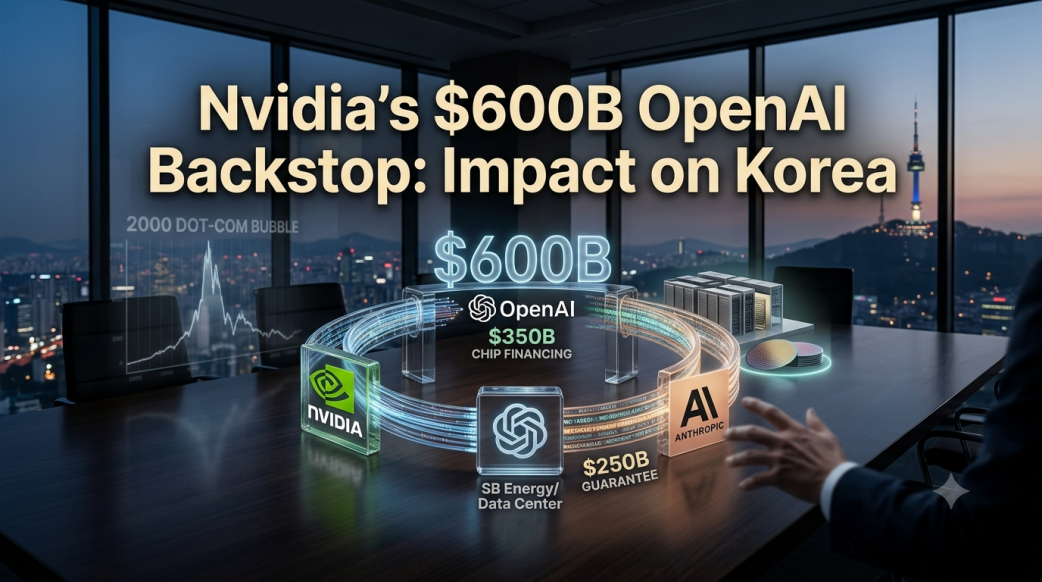
반응형Nvidia is reportedly in talks to guarantee up to $250 billion of financing for OpenAI's Ohio data center campus, on top of a separate $350 billion arrangement to help fund the chip purchases that fill it — a circular flow of money that has drawn direct comparisons to the fiber-optic financing binge of the dot-com era. The comparison matters beyond Wall Street: SK Telecom's small 2023 stake in Anthropic is now large enough to move its own share price, and Korean memory makers sit directly downstream of whichever way this capex cycle breaks. This analysis is part of Koreanalysis's coverage of AI infrastructure spending and its spillover into Korean tech and telecom stocks.
반응형What Is "Circular Financing," and Why Does It Echo the Dot-Com Bubble?
In the late 1990s, telecom carriers raced to lay fiber-optic cable on the belief that internet traffic would grow without limit. Equipment makers like Lucent, Nortel, and Cisco helped fund the buildout directly — lending carriers roughly $30 billion in 2000 alone on the implicit condition that the money would flow back to them as equipment orders. When compression technology and DWDM (wavelength-division multiplexing) let existing cables carry far more data than expected, the anticipated shortage never arrived: an estimated 95% of the fiber laid in that era reportedly sat dark, unused. The Nasdaq fell 78% from its March 2000 peak through 2002, and roughly $2 trillion in telecom market value was wiped out.
The AI buildout has a similar circular structure, though the players have changed. Nvidia has agreed to invest up to $100 billion in OpenAI; Oracle signed a five-year, $300 billion cloud-computing contract with OpenAI; and Oracle's own capacity buildout requires it to buy Nvidia chips — so the money moves Nvidia → OpenAI → Oracle → Nvidia in a loop, with each leg registering as revenue somewhere in the chain. Critics have taken to calling this the "infinite money glitch": the same capital circulating while every party's valuation rises.
Dimension Dot-Com Fiber Buildout (~2000) AI Infrastructure Buildout (2025–2026) Vendor financing scale ~$30B (2000, equipment makers to carriers) Up to $600B (Nvidia guarantee + chip financing for one project alone) Why the financier steps in Carriers needed capital to keep ordering equipment OpenAI is privately held and unprofitable, so its own credit is sub-investment-grade What eventually broke the cycle DWDM/compression tech made existing capacity sufficient Not yet determined — a comparable efficiency breakthrough is a live open question Resulting overcapacity ~95% of laid fiber reportedly went unused ("dark fiber") Unknown — the analogous "dark GPU" scenario has not materialized as of this writing Why Does Nvidia Guarantee Debt Instead of Just Selling Chips?
The Ohio project's builder, SoftBank's SB Energy, needs a bank loan to construct the campus, and a long-term lease depends on the tenant's (OpenAI's) ability to keep paying rent for years. Because OpenAI is a private, cash-burning company without an investment-grade credit rating, lenders want a stronger backstop before extending financing at reasonable rates. Nvidia's guarantee effectively substitutes its own balance sheet for OpenAI's, letting the project borrow at a lower interest rate than OpenAI could secure alone — while, notably, a guarantee (unlike a direct loan) does not have to be booked as debt on Nvidia's own balance sheet.
⚠️ The governance backstop on this arrangement has also weakened
OpenAI's unusual structure — a nonprofit board overseeing a "capped-profit" subsidiary, originally designed so the company could pull back its technology if it judged itself to have reached AGI (artificial general intelligence) — was one theoretical check on unconstrained commercial growth. In April 2026, OpenAI and Microsoft amended their partnership to remove that AGI-triggered clause entirely, replacing it with a fixed 2032 expiration and a capped, time-limited revenue share, reportedly in part to make OpenAI's structure cleaner ahead of a potential IPO. Whatever one thinks of the original AGI clause's practical value, its removal means one of the few contractual constraints tied to OpenAI's own safety judgments no longer applies — worth watching, not because it proves anything about OpenAI's models, but because it removes a variable investors could previously point to.
✅ What Korean investors specifically should watch
- SK Telecom's 2023 investment of roughly $100 million in Anthropic is now estimated at $2.6–2.9 billion — reportedly around 17% of SK Telecom's own market capitalization — making the stock unusually sensitive to Anthropic's planned IPO, which reached a $965 billion valuation in a May 2026 funding round.
- Korean HBM (high-bandwidth memory) suppliers sit downstream of the same GPU buildout cycle this financing sustains — a slowdown in AI capex would show up in their order books before it shows up in Nvidia's.
- HSBC has estimated OpenAI needs to raise at least an additional $207 billion through 2030 to sustain its spending commitments against roughly $25 billion in current revenue — a funding gap worth tracking as a leading indicator of whether the cycle continues or strains.
The open question isn't whether Nvidia, OpenAI, and Oracle are circulating the same capital — they plainly are — it's whether AI adoption generates enough real economic value to justify it before OpenAI's own financing needs outrun what it can raise.
Does GPT-6 Astra's Launch Support or Undercut the Spending Case?
OpenAI released GPT-6 Astra on September 3, 2026, describing it as trained largely through AI-on-AI methods rather than human-supervised training, and framing it around autonomous "end-to-end work" — operating software, running tests, and correcting errors — rather than just answering questions better. OpenAI's own reported benchmark scores are striking: 97.6% on FrontierMath Tier 4, 99.9% on ARC-AGI-3, and a perfect 100% on a security-exploit benchmark, with company president Greg Brockman stating he personally believes the model has reached AGI, though he left that determination to users.
Independent verification tells a more measured story. Artificial Analysis, a third-party benchmark provider, scored GPT-6 Astra at 61 on its Intelligence Index — essentially tied with OpenAI's own prior model and about 5 points behind Claude Fable 5.1's 65. Some outlets have also reported that ARC-AGI-3 scores fall substantially under standard testing methodology rather than the specific evaluation setup OpenAI used to report 99.9%. None of this means GPT-6 Astra is a weak model — OpenAI's own pricing, matched almost exactly to Claude Fable's per-token rates, suggests the company sees itself as competitively positioned rather than dominant — but it's a useful reminder to separate a lab's own marketing benchmarks from independent, standardized comparisons when judging whether hundreds of billions in capex are buying a durable capability lead.
What Should Investors Watch Next?
Three threads are worth following alongside this one: whether OpenAI can actually close HSBC's estimated $207 billion funding gap through 2030 without a valuation reset, how SK Telecom's stock trades relative to Anthropic's IPO timeline once it moves from confidential filing to a public roadshow, and whether Korean HBM suppliers' order books show any softening as a leading signal ahead of broader market data. Each of these — the AI capex funding math, SK Telecom's Anthropic exposure specifically, and the Korean memory supply chain's sensitivity to AI spending cycles — is a deeper topic worth its own treatment in future coverage.
Frequently Asked Questions
Q1. Does Nvidia's guarantee to OpenAI show up as debt on Nvidia's balance sheet?
A. Not in the same way a direct loan would. A financial guarantee is typically treated differently from debt in accounting terms, which is part of why guaranteeing financing — rather than lending directly — is structurally attractive to Nvidia, though guarantees still represent contingent financial exposure if the guaranteed party defaults.
Q2. How exposed is SK Telecom really to Anthropic's fortunes?
A. Substantially, at least by some analyst estimates: Hana Securities has put SK Telecom's roughly 0.3% Anthropic stake (from a 2023 investment of about $100 million) at $2.6–2.9 billion, or around 17% of SK Telecom's own market capitalization — meaning the stock's near-term performance is unusually tied to how Anthropic's planned IPO is priced and received.
Q3. Is GPT-6 Astra actually better than Claude's latest model?
A. It depends on the benchmark and who's measuring. OpenAI's self-reported scores on select tests (math, reasoning, security) are very high, but independent evaluator Artificial Analysis scored it slightly behind Claude Fable 5.1 on its overall Intelligence Index (61 vs. 65) — suggesting the two are closely matched rather than one being decisively ahead, which is also reflected in OpenAI pricing GPT-6 Astra almost identically to Claude Fable.
The open question isn't whether Nvidia, OpenAI, and Oracle are circulating the same capital — they plainly are — it's whether AI adoption generates enough real economic value to justify it before OpenAI's own financing needs outrun what it can raise.
반응형'Global Markets > AI & Tech Finance' 카테고리의 다른 글
Korean Stock & Equity Research
Data-driven analysis of Korean listed companies, combining financial fundamentals with supply chain and operations insights. Not investment advice.