On June 23, 2026, China's securities regulator quietly moved to shut down a financial mechanism that had let wealthy Chinese investors bypass capital controls to buy foreign tech stocks — including Korean semiconductor names. The move offers one plausible explanation for part of Korea's summer stock decline, though as with most China-related capital flow stories, hard data is scarce and much of the picture remains inferential.
Table of Contents
- What Is a TRS, and Why Did China Use It?
- The June 23 Crackdown
- Why the Unwind Became a Forced Liquidation
- Where the Money Went Instead
- What We Don't Know
- Bottom Line
What Is a TRS, and Why Did China Use It?
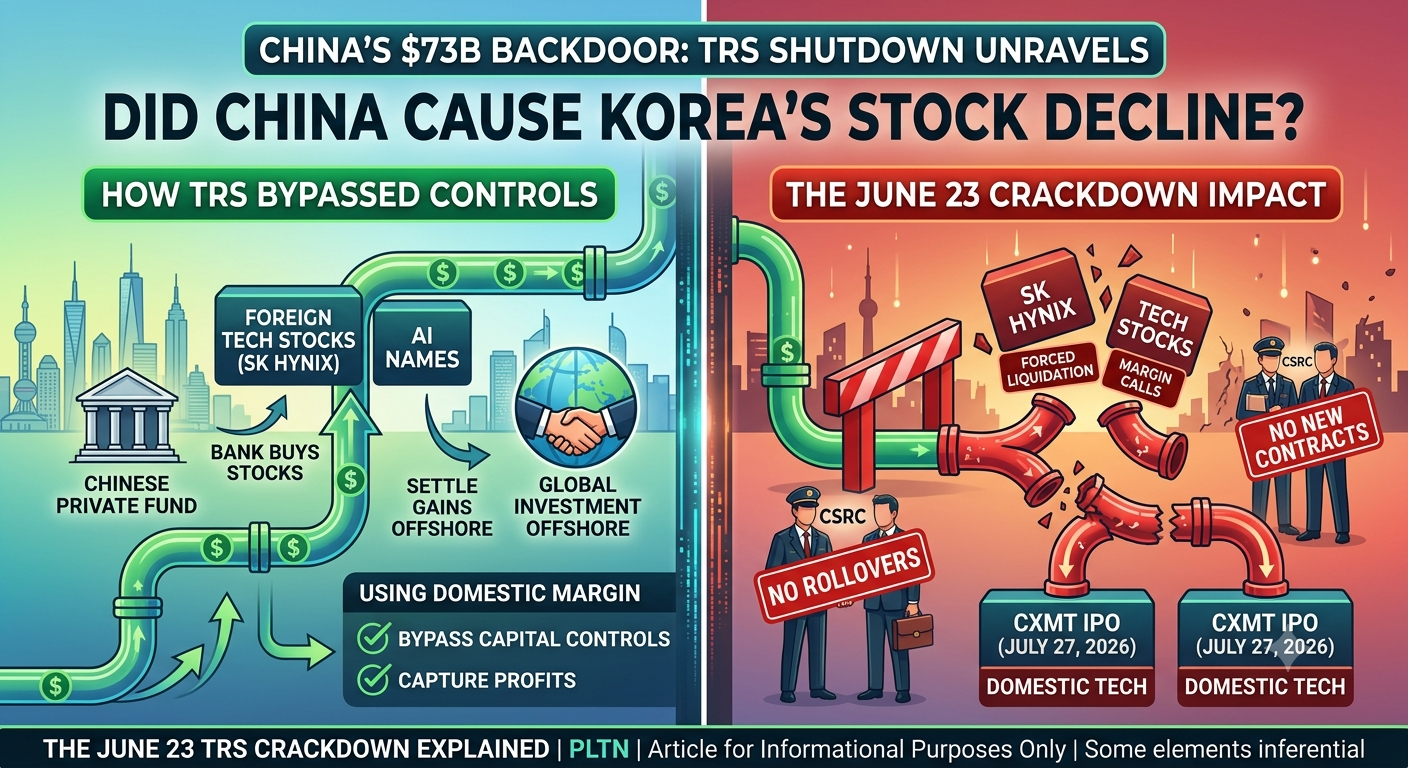
A Total Return Swap (TRS) is, in simple terms, a contract to buy a stock in someone else's name while still capturing the profit or loss yourself. Consider a hypothetical Chinese private fund that wants exposure to a memory chipmaker like SK Hynix, but faces capital controls preventing it from moving money offshore directly. By signing a TRS with a global investment bank such as Goldman Sachs or Morgan Stanley, the bank buys and holds the stock under its own name, while settling gains and losses with the Chinese fund privately. Because the transaction is handled offshore by the bank, the Chinese investor can capture the returns on foreign stocks using only domestic margin — without ever converting funds into Dollars.
As China's domestic stock and property markets struggled, demand reportedly surged for using this back channel to buy AI and semiconductor names in the US, Japan, and Korea.
The June 23 Crackdown
On June 23, 2026, the China Securities Regulatory Commission (CSRC) issued informal guidance — verbal instructions rather than a public rule — to securities firms. The guidance reportedly prohibited new TRS contracts, blocked increases to existing contract limits, and, critically, barred rollovers of existing agreements. Chinese authorities framed the move around capital outflow prevention, Yuan defense, and risk control, with officials reportedly citing large flows from high-net-worth individuals into surging global tech stocks in the US, Japan, and Korea as a direct trigger.
China's total TRS exposure was reportedly around $73.5 billion, with the large majority tied to foreign equities.
Why the Unwind Became a Forced Liquidation
TRS contracts are typically short-dated — commonly one, three, or six months, with three-month terms most common — and are kept alive through repeated rollovers rather than long initial terms. Because individual funds entered their contracts at different times, maturity dates were staggered. If rollovers were blocked starting June 23, three-month contracts would have begun maturing in a wave stretching from late June through late September. As each contract matured without the option to renew, and with new contracts also blocked, funds had no way back in once a position closed.
This timing collided with a sharp drop in AI and memory stocks in July, which increased unrealized losses and margin requirements on the remaining open positions. The result was reportedly large-scale margin calls, forcing mechanical liquidations that added further selling pressure — a self-reinforcing cycle of forced selling and further price declines.
Where the Money Went Instead
Investors caught in this unwind appear to have had a domestic alternative ready: ChangXin Memory Technologies (CXMT), which listed on July 27, 2026. As TRS access closed off, funds that were deleveraging or being liquidated reportedly redirected remaining capital toward the CXMT IPO instead.
What We Don't Know
TRS flows are not disclosed by nationality or by underlying stock, so it is not possible to precisely quantify how much of Korea's semiconductor stock decline is attributable to this mechanism, nor what share of the $73.5 billion in TRS exposure was tied to Korean names specifically. What can be said is that China halted offshore TRS activity starting June 23, and that TRS-linked capital has likely been unwinding and flowing back to China in the months since — one plausible contributing factor among several behind Korea's summer market weakness, not a complete explanation on its own.
Bottom Line
China's June 23 crackdown on offshore Total Return Swaps appears to have redirected capital that had been flowing into global AI and semiconductor stocks back toward domestic Chinese tech names like CXMT. Because TRS-linked funds skewed heavily toward AI and semiconductor exposure, this unwind may have contributed to selling pressure on Korean chipmakers — though it should be treated as one factor among many rather than a full explanation for the broader stock decline.
This article is for informational purposes only and does not constitute investment, tax, or legal advice. Given the limited transparency into Chinese capital flows, some elements of this analysis are inferential rather than confirmed by official data. Readers should consult a licensed professional before making investment decisions.


