-
Macro & Policy/Currency & Rates
Kevin Warsh Just Ended Forward Guidance — Here's What That Means for Markets
2026. 8. 6.
Table
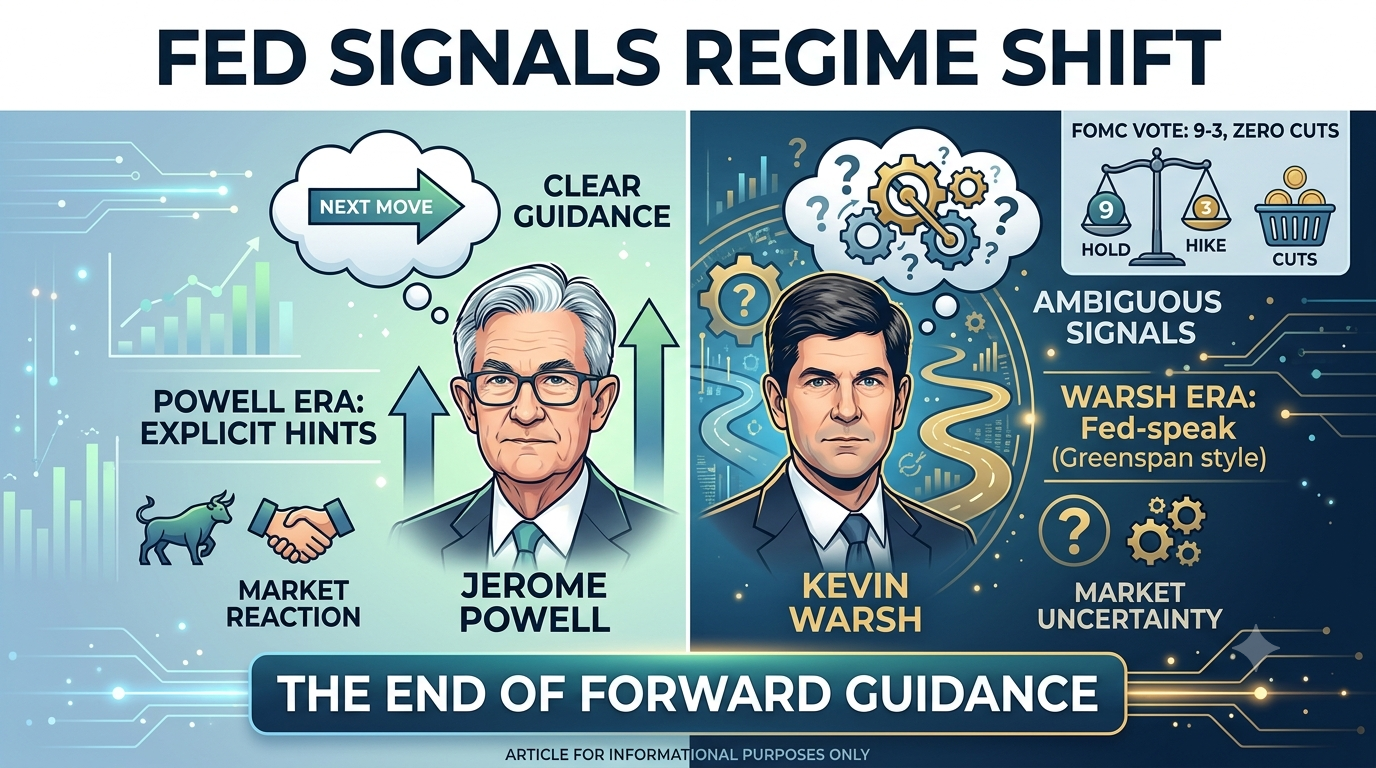
반응형The Fed held rates steady at its latest FOMC meeting, but the more consequential story wasn't the vote itself — it was what Chair Kevin Warsh didn't say. In a marked departure from the Powell era, Warsh offered no forward hints on the Fed's next move, signaling a deliberate return to the ambiguous "Fed speak" of the Greenspan era. For markets that have spent over a decade trading off explicit Fed guidance, this is a meaningful regime shift.
Table of Contents
- The FOMC Vote: 9-3, and No Votes for a Cut
- Warsh's Key Message: The End of Forward Guidance
- Why Central Banks Speak in Riddles
- The Origin of Forward Guidance
- Bottom Line
The FOMC Vote: 9-3, and No Votes for a Cut
A Debate Between Holding and Hiking
The Federal Reserve held its benchmark rate steady. Of the 12 voting members, 9 voted to hold while 3 voted for a hike — notably, zero members voted for a cut, meaning the entire policy debate is currently framed between holding rates and raising them further.
Kevin Warsh Just Ended Forward Guidance — Here's What That Means for Markets 반응형A Unified Board of Governors
The three dissenting votes for a hike — Beth Hammack, Neel Kashkari, and Lorie Logan — all came from regional Fed presidents. By contrast, all seven members of the Board of Governors voted unanimously to hold, suggesting Chair Warsh has successfully aligned the Board around a single, unified stance.
Warsh's Key Message: The End of Forward Guidance
Unlike his predecessor Jerome Powell, Chair Warsh avoided offering explicit hints about future policy direction during his press conference. His core message was direct: when the Fed refrains from pre-announcing decisions or signaling future direction, financial markets are forced to price in their own read of economic conditions, rather than simply reacting to Fed signals. This points toward a deliberate phasing-out of forward guidance — and a corresponding decline in how much weight markets should place on post-FOMC press conferences going forward.
Why Central Banks Speak in Riddles
Deliberately ambiguous central bank language serves several practical purposes:
- Giving markets time to adjust: Subtle, gradual signals let participants process information without triggering abrupt volatility.
- Preserving policy flexibility: Vague language lets the Fed pivot quickly in response to unforeseen shocks — wars, pandemics, financial crises — without undermining its own credibility.
- Avoiding self-fulfilling downturns: Overly direct negative commentary can itself cause businesses to halt investment or households to cut spending, turning a warning into the very outcome it warned against.
The Origin of Forward Guidance
Forward guidance itself was introduced by Ben Bernanke during the 2008 Financial Crisis. With interest rates at zero and no room to cut further, Bernanke used explicit forward guidance to reassure markets that low rates would persist — effectively pulling future policy easing into the present through communication alone.
Bottom Line
While the FOMC froze rates in a 9-3 vote, Chair Kevin Warsh signaled an end to forward guidance and a return to traditional, ambiguous central bank rhetoric — forcing markets to price in economic data directly rather than relying on Fed hints.
This article is for informational purposes only and does not constitute investment, tax, or legal advice. Readers should consult a licensed professional before making investment decisions.
반응형'Macro & Policy > Currency & Rates' 카테고리의 다른 글
Korean Stock & Equity Research
Data-driven analysis of Korean listed companies, combining financial fundamentals with supply chain and operations insights. Not investment advice.