-
Market Structure/Institutional Behavior
KOSPI Circuit Breaker 2026: A Record Year, and Where the Pension Fund Went
2026. 8. 6.
Table
반응형South Korea's stock market tripped its circuit breaker nine times between January and July 2026 — more activations in seven months than the country saw across entire decades in the past. But the real story isn't the drops themselves. It's who used to show up to buy, and stopped.
Table of Contents
- What Is a Circuit Breaker, and Why Does Korea Have One?
- From Black Monday to Korea's 15 Circuit Breaker Events
- 2026: The Year the Safety Net Didn't Show Up
- Why the National Pension Service Couldn't Buy
- The Real Cost: 219 Trillion Won in Vanished Gains
What Is a Circuit Breaker, and Why Does Korea Have One?
A circuit breaker is an automatic trading halt triggered when a stock index falls too far, too fast. The concept traces back to the aftermath of the 1987 "Black Monday" crash in the United States, when the Dow Jones plunged 22.6% in a single session. Exchanges reasoned that markets needed a forced pause — like a tripped electrical breaker — to let panicked investors regain composure before trading resumed.
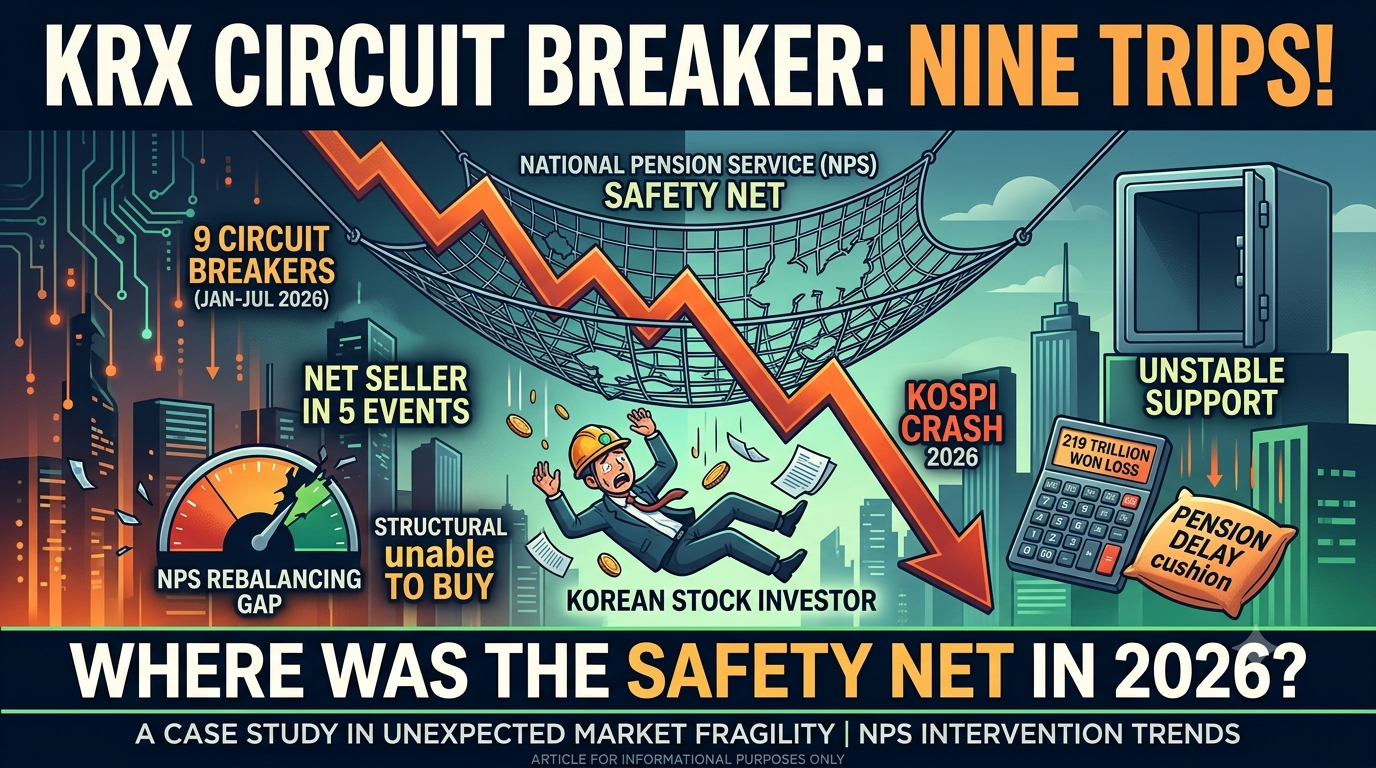
The KOSPI circuit breaker triggered 9 times in 2026 alone. Here's why Korea's National Pension Service wasn't there to buy the dip 반응형Korea's Version of the Safety Valve
Korea introduced its own circuit breaker system on December 7, 1998, in the wake of the 1997 IMF foreign exchange crisis, as the country widened access to its stock market for foreign capital. That same push also raised the daily price limit from 12% to 15% in December 1998 — and wider price swings meant a greater need for a safety mechanism during crashes.
From Black Monday to Korea's 15 Circuit Breaker Events
The first activation came on April 17, 2000, when the collapse of the U.S. dot-com bubble dragged the KOSPI down 11.6% in a single day. The second came on September 12, 2001, following the 9/11 terrorist attacks. In other words, for years, it took a shock on the scale of Black Monday or 9/11 to trip the breaker.
In 2015, the price limit was expanded further, from 15% to 30%, and the circuit breaker system was restructured into three stages — halting trading at 8%, 15%, and 20% declines. Since its introduction in 1998, the mechanism has been triggered 15 times in total.2026: The Year the Safety Net Didn't Show Up
Before 2025, every circuit breaker event followed a familiar script: the market would crash, and the National Pension Service (NPS) — Korea's roughly $700+ billion sovereign pension fund — would step in as a buyer of last resort. It bought an estimated 573 billion won on March 13, 2020, another 380 billion won on March 19, 2020, and 236 billion won on August 5, 2024. Across all six circuit breaker events between 1998 and 2025, the NPS injected capital every single time to help stabilize the market.
2026 broke that pattern. Of the nine circuit breaker events triggered in the first seven months of the year, the NPS was reportedly a net seller — not a buyer — in five of them. Even when it did buy, the amounts were a fraction of past interventions: roughly 48 billion won on June 8, and just 29 billion won on July 7.1998–2025 6 events Buyer in all 6 events ~236B–573B won per event Jan–Jul 2026 9 events Net seller in 5 of 9 events ~29B–48B won when buying Late July 2026 — Buyer returns at scale ~116B won (Jul 28), ~338B won (Jul 29) Why the National Pension Service Couldn't Buy
The likely explanation comes down to rebalancing timing. The NPS operates under domestic equity allocation limits, and when the market had been running hot earlier in 2026, its actual domestic stock holdings appear to have drifted above those limits — leaving little room to add more shares even as prices fell. It wasn't until the KOSPI dropped low enough in July that the fund's holdings naturally fell back within its allocation ceiling, freeing it to buy meaningfully again — an estimated 116 billion won on July 28 and 338 billion won on July 29.
This matters for a reason beyond any single fund: the NPS has historically functioned as an informal stabilizer during Korean market stress. When it's structurally unable to act — regardless of intent — that stabilizing mechanism goes quiet exactly when markets need it most.The Real Cost: 219 Trillion Won in Vanished Gains
The timing gap wasn't free. On June 19, 2026, with the KOSPI near 9,100, the NPS was reportedly sitting on roughly 314 trillion won in unrealized gains for the year. By the time the index had fallen to 5,663, that year-to-date gain had shrunk to an estimated 95 trillion won — a swing of around 219 trillion won, largely because the fund was unable to lock in profits through rebalancing while it still could.
Using the Ministry of Health and Welfare's own estimates, every 49 trillion won in fund gains is said to delay the pension system's projected depletion date by roughly one year. At its June peak, the NPS's 314 trillion won in gains would have represented about 6.4 years of delay. After the drawdown, that cushion had shrunk to around 1.9 years.Bottom Line
The National Pension Service's core mandate is to manage the fund well enough to secure retirees' futures. A structural gap in rebalancing timing — not a change in strategy — appears to be what kept it on the sidelines during 2026's most volatile stretch.
This article is for informational purposes only and does not constitute investment, financial, or tax advice. Figures are drawn from secondary reporting and have not been independently verified against official NPS or KOSPI disclosures; readers should consult official sources or a licensed professional before making investment decisions.
반응형'Market Structure > Institutional Behavior' 카테고리의 다른 글
Korean Stock & Equity Research
Data-driven analysis of Korean listed companies, combining financial fundamentals with supply chain and operations insights. Not investment advice.