-
Macro & Policy/Currency & Rates
Why US Real Yields Just Hit a 2008 High — And It's Not About Oil
2026. 8. 7.
Table
반응형The 30-year US Treasury real yield recently hit its highest level since the 2008 financial crisis — even as textbook logic suggests an oil price shock should push real yields lower, not higher. Understanding why requires breaking the nominal interest rate down into its component parts, and tracing a structural supply-demand imbalance building in the Treasury market. This piece also covers the August 5, 2026 quarterly refunding announcement, where a single word change revealed how the Treasury is quietly preparing for a funding gap ahead.
Table of Contents
- Breaking Down the Nominal Interest Rate
- What TIPS Reveal: Real Yields Decoupled From Oil
- A Treasury Market That Has Grown Sevenfold
- Waning Demand From Traditional Buyers
- The Rising Interest Cost Snowball
- Competing With Big Tech for Capital
- The August 5 Quarterly Refunding Announcement
- Implications for Korea
- Bottom Line
Breaking Down the Nominal Interest Rate
Interest rates can be decomposed into three components: expected inflation, the neutral rate, and the term premium. The nominal rate equals the real rate plus expected inflation, and the real rate itself equals the neutral rate plus the term premium. Expected inflation reflects the fact that fixed-rate returns lose value as prices rise, so lenders demand higher compensation. The neutral rate is the theoretical rate at which an economy is neither overheating nor contracting — a level the Fed itself doesn't precisely disclose. The term premium reflects the extra compensation lenders demand for the added uncertainty of lending over longer periods; lending a friend money for a week feels very different from lending it for five years, even if their circumstances look identical today.
Because the neutral rate is difficult to estimate directly, a simpler practical approach uses just two observable inputs — the real rate and expected inflation — to arrive at the nominal rate, without needing to isolate the neutral rate and term premium separately.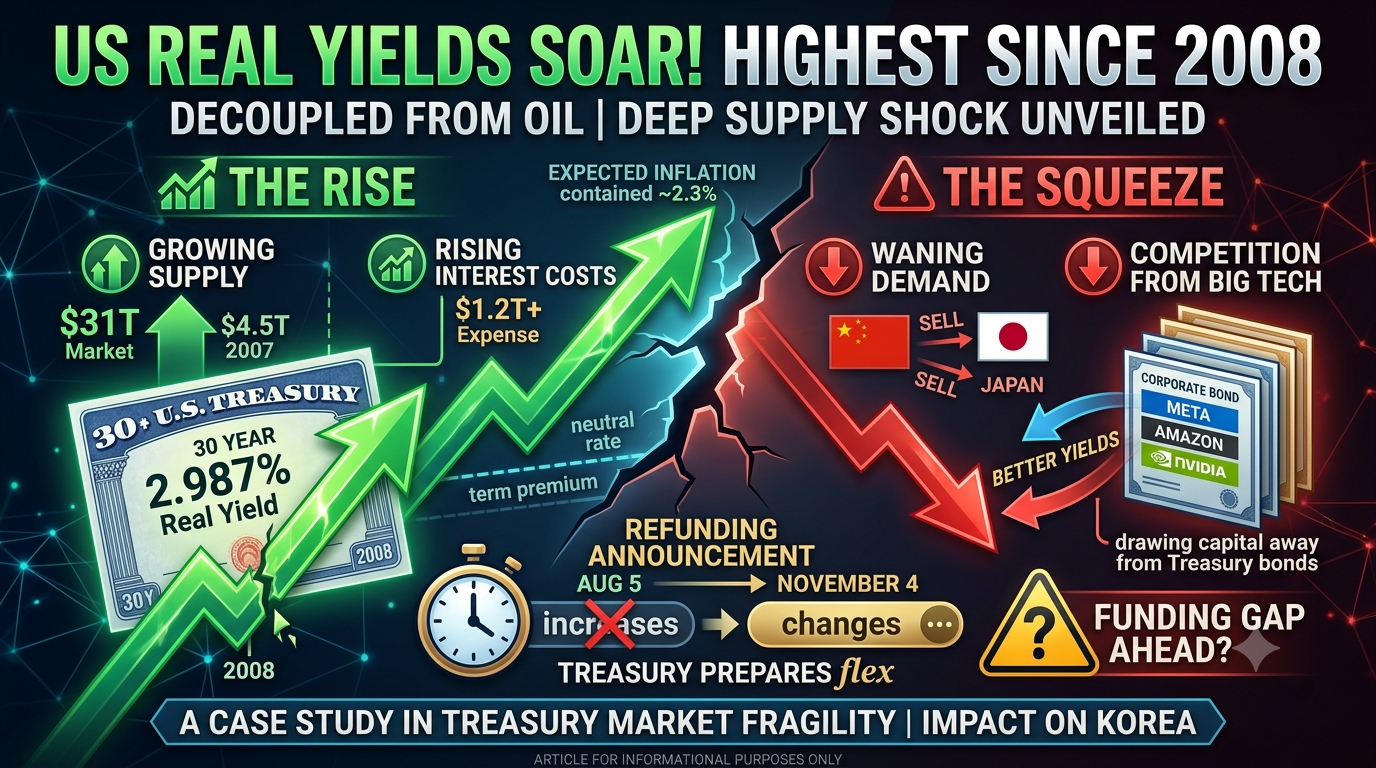 반응형
반응형What TIPS Reveal: Real Yields Decoupled From Oil
Treasury Inflation-Protected Securities (TIPS) adjust their payouts with inflation, making their yield a direct read on the real interest rate. Subtracting the TIPS yield from the nominal Treasury yield produces the breakeven inflation rate (BEI) — the market's implied expectation for future inflation.
Under normal conditions, an oil price shock should show up primarily in expected inflation, while real yields should if anything decline, since expensive oil squeezes consumer spending power and weighs on growth. Yet the 30-year real yield recently reached 2.987%, its highest level since the 2008 financial crisis, even as breakeven inflation has stayed contained around 2.3% for both the 10-year and 30-year — largely unmoved despite oil prices rising 30–40% in a single month. In short: the underlying cost of borrowing itself has gotten more expensive, independent of inflation expectations.A Treasury Market That Has Grown Sevenfold
The US Treasury market has expanded from $4.5 trillion in 2007 to roughly $31 trillion today. Like any asset, Treasuries are subject to basic supply-and-demand pricing: absorbing seven times the supply requires either a proportional increase in demand, or a lower price to clear the market — and a lower bond price means a higher yield.
Waning Demand From Traditional Buyers
China and Japan have historically been major absorbers of US Treasury issuance. That dynamic has shifted: China has moved from buying new Treasuries to selling existing holdings in favor of gold and other assets, while Japan — facing its own rising domestic bond yields — has reduced its buying power. In the first quarter of 2026 alone, Japanese investors were net sellers of US Treasuries, offloading a net $29.6 billion.
At the same time, the Federal Reserve continues shrinking its balance sheet, a policy stance both former Chair Powell and current Chair Kevin Warsh have maintained — meaning the Fed itself is no longer absorbing Treasury supply the way it once did. That leaves price-sensitive private buyers — insurers, asset managers, and hedge funds — to fill the gap, and these buyers demand lower prices (higher yields) as available supply increases.The Rising Interest Cost Snowball
Years of elevated spending have pushed annual US government interest expense above $1.2 trillion, with the FY2026 fiscal deficit estimated at $2.07 trillion. Tariff refunds add further pressure: following a Supreme Court ruling against IEEPA-based tariffs, $22 billion was refunded in May 2026 and $50 billion in June, turning tariff revenue into a net outflow. Analysis suggests the tariff ruling alone could add roughly $180 billion annually to the deficit through 2036 — all of which requires additional Treasury issuance to finance.
Compounding this, a wave of long-term bonds issued during the zero-rate era at 1–2% yields are now maturing and must be refinanced at today's 4–5% rates. In 2026 alone, $3.46 trillion in Treasuries mature (excluding bills) — more than 10% of the total market being rolled over at meaningfully higher rates. This creates a self-reinforcing cycle: rising rates increase interest costs, higher interest costs widen the deficit, a wider deficit requires more Treasury issuance, more issuance increases supply and pushes yields higher, and higher yields further increase interest costs. As Nuveen's head of fixed income, Rodriguez, put it, elevated government debt and deficits are what's continuing to push long-term rates higher.Competing With Big Tech for Capital
Beyond supply, demand-side competition is also intensifying. Pension funds and insurers — major traditional Treasury buyers — have limited capital to deploy, and Big Tech's AI-driven borrowing is absorbing an increasing share of it. Global corporate bond issuance reached a record $3.68 trillion in the first half of 2026, led by Amazon at $54 billion, with Meta, Nvidia, Oracle, and SpaceX each issuing roughly $25 billion, and Alphabet raising $20 billion domestically.
When pension funds and insurers can earn better yields on Big Tech corporate bonds than on Treasuries, they buy fewer Treasuries — forcing the Treasury to offer higher yields to stay competitive. Big Tech, in turn, has had to keep raising its own offered spreads to attract capital: Meta reportedly moved from offering 1.2 percentage points over Treasuries to 1.4 points. The result is direct competition between the US government and the largest technology companies for a limited pool of market liquidity.The August 5 Quarterly Refunding Announcement
The market's key focus in early August was the Treasury's quarterly refunding announcement, released August 5, 2026 at 9:30 PM Korea time. The outcome was reassuring on the surface: auction sizes for 3-year, 10-year, and 30-year notes were held steady at $58 billion, $42 billion, and $25 billion respectively, and the Treasury retained language committing to stable auction sizes for "at least" the next few quarters — meaning markets avoided the feared signal of a near-term increase in long-term bond issuance.
However, one phrase changed subtly from the prior announcement. In May, the Treasury stated it would continue evaluating potential "increases" to coupon and FRN auction sizes; in August, that language shifted to potential "changes." The accompanying Treasury Borrowing Advisory Committee (TBAC) letter offers the explanation: the committee recommended the Treasury build flexibility into its forward guidance ahead of an anticipated FY27 funding gap, and the shift from "increases" to "changes" appears to be the Treasury adopting that recommendation.Implications for Korea
Rising US Treasury yields directly affect the US-Korea interest rate differential discussed in our earlier coverage of the Won's July rally and the Bank of Korea's rate decisions. All else equal, higher US real yields make Dollar-denominated assets more attractive relative to Won-denominated ones, working against further Won appreciation — a dynamic worth watching alongside the Fed's own policy path under Chair Warsh, covered in our recent piece on the end of forward guidance.
Bottom Line
US real yields have climbed to their highest level since the 2008 financial crisis — not primarily because of inflation expectations, but because of a structural supply-demand imbalance: a Treasury market that has grown sevenfold since 2007, waning demand from China, Japan, and the Fed itself, a self-reinforcing rise in government interest costs, and new competition from record Big Tech corporate bond issuance. The August 5 quarterly refunding announcement avoided an immediate shock by holding auction sizes steady, but a subtle wording change signals the Treasury is quietly preparing markets for a funding gap ahead of the next refunding announcement on November 4.
This article is for informational purposes only and does not constitute investment, tax, or legal advice. Readers should consult a licensed professional before making investment decisions.
반응형'Macro & Policy > Currency & Rates' 카테고리의 다른 글
Korean Stock & Equity Research
Data-driven analysis of Korean listed companies, combining financial fundamentals with supply chain and operations insights. Not investment advice.