-
Korean Equities/Dividend & Value-up
Korea's Separate Dividend Taxation Law: What High-Dividend Investors Should Know
2026. 8. 25.
Table
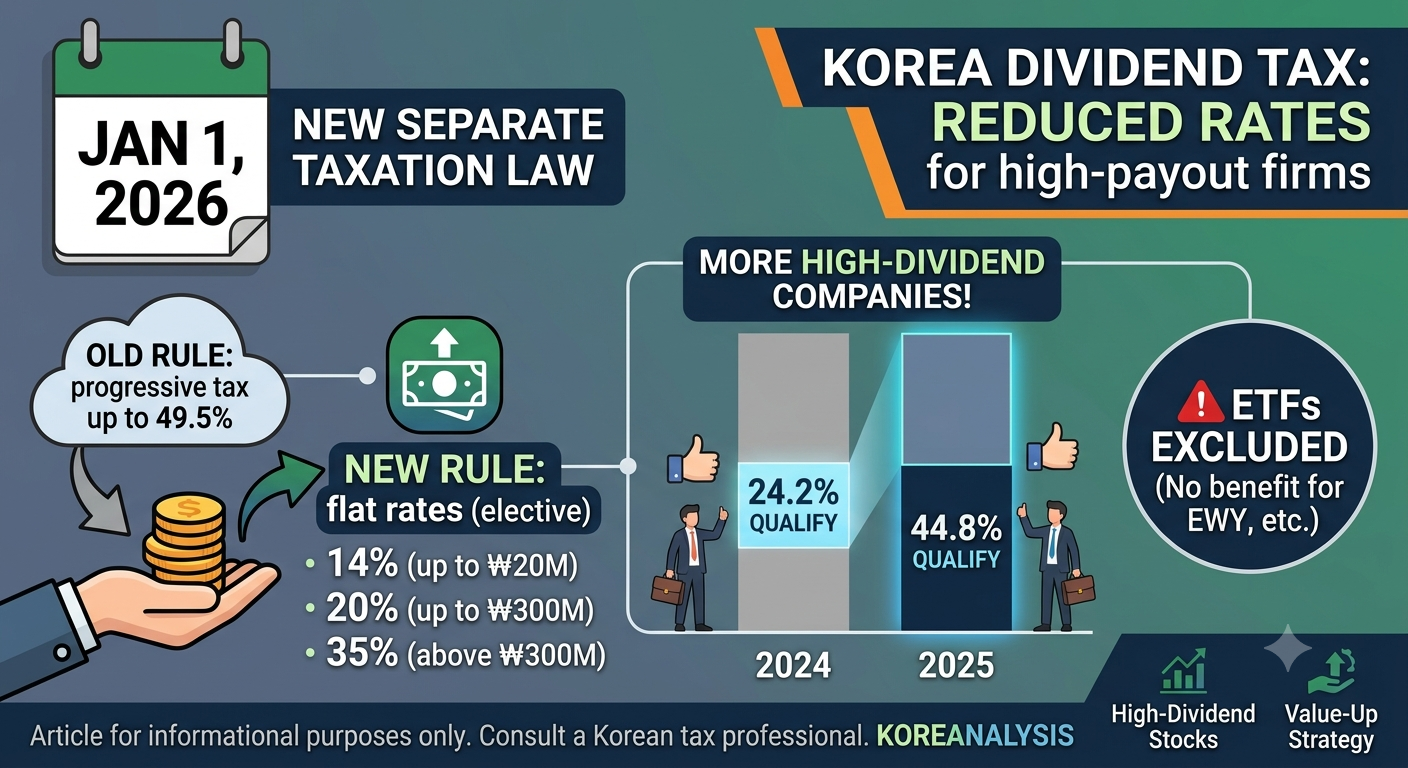
반응형Korea's new separate taxation rule for dividend income, effective January 1, 2026, lets individual investors in qualifying high-dividend companies elect a flat 14-35% rate instead of folding dividends into Korea's steeply progressive comprehensive income tax — and it's already working: the share of listed companies qualifying for the benefit nearly doubled year-over-year, from 24.2% to 44.8% of dividend-paying firms analyzed. This article is part of our Top High-Dividend Korean Stocks & Corporate Value-Up Strategy guide.
How Does Separate Taxation Actually Work?
Under Article 104-27 of Korea's Act on Restriction on Special Cases Concerning Taxation, passed by the National Assembly on December 2, 2025, dividend income from qualifying "high-dividend companies" is excluded from Korea's comprehensive (global) income taxation — which can otherwise push dividend income into brackets as high as roughly 49.5% when combined with other income — and instead taxed separately at flat rates of 14% on amounts up to 20 million Won, 20% up to 300 million Won, and 35% above that threshold.
Which Companies Qualify as "High-Dividend"?
Qualification is tied to meeting specific payout and disclosure requirements under the same regulatory framework connected to the Value-Up Program — companies must disclose the information demonstrating they satisfy all requirements, in a manner specified by presidential decree, effective from the same January 1, 2026 date. Importantly, high-dividend ETFs are explicitly excluded from this benefit — the separate taxation applies to direct dividend income from qualifying individual company stocks, not to ETF distributions.
⚠️ ETF Investors Don't Get This Benefit
If you're holding EWY or another Korea-focused ETF for dividend exposure, this separate taxation benefit does not apply to you — it's specifically limited to direct dividend income from qualifying individual stocks, and does not extend to fund-level distributions.
Is This Benefit Available to Foreign Investors?
This reform targets Korean resident individual taxpayers' comprehensive income tax treatment. As covered in our dividend tax guide, foreign investors are subject to a separate withholding tax framework (15% for US treaty residents) at the point of payment, which operates independently of Korea's domestic comprehensive income tax system — so this specific reform doesn't directly change the withholding rate foreign investors face, though it does directly incentivize the companies foreign investors might also want to hold for dividend income.
 반응형
반응형Has This Reform Actually Changed Corporate Behavior?
Early data suggests yes. Among 888 companies analyzed with identifiable net income out of 1,068 total dividend-disclosing listed companies, 44.8% (398 companies) qualified for separate taxation benefits on their 2025 fiscal year dividends — up from 24.2% (287 companies) under the same criteria applied to 2024 fiscal year dividends, roughly a twofold increase. Analysts attribute this directly to companies actively reallocating capital toward dividends specifically to help their shareholders access the reduced tax treatment.
Frequently Asked Questions
Q1. Is separate taxation automatic, or does it require an election?
A. The law describes this as an elective benefit for qualifying individuals — investors should confirm election procedures with a Korean tax professional given the nuances of eligibility and filing.
Q2. Do companies that pay dividends despite net losses ever qualify?
A. Yes, on a limited basis — the enforcement decree specifically addresses this scenario, though with more restrictive conditions than standard qualifying companies.
Q3. Does this reform apply retroactively to dividends paid before 2026?
A. No, the amendment applies to dividends attributable to fiscal years beginning on or after the law's effective date, not retroactively to prior dividend payments.
반응형'Korean Equities > Dividend & Value-up' 카테고리의 다른 글
Korean Stock & Equity Research
Data-driven analysis of Korean listed companies, combining financial fundamentals with supply chain and operations insights. Not investment advice.