-
Global Markets/Supply Chain & Geopolitics
What Takaichi's Japan Means for South Korean Investors
2026. 9. 6.
Table
반응형Since taking office in October 2025, Japanese Prime Minister Takaichi Sanae has combined a record ¥21.3 trillion ($135 billion) stimulus package with an unusually blunt hard line on China over Taiwan — a combination that has already moved currency, tourism, and security dynamics across Northeast Asia in ways that reach directly into Korean markets. None of this is happening to Korea; it's happening next door, to Korea's closest economic competitor and one of its most important security partners, which is exactly why it's worth tracking.
반응형Who Is Takaichi Sanae, and Why Is Her Government Different?
Takaichi became Japan's first female prime minister on October 21, 2025, after her Liberal Democratic Party formed a coalition with the more hawkish Japan Innovation Party (Ishin) — a pairing local media dubbed a harder-edged, more nationalist LDP than the one it replaced. That reading was reinforced on her first day in office, when she ordered a revision of Japan's three core security documents to accelerate and deepen defense-spending increases beyond the 2%-of-GDP target her predecessor had set for 2027. A snap election in February 2026 handed her coalition a two-thirds supermajority in the lower house — enough, in principle, to pursue the constitutional revision (loosening Article 9's renunciation of war) that she has long advocated.
How Could Japan's Record Stimulus Affect the Korean Won?
In November 2025, Takaichi's cabinet approved a ¥21.3 trillion stimulus package — Japan's largest since the pandemic — combining direct household payouts, a two-year exemption of the consumption tax on food, fuel-tax relief, and increased defense and growth-industry spending, funded substantially through new supplementary bond issuance. Japan's government debt already exceeds ¥1,369 trillion, and the new borrowing has pushed Japanese government bond yields higher as investors price in a larger supply of debt. Takaichi's own defense of the plan leans on a "net debt, not gross debt" framing — Japan's net-debt-to-GDP ratio (around 134%) looks less extreme than its gross figure (over 255%, the highest among G7 economies) — and on IMF projections showing Japan's debt ratio actually declining over the next five years as inflation erodes the real value of existing yen-denominated debt.
The part that matters most for Korean investors is the currency mechanics. Heavier bond issuance and looser fiscal policy generally put downward pressure on a currency, and Japan is Korea's single closest competitor in autos, steel, shipbuilding, and consumer electronics in third-country export markets. A weaker yen relative to the won makes Japanese exporters cheaper for the same overseas customer, squeezing the price competitiveness of Korean automakers and electronics manufacturers selling into the same markets. That's a real transmission channel — not a hypothetical one — and it's one Korean equity investors in export-heavy names have had to price around during past periods of yen weakness.
⚠️ The Yen Call Isn't as Simple as "Stimulus Means Weaker Currency"
Takaichi has simultaneously appointed a finance minister known as a yen-strength advocate, and the Bank of Japan retains formal independence over monetary policy even as Takaichi has said she wants "sufficient coordination" with it. A government spending aggressively while its own finance chief leans toward currency strength is not a clean, one-directional setup — rising JGB yields could just as easily support the yen if they outpace comparable moves elsewhere. koreanalysis.com is not forecasting a specific yen level here; the point for Korean investors is that the direction of this policy mix is a live variable worth tracking, not a settled trade.
Could China's Rift With Japan Redirect Tourists and Spending to Korea?
On November 7, 2025, Takaichi told parliament that a Chinese military attack on Taiwan could constitute a "survival-threatening situation" for Japan — language that, under Japan's 2015 reinterpretation of collective self-defense, could justify Japanese military involvement even without a direct attack on Japan itself. It was the first time a sitting Japanese prime minister had used that specific framing about Taiwan, and Beijing's response was immediate: a formal protest, a travel advisory warning Chinese citizens against visiting Japan, and — according to multiple outlets including CNBC and Al Jazeera — fee waivers from Chinese airlines for canceling or rebooking Japan-bound flights. Japan received roughly 31.65 million foreign visitors in the first nine months of 2025, with Chinese visitors accounting for about 7.49 million of them; even a partial pullback in that flow is large enough to move Japanese tourism and retail stocks, which is exactly what happened in the days after the remarks.
Whether that translates into a visible bump for Korean tourism and duty-free retail is a real question, not a given. Korea is a plausible substitute destination for both Chinese travelers avoiding Japan and Japanese travelers avoiding a tense standoff at home, and outbound Chinese tourism has shifted toward Korea during past frictions with other destinations. But Korea has its own history on this exact point: the 2017 THAAD missile-defense dispute triggered an extended, informal Chinese boycott of Korean tourism and retail that took years to fully unwind, which is a reminder that Beijing's travel-advisory lever is not one that spares Korea by default — it's one Korea has been on the receiving end of before.
✅ What to Track If You're Watching for a Tourism Spillover Into Korea
- Monthly Chinese outbound travel data — whether the drop in Japan-bound travel is showing up as a corresponding rise in Korea-bound arrivals, rather than simply deferred travel.
- Korean duty-free, hotel, and cosmetics names with direct exposure to Chinese tourist spending, and how their guidance discusses the Japan situation specifically.
- Whether the China-Japan standoff cools before it meaningfully redirects travel — diplomatic disputes like this one can resolve faster than tourism patterns take to shift.
Why Does a Harder-Line Japan Change Korea's Security and Supply Chain Calculus?
Takaichi has publicly said she wants a summit with President Lee Jae-myung and has emphasized personal fondness for Korean products and culture — a notably warmer opening tone toward Seoul than toward Beijing. That matters because her government is simultaneously pushing defense spending higher, seeking to loosen Japan's export restrictions on defense equipment (currently limited to rescue, transport, surveillance, minesweeping, and warning-related uses), and taking a more confrontational posture on China than any recent Japanese government. For Korea, a Japan that spends more on defense and courts closer trilateral coordination with Washington and Seoul is, on one hand, a tailwind for deeper US-Japan-Korea supply chain and security cooperation at a moment when China tensions are rising broadly across the region. On the other hand, a Japan actively working to loosen its own defense-export restrictions is also a Korean shipbuilding and defense industry competitor gearing up to compete more aggressively for the same export contracts Korean firms — Hanwha Ocean, HD Hyundai Heavy Industries, LIG Nex1 among them — have been winning in recent years.
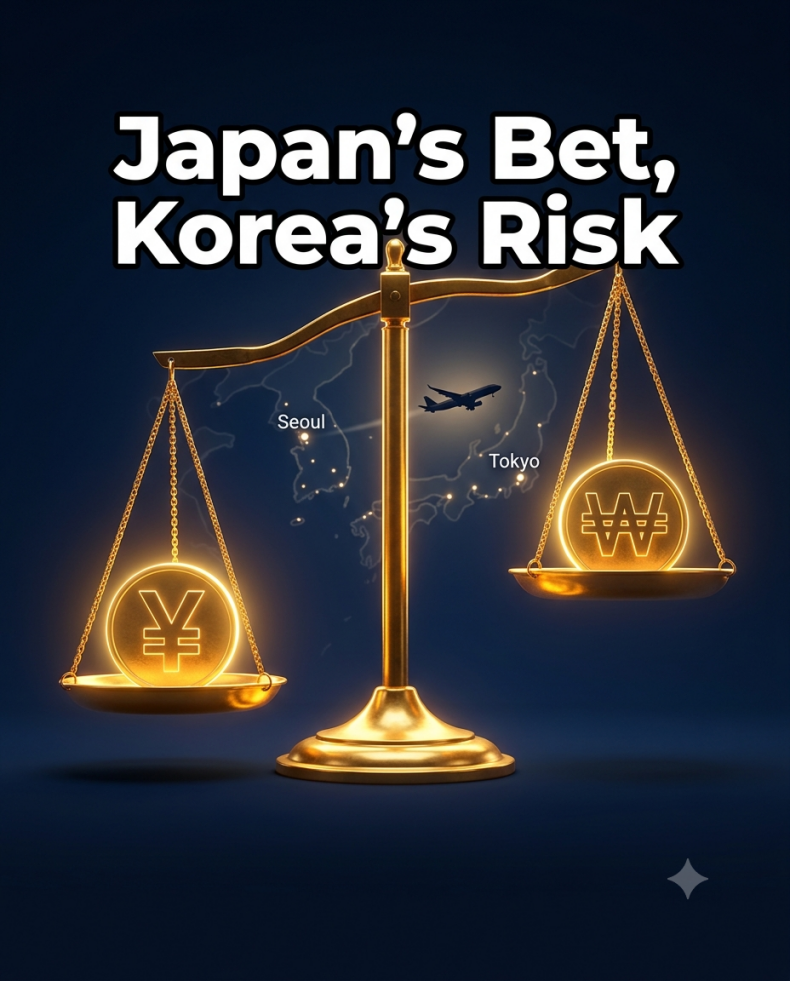
Japan's fiscal spending and China standoff aren't just Tokyo's story: a weaker yen tests Korean exporters' margins, while a Chinese tourism pullback from Japan tests whether Seoul can catch a spillover this time, given how quickly the same pressure turned on Korea itself during the 2017 THAAD dispute.
What Should Investors Watch Next?
Two related threads are worth following alongside this one: how KRW/JPY cross-currency moves have historically affected Korean export earnings, and Korea's own 2017 THAAD tourism boycott as the closest precedent for how a China travel dispute plays out over time. Both are worth a closer look in future coverage.
Frequently Asked Questions
Q1. Will Japan's stimulus and rising bond yields weaken the yen against the Korean won?
A. It's not settled either way. Heavier Japanese government bond issuance and fiscal expansion typically pressure a currency lower, but Takaichi has also appointed a yen-strength-leaning finance minister, and rising JGB yields can support the yen under some conditions. It's a live variable for Korean exporters to watch, not a confirmed direction.
Q2. Is Korea definitely benefiting from China's travel boycott of Japan?
A. Not confirmed. Korea is a plausible alternative destination for Chinese and Japanese travelers given the timing, but there is no independently verified data yet showing a direct tourism transfer, and Korea's own 2017 THAAD experience shows Beijing's travel-advisory tool can just as easily target Korea.
Q3. Does Takaichi's hardline China stance mean closer Korea-Japan security cooperation?
A. Takaichi has expressed interest in a summit with President Lee Jae-myung and warmer rhetoric toward Seoul than toward Beijing, which points toward closer trilateral coordination with the US. At the same time, Japan's push to loosen its own defense-equipment export restrictions means Japanese firms could become more direct competitors to Korean shipbuilders and defense manufacturers in export markets.
Tokyo's fight with Beijing and its own finance minister isn't a spectator sport for Seoul — it runs straight through the yen-won cross rate, Korea's tourism sector, and its shipbuilders' export order books.
반응형'Global Markets > Supply Chain & Geopolitics' 카테고리의 다른 글
Korean Stock & Equity Research
Data-driven analysis of Korean listed companies, combining financial fundamentals with supply chain and operations insights. Not investment advice.