-
Global Markets/Supply Chain & Geopolitics
US-Venezuela Oil Deal: What It Means for South Korea's Refiners
2026. 9. 1.
Table
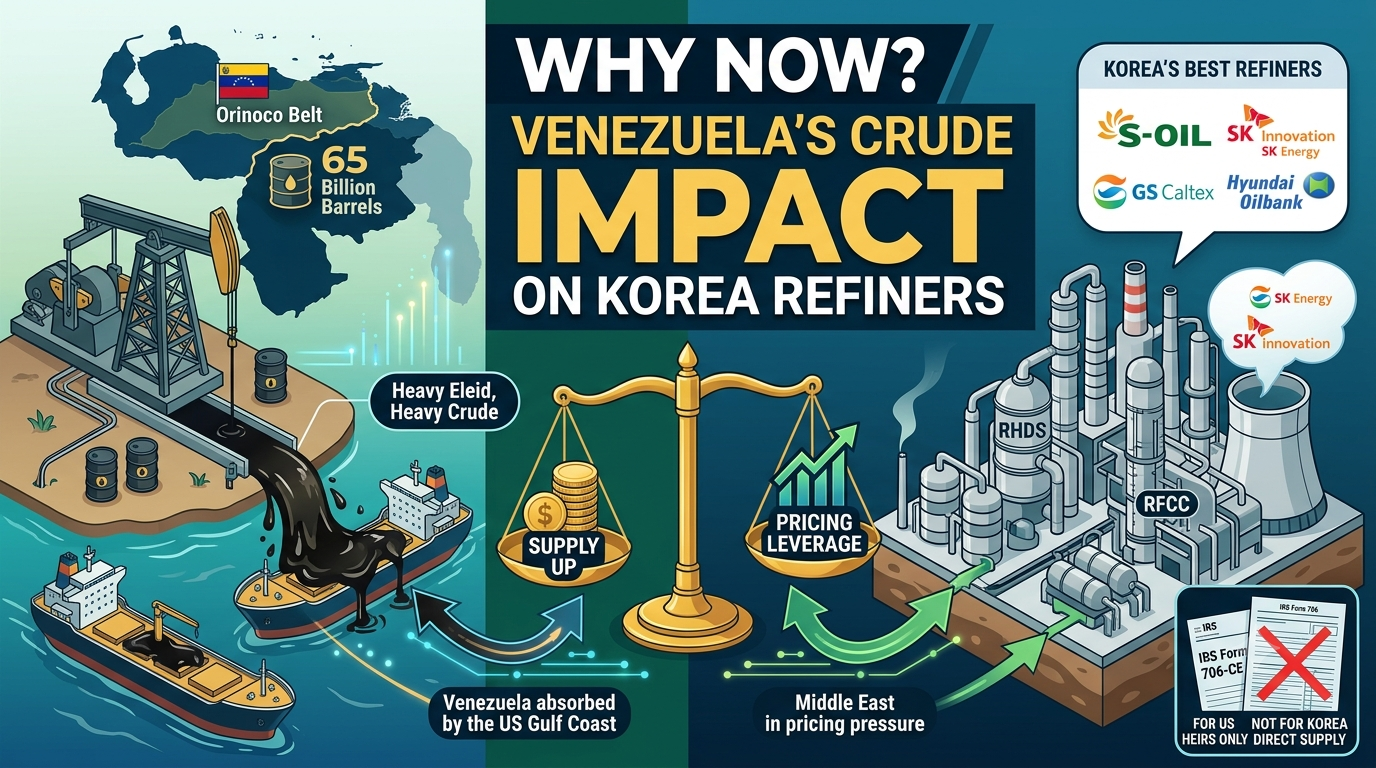
반응형The United States has secured development rights to roughly 65 billion barrels of Venezuelan crude — about 21% of the country's proven reserves — through a production-sharing structure that hands Washington equity, offtake rights, and control over export proceeds. For South Korea, a country that imports nearly all of its crude and spent two decades building refineries around one very specific grade of oil, the more relevant question isn't what happens in Caracas. It's what happens to the global mix of heavy and light crude once Venezuelan barrels start flowing back into the market at scale.
What Did the US Just Secure in Venezuela's Oil Fields?
Following the January 2026 detention of Nicolás Maduro and the transition to acting president Delcy Rodríguez, the US and Venezuela finalized a deal covering 17 oil fields with combined proven reserves of about 65 billion barrels. Under the arrangement, US entities hold a 35% equity stake in key producers such as NABEP, acquired through so-called "penny warrants" — a restructuring technique typically used when a lender or government recapitalizes a distressed asset in exchange for near-free equity. On top of that stake, US buyers secured the right to purchase 20% of production at cost and first-refusal rights on up to 55% of output.
Venezuela, in turn, is projected to collect roughly $19 per barrel in tax revenue at a $65 oil price, with Caracas estimating that US investment could reach $100 billion over 25 years and generate around $209 billion in tax receipts over that period. Export proceeds and licensing now run through accounts and approvals controlled by the US Treasury and the Office of Foreign Assets Control, giving Washington effective oversight of both the money and the paperwork.
Why Is Venezuelan Crude So Different From the Oil Everyone Else Is Producing?
Venezuela's Orinoco Belt produces what the industry calls extra-heavy crude — a dense, high-sulfur, tar-like oil that behaves nothing like the light shale crude coming out of the Permian Basin or the medium crude produced across the Middle East. It has to be diluted just to move through a pipeline, and refining it into gasoline or diesel requires expensive, metallurgically upgraded equipment capable of handling high sulfur and heavy-metal content. According to figures cited in Korean-language industry commentary, break-even production costs for Venezuelan crude have historically run as high as $70 per barrel, compared with roughly $10 for Saudi crude — a gap explained almost entirely by density and processing complexity rather than by geology alone.
Crude Type Density (API) Sulfur Content Refining Requirement US Shale (e.g., WTI) High (light) Low Minimal upgrading; yields more gasoline, less diesel/bunker fuel Middle East Medium (Saudi/UAE) Medium Medium-high Standard desulfurization — the baseline most Korean refineries were built around Venezuelan Extra-Heavy Very low (heavy) High Advanced upgrading (RHDS/RFCC-type units), corrosion-resistant metallurgy, dilution for transport That table matters more than it looks. South Korea's refining industry — S-Oil, SK Energy, GS Caltex, and Hyundai Oilbank among them — built its competitive advantage over the past two decades by investing heavily in exactly the kind of upgrading facilities (residue hydrodesulfurization units and residue fluid catalytic crackers) needed to turn cheap, heavy Middle Eastern crude into higher-margin gasoline and diesel. That capital-intensive bet is precisely what makes the Venezuela story relevant to Korean energy investors, even though the deal itself has nothing to do with Korea directly.
 반응형
반응형How Are US Shale Oil and Venezuelan Crude Being Blended to Solve the Refinery Problem?
US Gulf Coast refiners — several of which were purpose-built in the 1980s to process Venezuelan crude — are already exploiting this chemistry. Rather than running Venezuelan extra-heavy crude alone, they are blending it with light, low-sulfur US shale oil to approximate a medium-grade crude their existing equipment can handle without a multi-year, capital-heavy retrofit. Recent trade flow data referenced in Korean-language analysis suggests a meaningful share of the roughly 1.1–1.25 million barrels per day now coming out of Venezuela is being routed to these Gulf Coast plants, displacing heavy Canadian crude that previously filled that role.
This is the mechanism worth watching. If light US shale and heavy Venezuelan crude can be blended cost-effectively into something that behaves like Middle Eastern medium crude, it effectively creates a new, potentially cheaper substitute for the exact feedstock Korean refiners depend on — without Korea needing to build new upgrading capacity of its own, since its RHDS and RFCC units were already designed for medium-to-heavy grades in the first place.
What Does This Mean for South Korea's Refiners and KOSPI Energy Investors?
The direct read-through is about feedstock diversification and pricing leverage rather than a dramatic windfall. South Korea currently sources the large majority of its crude from Saudi Arabia, the UAE, and Kuwait. A meaningful increase in global heavy-to-medium crude supply — even if most of the incremental Venezuelan barrels are absorbed by the US Gulf Coast rather than shipped to Asia — tends to loosen the pricing power Middle Eastern producers have historically held over grades that suit Korean refinery configurations. Over time, that dynamic can show up as more competitive official selling prices from Middle Eastern suppliers defending market share, which matters directly to refining margins at S-Oil, SK Energy, GS Caltex, and Hyundai Oilbank.
⚠️ The Exception Worth Sitting With
None of the four major Korean refiners currently has a confirmed, direct offtake arrangement for Venezuelan crude, and Venezuelan barrels carry sanctions-adjacent compliance risk that Gulf Coast refiners — operating inside US jurisdiction — don't face in the same way. For now, the benefit to Korea is indirect: a looser global heavy-crude market and marginally softer Middle Eastern pricing, not a new direct supply line. Treating this as a straightforwardly bullish catalyst for Korean refining stocks would be getting ahead of the facts.
✅ Three Questions to Ask Before Positioning Around This Story
- Does the company have exposure to refining margins specifically, or is it diversified into petrochemicals and battery materials that dilute the crude-sourcing story? SK Innovation's battery unit, for example, moves independently of refining economics.
- How much of the company's crude slate is already Middle East medium/heavy, versus a mix requiring different upgrading assumptions? This determines how directly a softer Middle East price environment flows through to margins.
- Is the read-through already priced in? Korean refining stocks tend to trade on near-term crack spreads, not multi-year geopolitical reshuffling — so a thesis built on this deal needs a realistic timeline, not a one-quarter catalyst.
One line worth remembering: the Venezuela oil deal doesn't hand South Korea new crude — it potentially hands Korean refiners a more competitive Middle East, and that distinction is where the real investment thesis lives.
What Political Risks Could Still Upend This Deal?
The arrangement rests on a government whose legitimacy is contested even inside Venezuela. Delcy Rodríguez's administration argues that Maduro's detention constitutes a temporary "vacancy" rather than a permanent one, a reading the Venezuelan Supreme Court has upheld, allowing her to remain as acting president well past the 90-day window the constitution otherwise requires for new elections. Opposition figures — including Nobel laureate María Corina Machado and exiled 2024 candidate Edmundo González — have been effectively sidelined, and a government perceived by much of the population as installed under US pressure carries an inherent durability risk that doesn't show up in production statistics.
Then there is the Guyana dimension. Venezuela has spent several years asserting a territorial claim over Guyana's oil-rich Essequibo region — home to ExxonMobil's roughly 45%-owned offshore fields — and folding that dispute into a broader picture of who controls output from the Orinoco Belt going forward. If Washington's involvement in Venezuela extends into managing or influencing that dispute, the timeline for stable, investable production estimates gets pushed out further, and any Korean refining thesis built on "more heavy crude supply, sooner" needs to be discounted accordingly.
What Should Investors Watch Next?
For readers tracking the Korean refining and energy-import side of this story specifically, two related angles are worth following alongside this one: how South Korea's Middle East crude dependence shapes its trade balance and won volatility during global oil-supply shocks, and how KOSPI energy stocks price in crack-spread cycles versus longer-run geopolitical shifts like this one. Both will be covered as standalone spokes under the energy security pillar linked above.
Frequently Asked Questions
Q1. Does South Korea import crude oil directly from Venezuela?
A. Not currently, and no major Korean refiner has confirmed a direct offtake agreement under the new US-brokered structure. The relevance to Korea is indirect, running through global heavy-crude supply and Middle Eastern pricing rather than a new physical supply line.
Q2. Which Korean companies are most exposed to this crude-grade shift?
A. S-Oil, SK Energy (a subsidiary of SK Innovation), GS Caltex, and Hyundai Oilbank all operate the type of heavy-crude upgrading infrastructure (RHDS and RFCC units) originally built around Middle Eastern medium and heavy grades, making their margins the most sensitive to shifts in that segment of the crude market.
Q3. Is Venezuelan crude a realistic long-term replacement for Middle Eastern oil in Korean refineries?
A. Not without further blending infrastructure or new investment. Venezuelan extra-heavy crude requires more intensive processing and different metallurgy than the medium grades Korean refiners are optimized for, so its more immediate impact is competitive pressure on Middle Eastern suppliers rather than a direct substitute.
The US-Venezuela oil deal doesn't send new crude to South Korea directly — it changes the competitive position of the Middle Eastern suppliers Korean refiners already depend on, and that is where the real, if indirect, investment implication lies.
반응형'Global Markets > Supply Chain & Geopolitics' 카테고리의 다른 글
Korean Stock & Equity Research
Data-driven analysis of Korean listed companies, combining financial fundamentals with supply chain and operations insights. Not investment advice.