-
Investing Guides/Market Mechanics
Common Mistakes Foreign Investors Make in the Korean Stock Market
2026. 8. 23.
Table
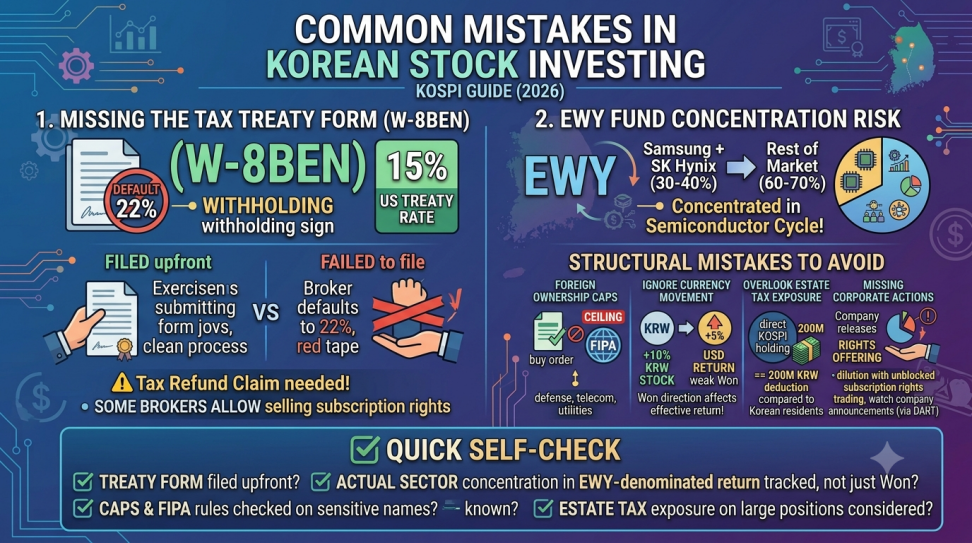
반응형The most common and costly mistake is failing to file the tax treaty benefit form before dividend payment, resulting in the default 22% withholding rate instead of the 15% treaty rate — a mistake that's fixable but requires a refund claim process most investors would rather avoid. Several other structural mistakes are just as avoidable with basic upfront research. This article is part of our Ultimate Guide to Investing in South Korean Stocks for Foreigners.
Mistake 1: Not Filing the Treaty Benefit Form
As covered in our dividend tax guide, failing to file a W-8BEN (or equivalent) before dividend payment means your broker defaults to Korea's 22% non-treaty withholding rate instead of the 15% US treaty rate. This is entirely avoidable simply by filing the form at account opening, before your first dividend-paying position.
 반응형
반응형Mistake 2: Assuming EWY Gives Full Market Diversification
Because Samsung Electronics and SK Hynix often represent 30-40% of EWY's weight, investors sometimes underestimate how concentrated their "diversified" Korea exposure actually is in semiconductor-cycle risk.
Mistake 3: Ignoring Foreign Ownership Caps on Certain Stocks
Investors targeting utility, telecom, or defense-adjacent names sometimes place buy orders unaware that a foreign ownership ceiling could reject execution, or that a large or control-oriented stake in a defense-designated company requires separate FIPA approval before proceeding.
Mistake 4: Not Accounting for Currency Movement in Return Calculations
As covered in our currency risk guide, a stock's KRW-denominated return and your actual USD-denominated return can diverge meaningfully. Investors sometimes evaluate a position's performance purely in Won terms and are surprised by the actual conversion result.
⚠️ Mistake 5: Overlooking Estate Tax Exposure on Large Direct Positions
As covered in our inheritance tax guide, direct KOSPI holdings are Korea-situs assets subject to Korean inheritance tax with only a 200 million Won deduction for non-residents — far smaller than deductions available to Korean residents. Investors building large concentrated direct positions sometimes don't factor this into estate planning until it's too late to restructure efficiently.
Mistake 6: Missing Rights Offerings and Other Corporate Actions
As covered in our corporate actions guide, Korean companies use rights offerings more frequently than US peers, and not every broker proactively notifies foreign account holders — leading some investors to be unknowingly diluted simply because they weren't watching DART filings closely enough.
✅ Quick Self-Check
- Have I filed my treaty benefit form with my broker?
- Do I know my actual sector concentration if I hold EWY?
- Have I checked foreign ownership caps on any sensitive-sector stock I'm considering?
- Am I tracking my returns in USD, not just KRW?
- Have I considered estate tax exposure if my direct position is sizable?
Frequently Asked Questions
Q1. Can I fix a missed treaty benefit filing after the fact?
A. A refund claim process for overwithheld dividend tax typically exists, though it involves additional documentation and processing time compared to filing correctly upfront.
Q2. Is EWY concentration risk unique to Korea, or common across single-country ETFs?
A. Sector concentration is common across many single-country ETFs reflecting their home market's economic structure, not unique to Korea specifically.
Q3. Which mistake is most common among first-time Korean stock investors?
A. Missing the treaty benefit form tends to be the most common and most easily avoidable, since it's a one-time filing step often overlooked simply due to unfamiliarity with the process.
반응형'Investing Guides > Market Mechanics' 카테고리의 다른 글
How the National Pension Service Affects KOSPI Liquidity (0) 2026.08.23 How Korean Dividend and Buyback Announcements Move Stocks (0) 2026.08.23 Best English-Language Resources for Researching Korean Stocks (0) 2026.08.23 How Stock Splits and Rights Offerings Work for Foreign KOSPI Investors (0) 2026.08.22 Korean Won Currency Risk: Should You Hedge When Investing in KOSPI? (0) 2026.08.20
Korean Stock & Equity Research
Data-driven analysis of Korean listed companies, combining financial fundamentals with supply chain and operations insights. Not investment advice.