-
Table
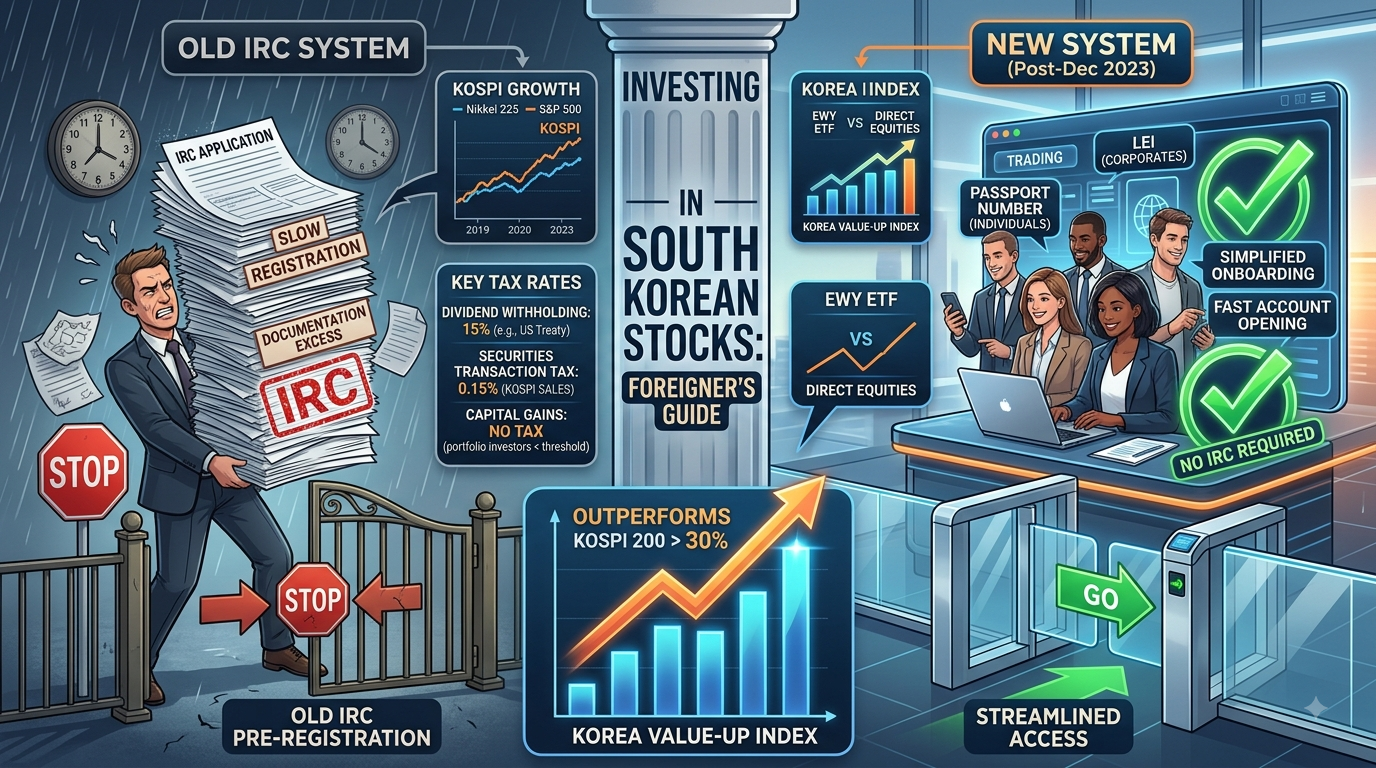
반응형Foreigners can invest in South Korean stocks directly through a local brokerage account (no longer requiring the old IRC registration, abolished December 2023) or indirectly through ETFs like EWY. Direct investors face a 15% dividend withholding tax under the US-Korea treaty, a 0.15% securities transaction tax on KOSPI sales, and no capital gains tax on most listed shares below the 1%/10 billion Won large-shareholder threshold. This guide covers everything you need to start.
Most-Read Guides in This Series
- Best Brokers for Foreign Investors in Korean Stocks (2026)
- KOSPI Trading Hours and 2026 Holidays: A Guide for Foreign Investors
- KOSPI vs. KOSDAQ: What's the Difference for Foreign Investors?
- EWY ETF vs. Direct Korean Stocks: Which Wins in 2026?
- How to Sell Korean Stocks and Repatriate Funds as a Foreigner
- Treasury Stock Cancellation in Korea: Why It Matters for Shareholders
- How to Read Korean Company Disclosures (DART) as a Foreigner
- Korea Short Selling Rules: What Foreign Investors Need to Know
Why Invest in Korean Stocks?
South Korea's KOSPI index has historically traded at a persistent valuation discount versus global peers — the so-called "Korea Discount" — with the benchmark's average price-to-book ratio hovering near 0.99, well below Japan's roughly 1.5x and Taiwan's roughly 3.4x. Over the past decade, KOSPI has grown just 35.0%, compared to 179.4% for the S&P 500 and 155.5% for Japan's Nikkei 225. That gap is exactly what's drawing renewed foreign interest: a market with globally dominant companies in semiconductors (Samsung Electronics, SK Hynix), batteries, shipbuilding, and defense, trading at multiples well below comparable international peers — combined with an active government reform program aimed specifically at closing that valuation gap.
 반응형
반응형How Do Foreigners Access the Korean Stock Market?
Foreign investors have two broad paths into Korean equities: direct ownership of individual KOSPI/KOSDAQ-listed shares through a Korean or international brokerage account, or indirect exposure through ETFs listed on foreign exchanges, most notably the iShares MSCI South Korea ETF (EWY) on the NYSE. Direct ownership offers stock-picking control and access to the full breadth of the market (including small and mid-cap names outside the index); ETF exposure offers simplicity, no Korean tax filings, and same-timezone US market-hours trading. See our detailed comparison below.
What Changed When Korea Abolished the IRC System?
Until December 14, 2023, any foreign investor wanting to trade Korean listed securities first had to obtain an Investor Registration Certificate (IRC) from Korea's Financial Supervisory Service (FSS) — a requirement in place since 1992 that was widely criticized as slow and document-heavy, discouraging foreign participation. Effective that date, Korea's Financial Services Commission abolished the IRC pre-registration requirement entirely. Individual foreign investors can now open accounts using just their passport number; corporate investors use a Legal Entity Identifier (LEI), a globally standardized 20-character identifier. Investors who already held an IRC continue using that number rather than switching to an LEI. In the first six months after the change, the FSC reported 1,432 new foreign-investor accounts opened, including 216 individual accounts — a meaningful uptick attributable directly to the simplified process.
Which Brokers Let Foreigners Trade Korean Stocks?
Removing the IRC requirement made account opening theoretically simpler, but individual brokerage platforms still set their own onboarding rules, and not every broker accepts every foreign resident smoothly. Broadly, three routes exist: (1) international brokers such as Interactive Brokers, which offer direct KOSPI/KOSDAQ market access to non-resident account holders without requiring physical presence in Korea; (2) Korean brokerages (Mirae Asset, Samsung Securities, KB Securities, and others) that increasingly offer English-language onboarding for foreign residents holding a Korean ARC (Alien Registration Card) or equivalent visa documentation; and (3) US-listed ETF exposure via any standard US brokerage, avoiding the Korean account-opening process entirely.
Should You Buy EWY or Individual Korean Stocks?
See our full comparison in EWY ETF vs. Direct Korean Stock Buying: Which Is Right for You?. In short: EWY offers simplicity and heavy weighting toward Samsung Electronics and SK Hynix (together often 35-40% of the fund), while direct ownership offers access to the full market and eligibility for Korea-specific tax treatment on dividends.
What Taxes Apply to Foreign Investors in Korea?
Korea's default withholding tax on dividends paid to non-residents is 22% (20% national + 10% local surtax on that amount), but this drops to 15% for US resident portfolio investors under the US-Korea income tax treaty (10% if the recipient owns 10% or more of the paying company's voting stock). Most other treaty partners see similar 15% portfolio dividend rates, though exact terms vary by country. A securities transaction tax of 0.15% applies to KOSPI sales (KOSDAQ carries a different rate). Capital gains on listed shares are generally not taxed for foreign portfolio investors below Korea's "major shareholder" threshold (currently defined around 1% ownership or roughly 5 billion-10 billion Won in holding value, depending on the stock and rule set in effect) — full details in our dedicated tax guide below.
What Is the Korea Value-Up Program?
Launched by the Financial Services Commission in early 2024 and modeled partly on Japan's earlier corporate governance reform push, the Corporate Value-Up Program aims to close the Korea Discount by pressuring listed companies to improve capital efficiency, raise shareholder returns, and strengthen governance. It operates on a "comply-or-explain" basis — companies not disclosing a Value-Up plan must explain why — and gained binding legal weight in 2025 when Korea amended its Commercial Act to establish that directors owe a fiduciary duty to all shareholders, not just controlling families. The associated Korea Value-Up Index (KVI), launched September 2024 with roughly 100 KOSPI and KOSDAQ constituents selected on profitability, shareholder returns, and valuation criteria, has outperformed the broader KOSPI 200 by more than 30% since inception. See our full analysis below.
Which Sectors Define the Korean Market?
Sector Representative Companies Global Position Memory Semiconductors Samsung Electronics, SK Hynix Combined ~65%+ of global DRAM market EV Batteries LG Energy Solution, Samsung SDI, SK On Top-tier global cathode/cell suppliers Shipbuilding HD Hyundai Heavy Industries, Hanwha Ocean Leading LNG carrier and naval shipbuilders Defense Hanwha Aerospace, LIG Nex1 Rapidly growing global arms exporter Auto Hyundai Motor, Kia Global top-3 vehicle manufacturer by volume Getting Started: A Step-by-Step Checklist
- ☐ Decide: direct KOSPI ownership or ETF (EWY) exposure
- ☐ If direct: obtain a Legal Entity Identifier (corporate) or use your passport number (individual) — no IRC needed since Dec. 14, 2023
- ☐ Choose a broker: international (Interactive Brokers) vs. Korean platform with English support
- ☐ File the appropriate treaty benefit form (e.g., IRS Form W-8BEN for US residents) to claim the reduced 15% dividend withholding rate
- ☐ Confirm your home country's tax treatment of foreign dividend income and available foreign tax credits
- ☐ Screen candidate stocks against the Korea Value-Up Index for governance-quality signal
FAQ
Do foreigners need a Korean visa to invest in Korean stocks?
No. Non-resident foreign investors can open accounts and trade Korean listed securities without a Korean visa, using an international broker or the LEI/passport-based system introduced after the IRC abolition. A visa or Alien Registration Card is only relevant if opening an account directly with a Korea-based brokerage as a resident.
Is EWY a good substitute for buying individual Korean stocks?
EWY offers simpler, single-ticket exposure to the Korean market but is heavily concentrated in Samsung Electronics and SK Hynix, and doesn't let you underweight or avoid specific names. Investors seeking targeted exposure (e.g., defense or battery names specifically) generally need direct share ownership.
How much tax will I pay on Korean stock dividends as a US investor?
Under the US-Korea tax treaty, portfolio dividend withholding is capped at 15% (versus Korea's 22% default rate for non-treaty countries), provided you file the correct treaty benefit documentation with your broker before payment.
반응형
Korean Stock & Equity Research
Data-driven analysis of Korean listed companies, combining financial fundamentals with supply chain and operations insights. Not investment advice.