-
Korean Equities/Dividend & Value-up
KB, Shinhan, and Hana Financial: Comparing Korea's Top Bank Dividend Stocks
2026. 8. 24.
Table
반응형KB Financial has delivered the fastest dividend growth among Korea's major banks — up 37.6% year-over-year to 4,367 Won per share — alongside the strongest 12-month share price return (+48.59%), while Shinhan and Hana have posted steadier, more moderate growth with comparably attractive yields. This article is part of our Top High-Dividend Korean Stocks & Corporate Value-Up Strategy guide.
How Do Their Shareholder Return Policies Differ?
Company Dividend Policy Framework 2026 Buyback Activity KB Financial CET1-linked: returns capital above 13% (Phase 1) and 13.5% (Phase 2) CET1 ratios 600B Won (H1) + 700B Won (H2) buyback and cancellation Shinhan Financial "Value-Up +++" plan targeting 50%+ shareholder return ratio, 10%+ ROE, 13%+ CET1 ~25 million shares cancelled by Jan 2026; 2025 return ratio hit 50.2% Hana Financial Quarterly dividend with periodic increases tied to earnings growth Quarterly dividend raised 10% to 220 Won/share in 2026 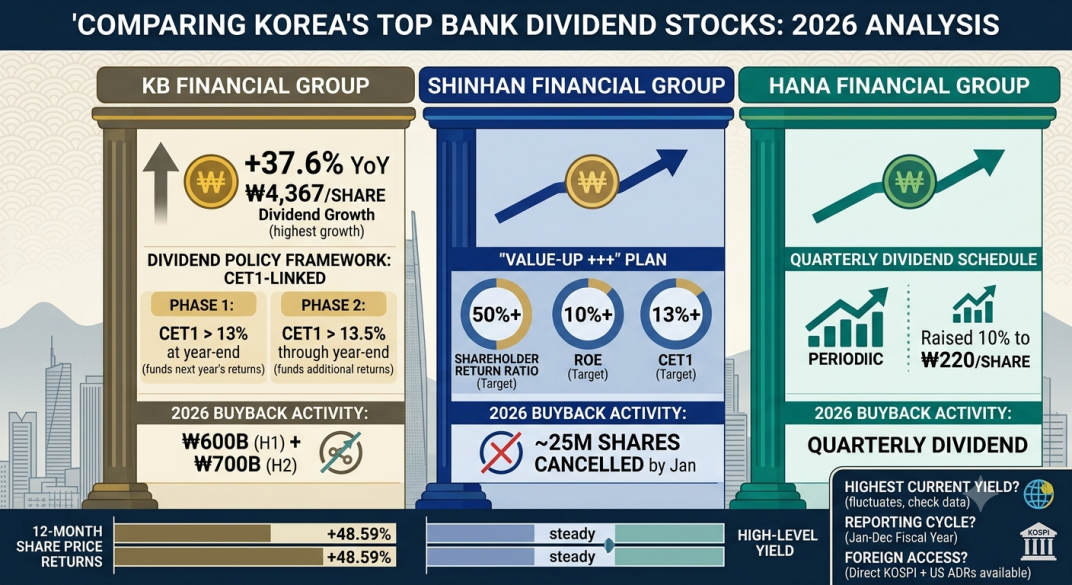 반응형
반응형What Does KB's CET1-Linked Framework Actually Mean?
Rather than committing to a fixed payout ratio, KB Financial ties its shareholder returns to capital exceeding specific CET1 (Common Equity Tier 1) capital adequacy thresholds — capital above 13% at year-end funds the following year's Phase 1 returns, while capital above 13.5% accumulated through the year funds additional Phase 2 returns. This structure means KB's total returns scale directly with excess capital generation rather than a simple percentage of net income, and quarterly dividends are distributed evenly based on the Phase 1 calculation.
Frequently Asked Questions
Q1. Which of the three has the highest current dividend yield?
A. Yields fluctuate with share price movement; check current data directly, since a rapidly appreciating stock (like KB in 2026) can see its yield compress even as the dividend per share rises.
Q2. Do these companies report earnings under a fiscal year matching the calendar year?
A. Yes, Korean financial holding companies generally report on a standard January-December fiscal year with quarterly reporting periods.
Q3. Can foreign investors access these stocks directly?
A. Yes, through standard KOSPI account access; Shinhan and KB also offer US-listed ADRs (SHG, KB) as an alternative access route.
반응형'Korean Equities > Dividend & Value-up' 카테고리의 다른 글
Korean Stock & Equity Research
Data-driven analysis of Korean listed companies, combining financial fundamentals with supply chain and operations insights. Not investment advice.