-
Market Structure/Institutional Behavior
Short Selling Is Back in South Korea: How It Works and What Still Breaks
2026. 9. 5.
Table
반응형South Korea fully reinstated short selling on every listed stock on March 31, 2025, ending the longest short-selling ban in the market's history and pairing it with a new real-time system meant to catch the kind of abuse that triggered the ban in the first place. That reform addressed one specific failure mode — undetected naked short selling — but it did nothing to touch a separate source of violent, fundamentals-free price swings that has become a defining feature of the Korean market in 2025 and 2026: the mechanics of weekly options expiry.
What Changed When South Korea Lifted Its Short-Selling Ban?
South Korea suspended short selling market-wide in November 2023 after regulators found major global investment banks had been executing illegal naked short sales — selling shares without borrowing them first — a practice retail investors had long argued tilted the market against them. The ban lasted roughly a year and a half, making it the longest in the market's history, before regulators lifted it on all listed stocks on March 31, 2025, according to reporting from Bloomberg, CNBC, and S&P Global. The reinstatement was conditioned on new infrastructure — most notably a central monitoring system built specifically to detect naked short selling as it happens, rather than months later in an audit.
How Does Short Selling Actually Work — and What Makes It "Naked"?
Short selling means borrowing shares, selling them immediately, and later buying identical shares back to return to the lender — profiting if the price fell in between. A trader who borrows and sells 10 shares at $100 each, then buys them back at $10 to return them, pockets the $900 difference. Because the position is "borrowed" before it's sold, this standard version is called covered short selling. Naked short selling skips the borrowing step entirely — the seller sells shares they never arranged to borrow, betting they can source them before settlement. Most markets, Korea included, have treated naked short selling as illegal for exactly this reason: it lets a seller manufacture supply that doesn't exist, with no natural limit on how much downward pressure they can apply.
A second safeguard sits alongside the borrowing requirement: the uptick rule, which generally bars a short sale from being placed below the last traded price. In practice, that means short sellers can only add to selling pressure as a stock rises or holds steady, not pile on during an active decline — with one significant carve-out. Korean exchange rules exempt hedging and arbitrage-related trades from the uptick rule, a carve-out that becomes relevant later in this piece.
Does Short Selling Help the Market or Hurt It?
Short sellers have a long, documented history of catching fraud before regulators do — and an equally long history of being blamed for manufacturing panic. Both sides of that record show up clearly in Korea and abroad.
Case What Happened Which Side of Short Selling It Shows Luckin Coffee (2020) Short seller Muddy Waters Research field-audited store receipts and found the Nasdaq-listed chain had roughly doubled reported sales; the stock was delisted within months. Fraud detection Woopung Mutual Savings (2000) A Korean savings institution naked-shorted a stock representing roughly half its free float; retail investors organized to buy up remaining shares, triggering 14 straight days of limit-up moves and the firm's eventual collapse. Market abuse / retail backlash GameStop (2021) Retail traders coordinated on Reddit to buy heavily shorted shares, forcing hedge funds into a short squeeze that took the stock from roughly $20 to over $480 within a month. Overcrowded short positioning Celltrion rumor (2012) False reports of deaths in a Chinese clinical trial pushed the Korean biosimilar maker's shares to a 52-week low; regulators later linked the rumor to parties holding large short positions. Disinformation-driven manipulation The pattern across all four: short selling itself is neutral. What determines whether it disciplines a market or damages one is whether the seller is exposing a true problem or manufacturing a false one — and whether the rules can tell the difference in time.
⚠️ A Detection System Doesn't Close Every Gap
Korea's new monitoring system reconciles short sellers' reported balances against independently calculated figures, aiming to flag naked selling the same day rather than in a later audit. That closes the specific hole exposed in 2023. It does not touch a separate structural feature of the current Korean market: a very large, very active weekly options market where price mechanics — not naked short selling — can move the index sharply in minutes with no new information behind it.
Why Has South Korea's Options Market Become So Volatile?
Independent of the short-selling story, South Korea's derivatives market has grown into what industry research firm SpotGamma describes as one of the most volatile options markets in the world. Retail leveraged equity positions reportedly reached roughly ₩60 trillion by the end of May 2026, with margin growth outpacing the US, China, and Japan through 2025. The number of retail investor accounts grew from about 6 million in 2019 to more than 14.5 million by the end of 2025, trading across a layered ecosystem of equity-linked warrants, leveraged ETFs, and — notably — Thursday-expiring weekly single-stock and KOSPI 200 index options. Samsung Electronics and SK Hynix alone often account for more than half of KOSPI's index weight, meaning memory-chip-driven swings can move the whole benchmark. The volatility index for the Korean market has spiked into the 70s and, on at least one occasion, close to 90 — territory usually associated with acute crisis periods in other markets.
What Happened During KOSPI's "Mysterious 30 Minutes" on September 3?
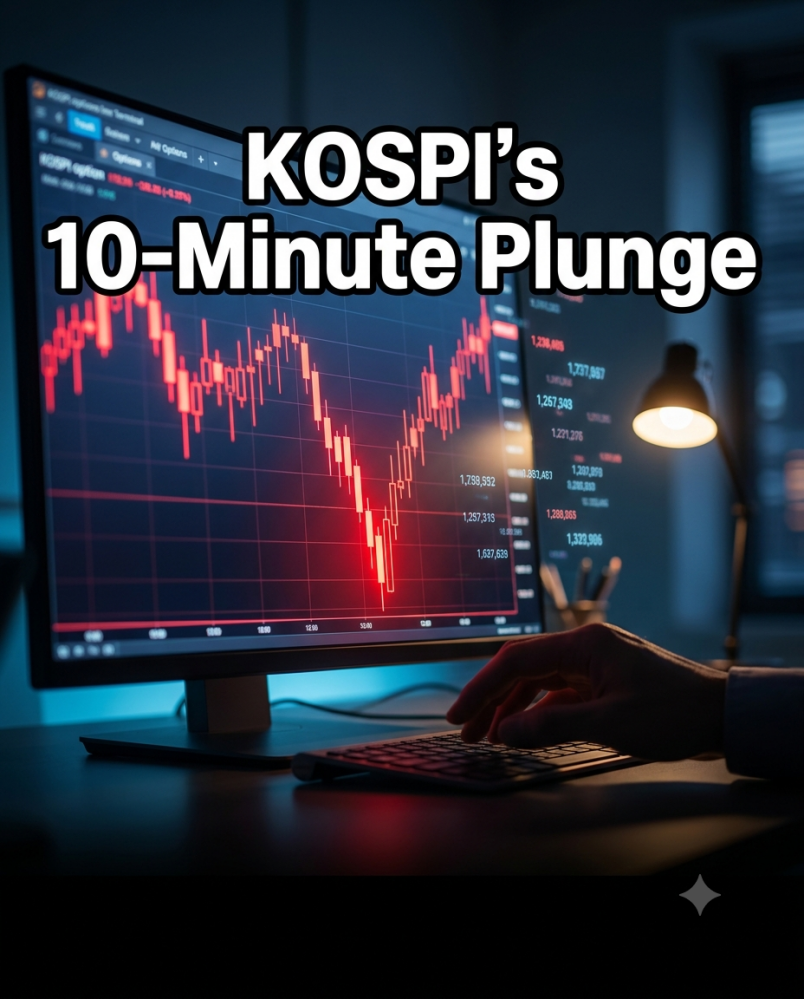
On Thursday, September 3, 2026 — a weekly KOSPI 200 options expiry day — the index reportedly climbed as much as 1.8% intraday before reversing sharply in the early afternoon: Korean-language market commentary that day described a roughly 220-point, 3.6-percentage-point drop compressed into about ten minutes shortly after 2:00 p.m., followed by a near-complete recovery by 2:30 p.m. that left the index closing modestly higher on the day. One specific out-of-the-money weekly put option was reported to have moved from roughly 0.01 to 14.95 — a gain on the order of 1,000-fold — within that same window.
koreanalysis.com has not independently verified the specific price levels in that account, and the commentator who first laid out a causal explanation explicitly framed it as an illustrative scenario rather than a confirmed one. The value of the explanation is mechanical, not accusatory: it's a clean example of how options gamma and the uptick rule's hedging exemption can combine on an expiry afternoon. Deep out-of-the-money puts are cheap because they're very unlikely to pay off — but as an index slides toward their strike price on expiry day, their value can accelerate non-linearly (the effect options traders call gamma), and any concentrated hedge or arbitrage-related selling exempt from the uptick rule can accelerate that slide further without triggering the brake that would normally apply to ordinary short sales. None of this requires anything to have actually gone wrong with a company, a sector, or the economy — which is consistent with the index fully round-tripping within half an hour.
✅ What to Check Before Trading Around a Korean Options Expiry
- Does your position window include a Thursday? KOSPI 200 and many single-stock options expire weekly, concentrating hedging and unwind flows into a single afternoon.
- Are you relying on the uptick rule as a floor? Hedge and arbitrage-related trades are exempt from it, so a sharp move isn't necessarily a signal that ordinary short sellers are piling on.
- Is the move tied to a fact or a rumor? The Celltrion case is a reminder that Korean equities have a documented history of rumor-driven short-term moves — check for a specific, sourced catalyst before treating a swing as informative.
Reinstating short selling changed who is allowed to bet against Korean stocks — it didn't touch the options-expiry mechanics that can move the index several percentage points in minutes without a single new fact entering the market.
What Should Investors Watch Next?
Two related questions are worth following alongside this one: how Korea's naked short-sale detection system (NSDS) actually verifies broker and seller balances in practice, and how KOSPI 200 weekly options expiry mechanics compare with the monthly-only structure most foreign investors are used to. Both will be covered as standalone spokes under the Market Structure pillar linked above.
Frequently Asked Questions
Q1. Is short selling legal in South Korea right now?
A. Yes. South Korea fully reinstated short selling on all listed stocks on March 31, 2025, ending an 18-month market-wide ban, alongside a new system designed to detect naked short selling in real time.
Q2. What is naked short selling, and why was it banned?
A. Naked short selling is selling borrowed-in-name-only shares without first securing a real borrow, letting a seller apply downward pressure with no natural supply limit. Korea suspended all short selling in November 2023 after finding that major global investment banks had been doing this illegally.
Q3. Why do Korean stocks sometimes swing sharply on Thursday afternoons?
A. Thursdays are the weekly expiry for KOSPI 200 and many single-stock options in Korea's unusually large and active retail options market. Combined with an uptick-rule exemption for hedging and arbitrage trades, expiry-day price action can diverge sharply from anything happening in the underlying fundamentals.
Korea fixed the short-selling loophole that caused its last crisis of confidence — the next source of unexplained volatility is sitting in plain sight on the options expiry calendar.
반응형'Market Structure > Institutional Behavior' 카테고리의 다른 글
Korean Stock & Equity Research
Data-driven analysis of Korean listed companies, combining financial fundamentals with supply chain and operations insights. Not investment advice.