-
Investing Guides/Market Mechanics
Korea's WGBI Inclusion Explained: What It Means for Markets
2026. 8. 23.
Table
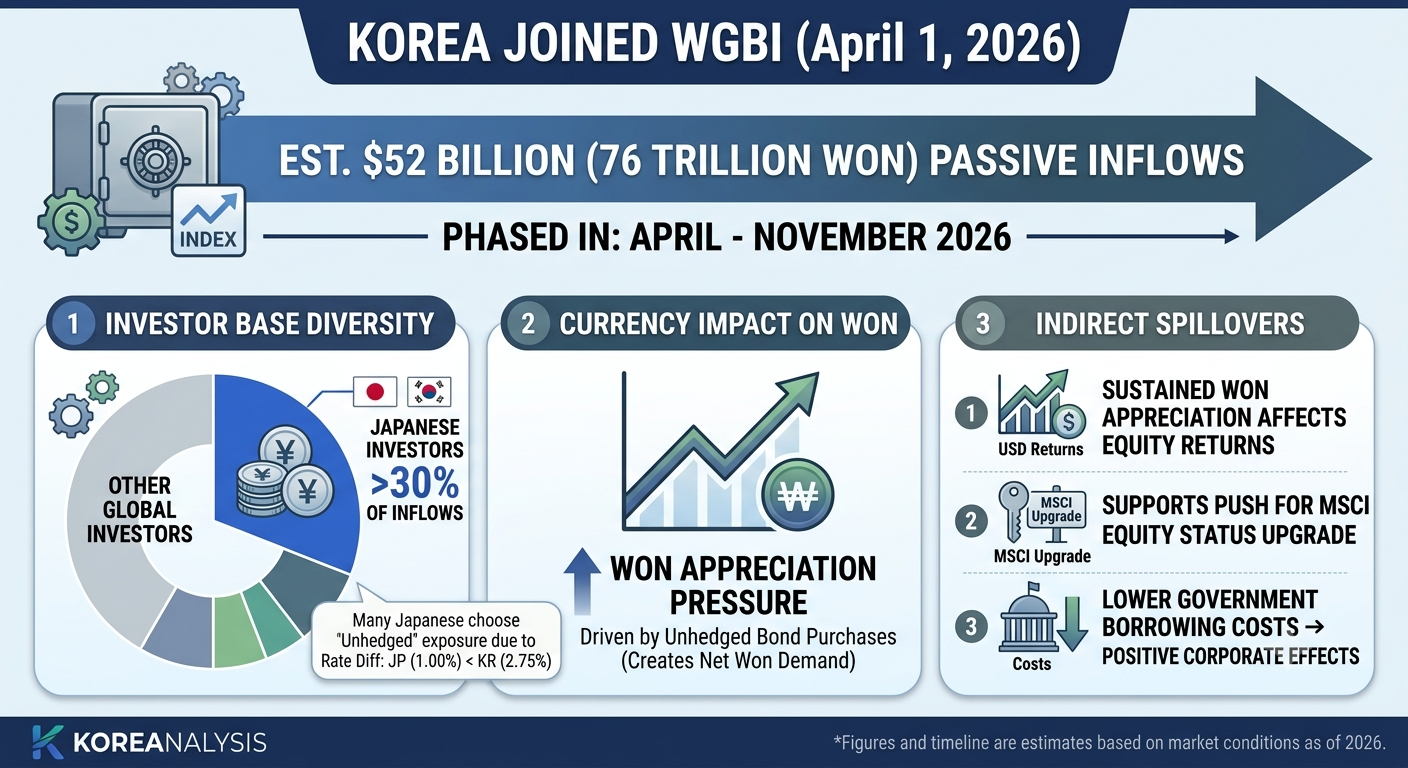
반응형Korean government bonds officially joined the FTSE World Government Bond Index on April 1, 2026, triggering an estimated $52 billion (roughly 76 trillion Won) in mandatory purchases from index-tracking funds, phased in evenly through November 2026. The inclusion is a milestone Korea pursued for years, reflecting improved market accessibility for foreign institutional investors. This article is part of our Ultimate Guide to Investing in South Korean Stocks for Foreigners.
What Is the WGBI, and Why Did Inclusion Take Years?
The FTSE World Government Bond Index tracks investment-grade sovereign debt across major global economies, and inclusion requires meeting specific market accessibility, size, and credit rating criteria. Korea's path to inclusion involved multi-year negotiations and market reforms — including some of the FX market accessibility improvements covered in our earlier piece on currency conversion for Korean stock investing — aimed at making the market easier for global institutional investors to access without the friction that had previously kept Korea off the index.
 반응형
반응형Who Is Actually Buying Korean Bonds as a Result?
Japanese investors represent over 30% of WGBI-tracking inflows into Korean bonds, and as covered in our piece on the Won's 2026 appreciation, many have been buying without currency hedging — a preference driven by the relatively large gap between Japan's 1.0% policy rate and Korea's 2.75% rate, which makes unhedged exposure more attractive than paying the hedging cost to neutralize currency risk.
Does WGBI Inclusion Affect Korean Equities Indirectly?
✅ Indirect Effects Worth Tracking
- Sustained unhedged bond inflows contribute to Won appreciation pressure, which affects USD-denominated equity returns
- Broader recognition of improved market accessibility can support Korea's separate push for MSCI equity market status upgrades
- Lower Korean government borrowing costs from expanded bond demand can have modest positive spillover effects on corporate borrowing conditions
Frequently Asked Questions
Q1. Is WGBI inclusion the same as an MSCI equity market upgrade?
A. No, these are separate index frameworks — WGBI covers government bonds, while MSCI's equity market classification (emerging vs. developed) is a distinct process Korea is pursuing separately.
Q2. Over what period were the WGBI-related inflows expected to occur?
A. The roughly $52 billion in flows were structured to phase in evenly on a monthly basis from April through November 2026, rather than arriving all at once.
Q3. Why does hedged vs. unhedged bond buying matter for the Won?
A. Hedged purchases are offset by the hedge counterparty bank's opposite market position, largely neutralizing currency impact; only unhedged flows create genuine net Won demand.
반응형'Investing Guides > Market Mechanics' 카테고리의 다른 글
Korean Bond ETFs vs. Equity Exposure: Diversifying Beyond KOSPI Stocks (0) 2026.08.23 How the National Pension Service Affects KOSPI Liquidity (0) 2026.08.23 How Korean Dividend and Buyback Announcements Move Stocks (0) 2026.08.23 Common Mistakes Foreign Investors Make in the Korean Stock Market (0) 2026.08.23 Best English-Language Resources for Researching Korean Stocks (0) 2026.08.23
Korean Stock & Equity Research
Data-driven analysis of Korean listed companies, combining financial fundamentals with supply chain and operations insights. Not investment advice.