-
Korean Equities/Company Deep Dives
Musk's Moonshot Chip Bet, SpaceX's Bond Trouble, and China's AI Surprise: One Week That Tested Big Tech's Spending Thesis
2026. 8. 16.
Table
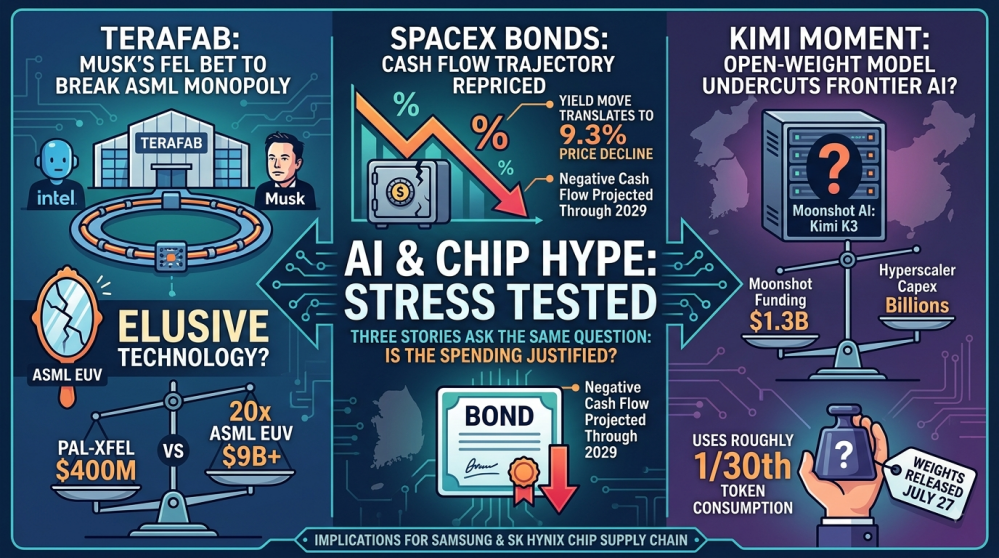
반응형In the span of about a week in July and August 2026, three unrelated stories quietly asked the same question: is the massive spending and hype behind AI and next-generation chip manufacturing actually justified? Elon Musk revealed he's betting Terafab on a lithography technology that's eluded the entire chip industry for over a decade. Bond investors punished SpaceX's own debt just weeks after its blockbuster IPO. And a Chinese AI lab's open-weight model threatened to undercut the entire rationale for hyperscaler capex. None of these stories individually settle the debate — but together, they're a useful stress test of the "spend more to win" thesis driving much of today's tech investment.
Table of Contents
- Musk's Terafab and the Bet to Break ASML's Monopoly
- How FEL Technology Actually Differs From ASML's EUV
- The Cost Case for FEL, and Why xLight Isn't Alone
- SpaceX's Bond Market Gets a Very Different Verdict
- The "Kimi Moment": Does Frontier AI Really Need Billions?
- Why This Matters for Korean Chipmakers
- Bottom Line
Musk's Terafab and the Bet to Break ASML's Monopoly
In March 2026, Elon Musk unveiled Terafab, aiming to build 1 terawatt of annual AI compute capacity — roughly comparable to total US power generation capacity — inside a single 100-million-square-foot facility in Grimes County, Texas, with Intel joining as a foundry partner in April using its 14A process. The first phase carries a reported $16.8 billion price tag, with Musk stating 80% of output would serve space-based data centers and 20% would go toward Optimus robot chips.
On August 6, 2026, a night-time render of the under-construction facility began circulating on X, showing a large ring structure beneath the building that observers speculated was a particle accelerator. When asked directly whether Terafab was pursuing a Free Electron Laser (FEL) based EUV light source, Musk replied simply: "FEL FTW." Independent industry outlets, including Bits&Chips and TrendForce, subsequently confirmed the speculation was directionally accurate, reporting that Terafab appears to be pursuing FEL technology as an alternative to the laser-produced plasma method ASML currently uses exclusively.
 반응형
반응형How FEL Technology Actually Differs From ASML's EUV
ASML's current EUV systems generate 13.5-nanometer light by firing high-power lasers at molten tin droplets roughly 50,000 times per second, vaporizing them into a light-emitting plasma. This approach, while proven, is highly energy-inefficient — most of the input energy is lost as waste heat rather than converted into usable light — and generates tin debris that damages precision mirrors over time, requiring frequent maintenance.
FEL technology instead accelerates electrons to near light-speed using a particle accelerator, then passes them through a series of alternating magnets (an undulator) that force the electrons into a zigzag pattern, causing them to emit coherent light. This is an established, decades-old technique already used in research facilities worldwide, including South Korea's own PAL-XFEL at the Pohang Accelerator Laboratory — the world's fourth such facility, operational since 2017, following similar systems in the US, Japan, and Switzerland. The core engineering challenge for chip manufacturing isn't proving FEL works, but shrinking and adapting a technology historically built at scales exceeding one kilometer into something viable for a semiconductor fab, and doing so at a cost and speed usable for actual production.
The Cost Case for FEL, and Why xLight Isn't Alone
Terafab isn't the only effort pursuing this path. xLight, a startup founded in 2021 with former Intel CEO Pat Gelsinger as board chair, has been developing FEL-based EUV light sources with a target of a working prototype by 2028. Independent reporting confirms the US National Institute of Standards and Technology (NIST) awarded xLight $150 million to support this development — corroborating earlier reports of federal government interest in the approach — and the company separately raised an oversubscribed $400 million Series B round to fund the effort.
The economic case, while unproven at scale, is directionally compelling: South Korea's 1.1-kilometer PAL-XFEL cost roughly $400 million to build (excluding land, which was already owned), while a single modern ASML EUV machine costs roughly $450 million, meaning 20 machines would run upwards of $9 billion. Even a purpose-built FEL costing several times more than PAL-XFEL could theoretically undercut a large EUV machine fleet, though translating a research-grade particle accelerator into a production-viable chip tool remains a substantial unsolved engineering problem — and FEL's efficiency advantage, via energy-recovery linac (ERL) systems that recycle deceleration energy from spent electrons back into accelerating new ones, is the core selling point that makes prolonged operation more economically feasible.
SpaceX's Bond Market Gets a Very Different Verdict
Just weeks after SpaceX's blockbuster June 11, 2026 Nasdaq debut, which raised $85.7 billion, the company issued an additional $25 billion across five new bond tranches (maturing 2031 through 2056), with initial demand strong enough to price 25 basis points tighter than originally planned — coupons ranging from 5.35% on the 2031 tranche to 6.65% on the 2056 tranche.
Within days of trading in the secondary market, the picture reversed sharply. The 2056 tranche's yield rose from 6.65% to roughly 7.3%, a combination of SpaceX-specific risk repricing (0.56 percentage points) and broader Treasury yield increases (0.16 percentage points). For a 30-year bond with roughly 13-year duration, that yield move translates to an estimated 9.3% price decline — meaning bonds purchased at 100 were trading closer to 91 within roughly three weeks. Market participants attributed the sharp move to hedge funds and short-term trading desks, rather than typical long-duration buyers like pension funds and insurers, having piled into the new issue expecting spreads to tighten further post-IPO, then dumping the position when that thesis didn't play out quickly. The divergence is notable: SpaceX's equity continues to trade on long-term vision, while its bond market is pricing genuine concern about the company's cash flow trajectory, given substantial spending plans and accumulating losses at its xAI unit, with negative cash flow reportedly projected through 2029.
The "Kimi Moment": Does Frontier AI Really Need Billions?
On July 17, 2026, Chinese AI lab Moonshot AI released Kimi K3, an open-weight model with a reported 2.8 trillion parameters — notably larger than DeepSeek V3's 671 billion — built on total funding of roughly $1.3 billion since the company's founding. On self-reported benchmarks, Kimi K3 reportedly outperformed Anthropic's Claude Opus 4.8 and matched top-tier closed models while using roughly 1/30th the token consumption, prompting comparisons to the "DeepSeek moment" of January 2025, when a similarly low-cost Chinese model briefly wiped roughly $600 billion off Nvidia's market cap in a single session.
The critical caveat: these figures come from Moonshot's own self-reported testing, raising the possibility of benchmark optimization rather than genuine general-purpose capability. Full model weights became available for independent third-party verification on July 27, 2026, meaning outside labs and researchers could subsequently test the claims directly rather than relying on the company's own scoring. If verified performance holds up, it would meaningfully challenge the core logic hyperscalers have used to justify hundreds of billions in AI infrastructure spending — the assumption that maintaining frontier-level AI capability requires correspondingly frontier-level compute spending.
Why This Matters for Korean Chipmakers
Each story carries a distinct implication for Samsung Electronics and SK Hynix. A viable FEL-based alternative to EUV, if it ever reaches production scale, would be a genuine structural shift in a supply chain both companies depend on entirely — though the timeline for this remains highly uncertain, likely years away even under an optimistic scenario. SpaceX's bond market stress is a reminder that even the most hyped AI-adjacent companies face real scrutiny from debt markets focused on cash flow rather than narrative, a dynamic worth watching as AI infrastructure financing (including the Nvidia-OpenAI-Oracle structure covered in our earlier piece) scales further. And a validated Kimi K3 result would cut both ways for Korean memory makers: reduced hyperscaler AI capex could soften near-term HBM demand growth, though cheaper, more efficient AI models could also broaden AI adoption overall in ways that support memory demand through different channels over time.
Bottom Line
Three stories from the same week — Musk's decade-defying FEL bet for Terafab, SpaceX bond investors pricing in real cash flow risk despite equity market euphoria, and a Chinese open-weight model challenging the assumption that frontier AI requires frontier-level spending — each independently tested the market's confidence in "spend more, win more" as the default strategy in AI and semiconductor infrastructure. None delivered a definitive verdict yet, but each is worth tracking as its own resolution point: Terafab's FEL system reaching functional prototype stage, SpaceX's cash flow trajectory through 2029, and third-party verification results from Kimi K3's July 27 weight release.
This article is for informational purposes only and does not constitute investment, tax, or legal advice. Readers should consult a licensed professional before making investment decisions.
반응형'Korean Equities > Company Deep Dives' 카테고리의 다른 글
Korean Stock & Equity Research
Data-driven analysis of Korean listed companies, combining financial fundamentals with supply chain and operations insights. Not investment advice.