-
Korean Equities/Company Deep Dives
How a Thai Snack Company Made Korean Seaweed a 70% Global Monopoly
2026. 8. 17.
Table
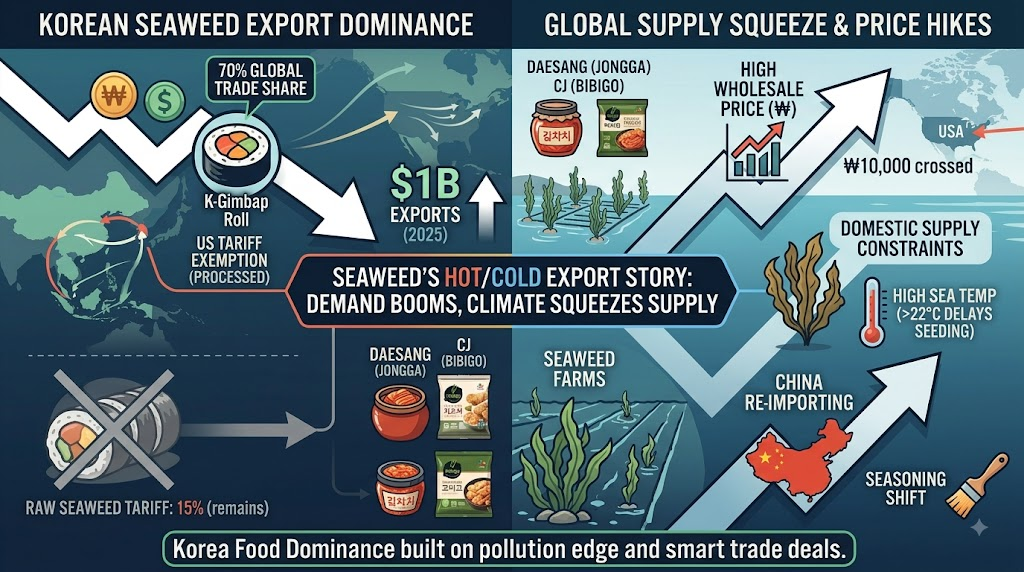
반응형Korea's most unglamorous export success story might be seaweed. In the first half of 2025 alone, Korea exported $594 million worth of dried and seasoned seaweed, hit $1 billion in exports for the year by early November, and now commands roughly 70% of the global seaweed trade. The story behind that dominance involves a Thai snack company, Chinese coastal pollution, US rice surpluses, and a warming ocean — and it connects directly to two Korean-listed food companies actively building on this trend.
Table of Contents
- How a Thai Snack Company Made Korean Seaweed a Global Commodity
- Why China's Pollution Became Korea's Advantage
- Daesang and CJ Cheiljedang: The Listed Beneficiaries
- The US Tariff Exemption, Explained
- The Other Side: Climate Is Squeezing Supply
- China Now Reimporting Korean Seaweed
- Bottom Line
How a Thai Snack Company Made Korean Seaweed a Global Commodity
Seaweed cultivation at scale is only viable in waters that drop below roughly 20°C, limiting large-scale production to Korea, China, and Japan — tropical Southeast Asian nations are structurally excluded. Korea's own growing season runs from October/November through April or May, when coastal water temperatures are cold enough.
The current export boom traces back to 2004, when Thai company Taokaenoi launched a seaweed snack — fried, seasoned with flavors like barbecue and durian — originally made with Chinese seaweed. As competitors tried to differentiate against Taokaenoi's roughly 70% market share in Thailand's seaweed snack category, several began marketing that they used Korean seaweed instead, citing pollution concerns around Chinese-sourced product. Facing this competitive pressure, Taokaenoi itself switched its sourcing from China to Korea. From there, Korean seaweed spread through Southeast Asia's snack market — Korean conglomerate Daesang built an Indonesian production subsidiary and launched "Mama Suka" seaweed snacks tailored to local tastes, capturing roughly 60% of the Indonesian seaweed snack market against Taokaenoi's remaining share.
 반응형
반응형Why China's Pollution Became Korea's Advantage
China is technically the world's largest seaweed producer by volume, but its output skews heavily toward a coarser variety used mainly for soup stock rather than the thinner, more palatable variety used in seasoned snack sheets — and quality is further constrained by severe coastal pollution. Chinese government marine environment surveys have found pollutant concentrations exceeding standard thresholds at roughly 84% of 600 sampled coastal sites, spanning the Bohai and Liaodong Bay areas in the north down through the Yangtze River estuary in the south. Because seaweed absorbs whatever is in the surrounding seawater as it grows, water quality translates fairly directly into product quality — a structural disadvantage Chinese seaweed hasn't been able to overcome for premium export markets, even as it remains adequate for China's own domestic consumption.
Daesang and CJ Cheiljedang: The Listed Beneficiaries
Two Korea-listed food companies have built meaningful export businesses on this trend, though seaweed itself is only one product line within broader K-food export strategies at both firms. Daesang (KRX: 001680), which owns the Chungjungwon and Jongga brands, has positioned itself as the largest beneficiary of the related US kimchi export boom, commanding roughly 56% of Korea's kimchi exports to the US in the first half of 2026, built on a dedicated Los Angeles production facility opened in 2022 with capacity for over 20,000 tons annually — infrastructure and market access built for one Korean food category (kimchi) that plausibly supports broader K-food distribution including seaweed products through the same retail relationships.
CJ Cheiljedang (KRX: 097950) reported Q1 2026 revenue of 7.11 trillion Won, up 30.3% quarter-over-quarter though down 1.4% year-over-year, with overseas food revenue showing mixed regional results — US revenue up 3%, European revenue up a stronger 17% driven by its Bibigo-branded frozen food lineup, while operating profit of 238.1 billion Won came in below consensus due to weaker overseas food margins and declining bio-segment pricing. CJ's Bibigo kimchi now exports to roughly 50 countries, illustrating the same global K-food distribution infrastructure that seaweed exports benefit from.
The US Tariff Exemption, Explained
A separate US policy shift added tailwind specifically for processed (roasted/seasoned) seaweed. Facing a buildup of unprocessed and milled rice inventory — up 35% and 34% year-over-year respectively in the second half of 2025 — US trade officials looked favorably on Korean seaweed as a product that pairs naturally with rice consumption (notably through the rising popularity of Korean-style kimbap and frozen kimbap products in the US) without competing against domestic US agricultural producers, since the US has no domestic seaweed farming industry. Because dried, unprocessed seaweed carries agricultural/seafood classification, it remained subject to a standard 15% tariff, while roasted and seasoned seaweed can be classified as a processed food product rather than raw seafood. This distinction is why the US retroactively cut tariffs on Korean seasoned seaweed from 15% to 0% effective November 1, 2025, while leaving the tariff on raw dried seaweed unchanged.
The Other Side: Climate Is Squeezing Supply
Rising demand has collided with climate-driven supply constraints. Korea's National Institute of Fisheries Science tracks real-time coastal water temperatures, and seaweed spore-seeding (chaemyo) requires water temperatures to fall below roughly 22°C. In fall 2024, temperatures in early-seeding regions like Taean, Chungnam remained above 22.8°C weeks past the normal seeding window, delaying the start of the season across the country. The same warming pattern affected seaweed, kelp, oysters, and clams simultaneously, with South Korea's south coast reporting over 56 billion Won in aquaculture losses from high water temperatures in a single reporting period in 2024. Wholesale dried seaweed prices, which stood at roughly 5,600 Won per unit (100 sheets) in 2023, crossed 10,000 Won for the first time in 2024 — an increase of roughly 80% in a single year — and had climbed further to 1,347 Won per 10-sheet unit by 2025, continuing a multi-year uptrend even as export volumes and value keep growing.
China Now Reimporting Korean Seaweed
In a notable reversal, China — the country whose pollution problem originally redirected Southeast Asian sourcing toward Korea — has itself become a growing buyer of Korean dried seaweed, with exports to China rising from 2,543 tons in 2024 to 4,539 tons in 2025, and 2,416 tons already shipped in the first half of 2026 alone. Chinese importers reportedly purchase inexpensive Korean dried seaweed, season it locally using Korean-style oil-and-salt preparation, and market it domestically under Korean-sounding branding — a practice that has compressed the share of higher-margin pre-seasoned seaweed within Korea's total seaweed export mix from 43% in 2020 to 35% in 2025, since more of the value-added seasoning process is happening after the raw product leaves Korea.
Bottom Line
Korea's roughly 70% global market share in seaweed exports traces back two decades to a Thai snack company's sourcing decision, reinforced by China's severe coastal pollution problem and a 2025 US tariff exemption tied to America's own rice oversupply. Rising global demand has collided with warming ocean temperatures constraining domestic supply, driving wholesale prices up roughly 80% in a single year even as export volumes climb — a dynamic that continues to support Korea-listed food exporters like Daesang and CJ Cheiljedang, both of which have built US and broader international distribution infrastructure around Korean food exports more broadly.
This article is for informational purposes only and does not constitute investment, tax, or legal advice. Readers should consult a licensed professional before making investment decisions.
반응형'Korean Equities > Company Deep Dives' 카테고리의 다른 글
Korean Stock & Equity Research
Data-driven analysis of Korean listed companies, combining financial fundamentals with supply chain and operations insights. Not investment advice.