-
Korean Equities/Company Deep Dives
Why Korea Sold Off on June 23 While SpaceX Rallied — The Same Mechanism, Working
2026. 8. 14.
Table
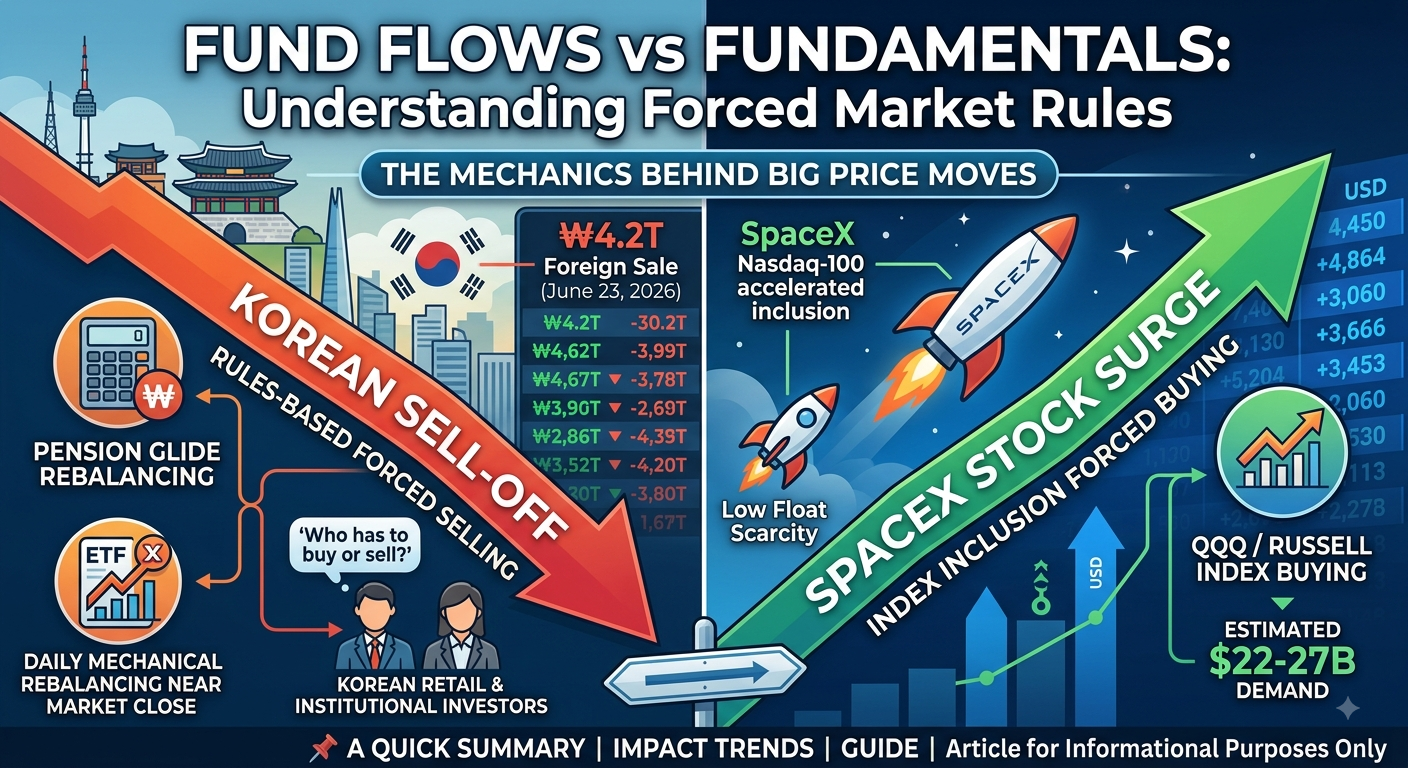
반응형On June 23, 2026, foreign investors sold 4.2 trillion Won of Korean equities in a single session, while Korea's National Pension Service sold only 300 billion Won — meaning the pension fund wasn't the main seller that day, despite widespread assumptions. Around the same time, halfway across the world, SpaceX's stock was being pulled higher not by earnings or news, but by a mechanical index-inclusion rule triggering an estimated $22-27 billion in forced buying. Both stories are really about the same thing: in markets increasingly dominated by rules-based funds, understanding who has to buy or sell — and why — often explains price action that pure fundamental analysis misses entirely.
Table of Contents
- How Index Rebalancing Actually Forces Trades
- Korea's June 23 Selloff: Ruling Out the Obvious Suspects
- The "Glide" Approach: How Pension Funds Rebalance Differently
- Why the National Pension Service Couldn't Buy the Dip
- Leveraged ETFs: A Volatility Amplifier That Never Sleeps
- The Mirror Image: SpaceX and Forced Index Buying
- The Broader Lesson for Retail Investors
- Bottom Line
How Index Rebalancing Actually Forces Trades
Global pension funds and passive ETFs tracking indices like MSCI or FTSE typically operate under fixed target allocations — for example, "Korea equities: X%, Samsung Electronics: Y%." When Korean stocks rally sharply, portfolio values can drift meaningfully above these targets purely through price appreciation, with no new buying involved. Rebalancing rules then require selling the excess back down to target — not because anything is wrong with the stock, but purely to maintain the fund's mandated allocation.
 반응형
반응형Korea's June 23 Selloff: Ruling Out the Obvious Suspects
Over the month starting May 7, 2026, foreign investors net sold 69 trillion Won of Korean equities, including 30 trillion Won of Samsung Electronics and 27 trillion Won of SK Hynix — largely profit-taking after a sharp rally. But attributing the specific June 23 decline to passive fund rebalancing doesn't hold up: MSCI Korea's rebalancing had already concluded on May 29, and FTSE Korea's on June 19, with no further rebalancing scheduled until August and September respectively. The more likely explanation was a different category of investor entirely: global pension funds and asset managers conducting their own separate portfolio rebalancing, which — unlike passive funds — isn't tied to a single index effective date. June is notable for being a month where monthly, quarterly, and semi-annual rebalancing cycles all overlap simultaneously. JPMorgan estimated total quarter-end rebalancing flows at $165 billion globally for this period, with Korea and Japan — markets that had rallied significantly — likely representing a meaningful share of the selling.
The "Glide" Approach: How Pension Funds Rebalance Differently
Passive funds tracking an index typically execute trades concentrated on the index's official rebalancing effective date, prioritizing tracking accuracy over trade execution price. Pension funds and asset managers operate under different incentives — since return matters more than precise index tracking, they typically spread rebalancing trades over one to two weeks rather than executing all at once, a pattern often described as a "glide," similar to an aircraft's gradual descent rather than an abrupt drop. When market commentary references "pension fund rebalancing supply hanging over the market" ahead of a quarter-end or half-year mark, this glide-phase selling is generally what's being described. This staggered execution also creates a game-theoretic dynamic: other market participants who anticipate this multi-day selling pressure have an incentive to sell ahead of it themselves, timing their own exits before the anticipated pressure fully materializes.
Why the National Pension Service Couldn't Buy the Dip
Historically, Korea's National Pension Service (NPS) has stepped in as a buyer during exactly these kinds of pullbacks, particularly when it was overweight US equities and underweight domestic ones following a Korean market decline — a natural rebalancing opportunity to buy Korean stocks cheaply. As covered in our earlier piece on the NPS's unusual 2026 asset allocation decisions, the fund's domestic equity holdings were already running well above target this year following the KOSPI rally, leaving it without the same rebalancing-driven buying capacity it has historically provided during downturns. The NPS also changed its own execution approach in 2026, capping daily rebalancing sale volumes to avoid concentrated market impact — a reasonable risk-management change in isolation, but one that has the side effect of extending the duration of pension-linked selling pressure over more trading days, with NPS-driven flows likely continuing into July even after most international funds complete their June rebalancing.
Leveraged ETFs: A Volatility Amplifier That Never Sleeps
Layered on top of these fund-flow dynamics is a structural amplifier: leveraged ETFs. Korea's ETF market has grown dramatically, from 121 trillion Won in total assets at the end of 2023 to over 500 trillion Won by late May 2026. Standard ETFs amplify volatility only when new money flows in or out — existing holdings simply track price changes without requiring active rebalancing. Leveraged ETFs work differently, because Korean leveraged products target 2x the daily return of their underlying asset, not a fixed 2x multiple over time, meaning they must rebalance every single trading day regardless of new investor flows.
The mechanics: if an underlying asset rises 20% in a day, a leveraged fund with 100 in net assets and 100 in borrowed capital (200 in total stock exposure) sees stock value rise to 240, while net assets rise to 140 — a 240/140 ratio of 1.71x, below the 2x target. To restore 2x leverage, the fund must buy an additional 40 in stock near the close, pushing exposure to 280/140. The reverse occurs on down days: a 20% decline turns 100 net assets/100 debt/200 stock into 60 net assets/100 debt/160 stock, a 160/60 ratio of 2.67x — requiring the fund to sell 40 in stock near the close to restore the 2x target, creating concentrated, mechanical selling pressure specifically in the final 20-30 minutes of trading on days when prices are already falling. This same mechanical amplification occurs in inverse leveraged products moving in the same rebalancing direction, and its overall market impact grows as leveraged assets represent a larger share of total trading activity — including via Hong Kong-listed leveraged products tracking individual Korean stocks like SK Hynix.The Mirror Image: SpaceX and Forced Index Buying
SpaceX's June 2026 stock performance illustrates the same fund-flow mechanics working in reverse — as a source of buying pressure rather than selling pressure. Following its June 12 IPO, SpaceX qualified for accelerated Nasdaq-100 inclusion under a rule change specifically loosened on May 1, 2026, allowing new listings ranked in the top 40 by market cap to join after just 15 trading days rather than waiting for standard quarterly review. SpaceX's inclusion date was calculated as July 6, 2026.
Because passive funds tracking the Nasdaq-100 (QQQ, QQQM, TQQQ, and others) must hold index constituents in proportion to their weighting, inclusion triggers mechanical forced buying independent of any fundamental view on the stock. Bloomberg estimated Nasdaq-100 and Russell index funds alone would need to acquire roughly 24% of SpaceX's tradeable float, with total demand — including benchmark-tracking active funds — potentially exceeding half of available float. ETF.com estimated total forced buying at $22-27 billion. This effect was amplified by SpaceX's unusually low float of just 4.3% (calculated from a $75 billion IPO offering against a $1.75 trillion valuation), meaning the pool of shares available to satisfy this mechanical demand was extremely limited — a scarcity dynamic that tends to push prices higher as index funds compete for the same limited supply.
This dynamic works in both directions, however. Low float amplifies gains from forced buying, but also limits the ability of short sellers to build positions against the stock during periods of stress — such as a Starship launch failure or other sector-specific bad news — since shares available to borrow for shorting are similarly scarce. SpaceX's low float also means upcoming lock-up expirations, beginning in August 2026, represent a meaningful supply-side variable to watch, even though CEO Elon Musk's own shares remain restricted under a longer 366-day lock-up.The Broader Lesson for Retail Investors
Rebalancing dynamics aren't inherently negative for individual investors — they can work in an investor's favor too. An investor who sets a target stock allocation and rebalances as prices rise effectively recovers their original capital automatically over time, redirecting gains into bonds or other assets as the equity position grows beyond target. Once original capital is recovered, remaining exposure represents only unrealized gains, which can meaningfully change an investor's risk tolerance and ability to stay calm through subsequent volatility.
Bottom Line
Korea's June 23, 2026 selloff traced not to passive index rebalancing, which had already concluded, but to global pension funds and asset managers executing overlapping monthly, quarterly, and semi-annual rebalancing cycles through a gradual "glide" approach — compounded by leveraged ETFs' mechanical daily rebalancing and a National Pension Service that, unusually, lacked its typical rebalancing-driven capacity to buy the dip. SpaceX's concurrent Nasdaq-100 inclusion demonstrates the same fund-flow mechanics working in the opposite direction, generating billions in mechanical buying pressure from an artificially scarce float. In both cases, understanding which funds are structurally required to buy or sell — and when — offers a clearer read on near-term price action than fundamentals alone.
This article is for informational purposes only and does not constitute investment, tax, or legal advice. Readers should consult a licensed professional before making investment decisions.
반응형'Korean Equities > Company Deep Dives' 카테고리의 다른 글
Korean Stock & Equity Research
Data-driven analysis of Korean listed companies, combining financial fundamentals with supply chain and operations insights. Not investment advice.