-
Korean Equities/Company Deep Dives
Why Samsung and Korea's Cable Makers Are All Fighting Legal Battles Right Now — And It's Not a Coincidence
2026. 8. 14.
Table
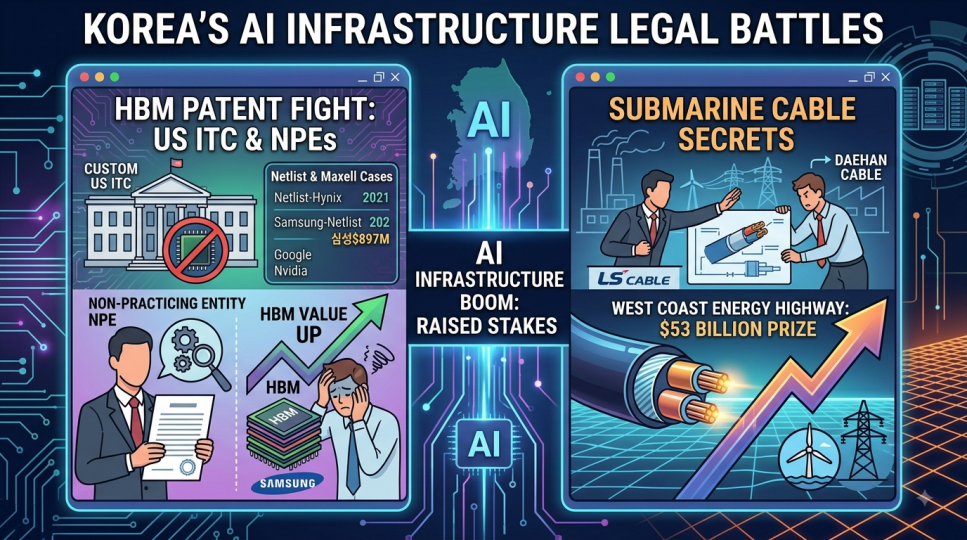
반응형Two seemingly unrelated legal battles are unfolding in Korea right now — one over HBM patents at the US International Trade Commission, the other over submarine cable trade secrets between two Korean manufacturers. Neither is really about the lawsuits themselves. Both are downstream consequences of the same AI infrastructure boom, which has made the underlying technology valuable enough to fight over.
How Section 337 and the ITC Actually Work
Section 337 of the US Tariff Act of 1930 targets imported goods that infringe US patents or trademarks and harm US industry. Unlike federal court litigation, which awards monetary damages, the US International Trade Commission (ITC) can issue exclusion orders blocking infringing products at customs, plus cease-and-desist orders halting sales of inventory already in the country. ITC cases also move dramatically faster than court litigation — typically resolving in 16-18 months versus several years through a full court appeals process — which is precisely why patent-holding firms that don't manufacture products themselves (often called NPEs, or non-practicing entities) tend to prefer the ITC route.
The AI Boom's Hidden Legal Tax: Inside Samsung's Patent Wars and Korea's Cable Feud 반응형The Netlist Case: From Lawsuit to Business Partner
Netlist, a California memory module company holding patents relevant to server memory and HBM technology, sued SK Hynix in 2016. After an ITC preliminary ruling against SK Hynix in 2019, the companies settled in April 2021: Netlist received a $40 million payment, purchase rights for up to $600 million in SK Hynix products, and a co-development agreement for CXL DIMM technology — converting an adversarial relationship into a business partnership.
Samsung followed a similar arc but started from a different position: Samsung and Netlist were originally partners under a 2015 joint development and licensing agreement that broke down over royalty disagreements. After Netlist won a $303 million jury verdict against Samsung in 2023 (with an additional $118 million added in 2024) in the Eastern District of Texas, Samsung pursued appeals rather than settling. Netlist escalated to the ITC in 2026, notably naming Google, Nvidia, Broadcom, and Supermicro as co-respondents — since their products (Google's TPUs, Supermicro's GPU servers) incorporate Samsung HBM. With customer companies now facing exposure, Samsung settled on August 5, 2026, agreeing to pay up to $897 million over five years alongside a partnership structure similar to SK Hynix's.
Maxell's Narrower Follow-On Case
A second, less consequential case is developing in parallel. Maxell, a Hitachi spinoff and another NPE, filed a new ITC complaint against Samsung on August 12, 2026, following a July 17, 2026 preliminary ruling that Samsung's Galaxy S25 infringed one of six asserted patents (related to camera image processing). The dispute traces to an expired 2011 licensing agreement between Samsung and Hitachi. Unlike Netlist's case, Maxell's claims are limited to Samsung's finished consumer products (smartphones, tablets) rather than component-level technology embedded in third-party AI infrastructure — and software/UI-related patents are typically easier to design around than deep hardware patents, suggesting Maxell's likely goal is negotiating a settlement rather than pursuing an actual import ban.
LS Cable vs. Daehan Cable: A Trade Secrets Fight
Separately, Korea's two dominant submarine cable makers, LS Cable and Daehan Cable, have been locked in litigation since 2019, when LS Cable sued over patent infringement involving a high-voltage power distribution component, alleging a former subcontracted employee brought proprietary designs to Daehan after switching employers in 2011. LS Cable won at both trial and appellate levels, with Daehan ordered to pay roughly 1.5 billion Won in damages after declining to appeal further.
A larger dispute is now developing: Korean police are investigating potential leaks of LS Cable's HVDC (high-voltage direct current) submarine cable factory design know-how, reportedly through an architectural firm that worked on LS Cable's Plants 1-4 through 2024. Daehan maintains it selected the firm through open competitive bidding. If the leak allegation is substantiated, LS Cable is expected to pursue a substantial civil suit. Daehan, meanwhile, has been building its own leverage — its parent company Hoban has acquired a roughly 3% stake in LS Corp (parent of LS Cable, which itself is 92.26% owned by LS Corp), a notable move given the active litigation between the two cable units.
The Real Prize: Korea's $53 Billion Offshore Power Grid
What makes this dispute higher-stakes than a typical corporate lawsuit is the size of the market both companies are competing for. Korea's "West Coast Energy Highway" project involves building offshore transmission connecting Saemangeum to Seohwaseong (2GW, by 2031), Sinhaenam to Dangjin (2GW, by 2036), and additional Saemangeum-Yeongheung and Sinhaenam-Seoincheon segments (2GW each, by 2038) — a combined 72.8 trillion Won (roughly $53 billion) investment through 2038. Submarine cable is dramatically more expensive than overhead transmission lines — roughly 2 trillion Won versus 600 billion Won for a comparable 200km overhead route — but overhead lines have become politically difficult to build following past local opposition to transmission tower projects, pushing Korea toward the costlier submarine route despite the price premium.
What the Stock Prices Reveal
The market's read on this opportunity is visible in share prices. LS Corp traded at 187,500 Won in September 2025; it now trades above 450,000 Won. Daehan Electric Wire moved from 16,000 Won to over 56,000 Won over the same period. Both companies are also winning increasing US business, driven not by direct data center supply contracts, but by the broader regional grid upgrades needed to support rising AI data center power demand across aging US and European transmission infrastructure.
The Common Thread: AI Demand Raises the Stakes
Both stories trace back to the same underlying force. Samsung's HBM patents became worth fighting over precisely because AI-driven memory demand made HBM one of Samsung's most valuable product lines — the same dynamic that made Netlist's leverage credible enough to draw in Google, Nvidia, and Broadcom as co-respondents. LS Cable and Daehan's submarine cable dispute has escalated in parallel with a market whose value has been directly inflated by AI data center-driven grid expansion. In both cases, litigation stakes rose in lockstep with the size of the underlying AI infrastructure opportunity — a pattern worth watching as similar high-value technology disputes likely continue to surface across Korea's AI supply chain.
Bottom Line
Samsung's $897 million Netlist settlement and the escalating LS Cable-Daehan trade secrets dispute are, on the surface, unrelated corporate legal battles — but both reflect the same underlying dynamic: AI-driven demand has made the technology at the center of each fight dramatically more valuable, raising the financial stakes of disputes that might otherwise have stayed minor. As Korea's AI-linked supply chains continue expanding, similar high-value IP and trade secret battles are a plausible recurring feature of the landscape, not an isolated event.
This article is for informational purposes only and does not constitute investment, tax, or legal advice. Readers should consult a licensed professional before making investment decisions.
Related Coverage
- CXMT's $8.5 Billion IPO: State Capital, Stolen Patents, and a Threat to Samsung and SK Hynix — a related case of Chinese entities acquiring Korean semiconductor technology
- China Just Cut Off a Back Channel Into Korean Semiconductor Stocks — how Chinese capital flows are separately pressuring Korean chip stocks
- How One Share of SK Hynix Triggered a $57 Million Crypto Liquidation — another example of unexpected risk in Korea's semiconductor supply chain
반응형'Korean Equities > Company Deep Dives' 카테고리의 다른 글
Korean Stock & Equity Research
Data-driven analysis of Korean listed companies, combining financial fundamentals with supply chain and operations insights. Not investment advice.