-
Global Markets/AI & Tech Finance
The Yen Carry Trade Explained: Why Its Unwinding Shakes Global Markets
2026. 8. 5.
Table
반응형The Japanese Yen carry trade is one of the most influential — and most dangerous — mechanisms in global financial markets. When it unwinds suddenly, it has historically triggered some of the sharpest volatility spikes on record, from the collapse of LTCM in 1998 to turmoil during the 2008 financial crisis. Understanding how the carry trade works, and why recent US-Japan policy moves have reignited unwinding concerns, is essential context for anyone tracking Korean equities, which remain highly sensitive to global liquidity swings.
Table of Contents
- How the Yen Carry Trade Works
- Historical Precedents of Unwinding
- Why Joint US-Japan Intervention Raises Unwinding Risk
- Bottom Line
How the Yen Carry Trade Works
The Basic Concept
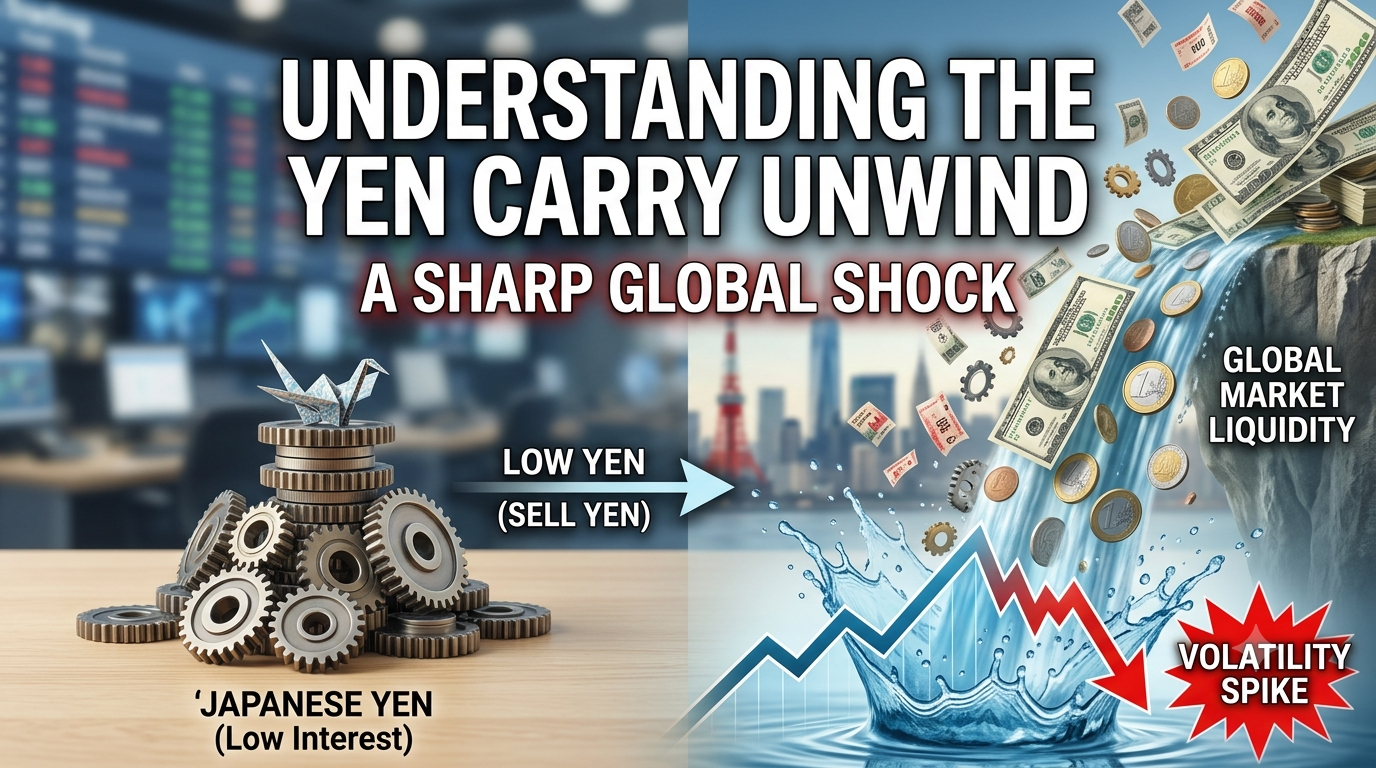
Investors borrow Japanese Yen at ultra-low interest rates and deploy those funds into higher-yielding foreign assets — US equities, bonds, or emerging market securities. The strategy profits from the interest rate gap between Japan and the destination market.
The Yen Carry Trade Explained: Why Its Unwinding Shakes Global Markets 반응형Impact on FX Markets
To invest overseas, carry traders sell Yen to buy foreign currencies such as the US Dollar. This steady, large-scale selling pressure on the Yen drives sustained Yen depreciation and Dollar strength, a dynamic that has shaped currency markets for decades.
Historical Precedents of Unwinding
1996–1998: The Asian Financial Crisis and IMF Period
A wide interest rate differential — around 5.25% in the US versus 0.5% in Japan — fueled massive carry positions, pushing the exchange rate as low as 147.64 JPY/USD. When the Asian Financial Crisis and Russia's debt moratorium triggered a broader financial panic, funds rapidly unwound their carry trades and fled to safety. Investors rushed to sell Dollars and buy back Yen, causing the currency to surge roughly 13% in just three days and move from 147.64 to 112 JPY/USD within two months. This abrupt shift was a major contributing factor in the collapse of Long-Term Capital Management (LTCM).
2008: The Global Financial Crisis
Severe market instability triggered another wave of Yen carry liquidation. Cross-currency ratios such as KRW/JPY more than doubled during this period, illustrating how quickly carry unwinding can ripple across unrelated markets.
Why Joint US-Japan Intervention Raises Unwinding Risk
Rising Japanese Government Bond (JGB) Yields
Higher JGB yields make domestic Japanese bonds more attractive relative to foreign assets, reducing the incentive to hold riskier positions abroad and weakening the core logic of the carry trade.
Coordinated FX Market Intervention
When US and Japanese authorities intervene to curb extreme Yen weakness, the resulting Yen appreciation creates foreign exchange losses for carry traders, since repaying Yen-denominated debt becomes more expensive as the Yen strengthens.
The Chain Reaction
To limit expanding currency losses, investors sell foreign equities and bonds, convert the proceeds back into Yen, and repay their debt. This unwinding process pulls liquidity out of global markets and can drive sharp, cross-asset volatility — including in Korean equity markets.
Bottom Line
Joint FX interventions and rising Japanese interest rates strengthen the Yen, prompting investors to sell global assets and buy back Yen to repay debt — triggering a Yen carry unwind that heightens volatility across global financial markets.
This article is for informational purposes only and does not constitute investment, tax, or legal advice. Readers should consult a licensed professional before making investment decisions.
반응형'Global Markets > AI & Tech Finance' 카테고리의 다른 글
Korean Stock & Equity Research
Data-driven analysis of Korean listed companies, combining financial fundamentals with supply chain and operations insights. Not investment advice.