-
Investing Guides/Account & Access
KOSPI vs. KOSDAQ: What's the Difference for Foreign Investors?
2026. 8. 19.
Table
반응형KOSPI is Korea's main board, listing large-cap blue chips like Samsung Electronics and Hyundai Motor, while KOSDAQ is the secondary board for smaller-cap growth, tech, and biotech companies — comparable to how Nasdaq differs from the NYSE. Both are accessible to foreign investors through the same account structure, but they carry different risk, liquidity, and tax profiles. This article is part of our Ultimate Guide to Investing in South Korean Stocks for Foreigners.
How Do KOSPI and KOSDAQ Actually Differ?
Factor KOSPI KOSDAQ Typical company profile Large-cap, established (Samsung, SK Hynix, Hyundai) Small/mid-cap growth, tech, biotech, entertainment Listing requirements Higher capital, profitability thresholds Lower thresholds, more startup-friendly Daily price limit ±30% ±30% Typical volatility Lower, blue-chip driven Higher, sentiment and momentum driven Foreign investor access Same account, no separate registration Same account, no separate registration 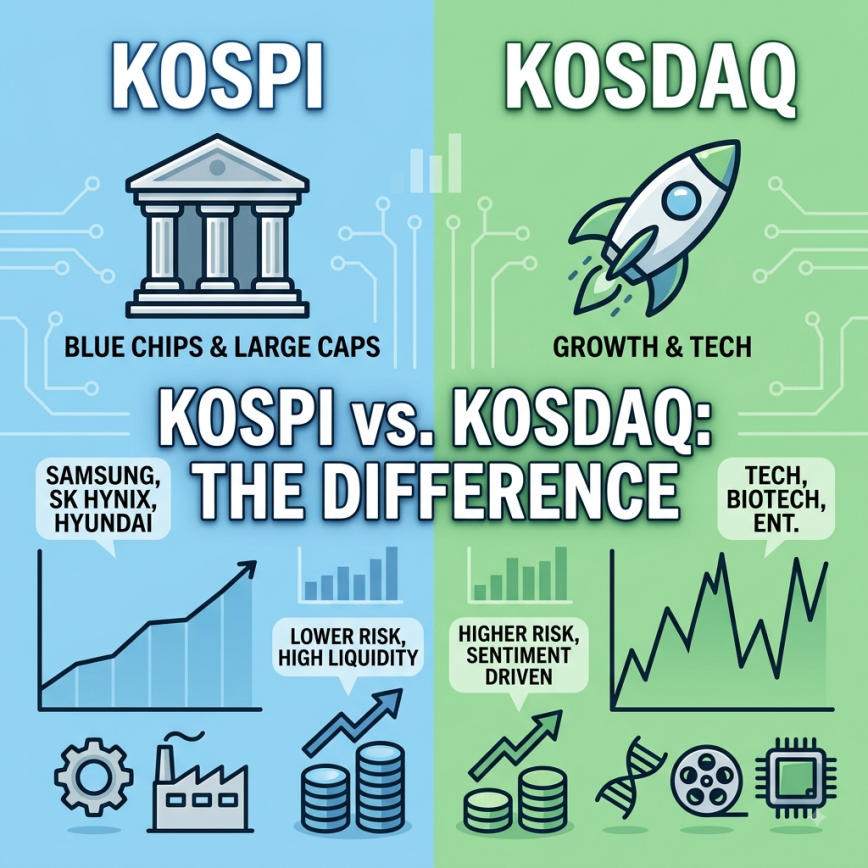 반응형
반응형Does EWY Give You KOSDAQ Exposure?
Not meaningfully. EWY tracks the MSCI Korea 25/50 Index, which is dominated by KOSPI large-caps — Samsung Electronics and SK Hynix alone often represent 30-40% of the fund. Investors specifically wanting KOSDAQ growth-stock exposure generally need direct share ownership, since broad Korea ETFs underweight or exclude most KOSDAQ names.
Does Tax Treatment Differ Between the Two Boards?
The core tax framework — 15% dividend withholding for US treaty residents, no capital gains tax below the major shareholder threshold — applies to both boards. The main practical difference is the securities transaction tax rate, which can differ between KOSPI and KOSDAQ sales; confirm the current applicable rate with your broker at the time of each trade, since Korea has adjusted these rates periodically.
✅ Before Buying a KOSDAQ Stock
- Check average daily trading volume — some KOSDAQ names are thinly traded, widening bid-ask spreads
- Confirm whether English-language disclosure is available for the specific company
- Review the company's KVI (Korea Value-Up Index) eligibility if governance quality is a priority
Frequently Asked Questions
Q1. Is KOSDAQ riskier than KOSPI for foreign investors?
A. Generally yes — KOSDAQ's smaller-cap, growth-oriented composition tends to carry higher volatility and lower average liquidity than KOSPI's blue-chip base.
Q2. Do I need a separate account to trade KOSDAQ stocks?
A. No, both boards trade through the same brokerage account and registration process.
Q3. Are there KOSDAQ-specific ETFs for foreign investors?
A. Dedicated KOSDAQ-tracking ETFs exist but are less commonly available on US exchanges than broad Korea ETFs like EWY; availability should be checked with your specific broker.
반응형'Investing Guides > Account & Access' 카테고리의 다른 글
Samsung and SK Hynix ADRs vs. Direct KOSPI Shares: Which Should You Buy? (0) 2026.08.22 KOSPI 200 vs. KOSPI Composite: What's the Difference for Investors? (0) 2026.08.22 Best Brokers for Foreign Investors in Korean Stocks (2026) (0) 2026.08.19 EWY ETF vs. Direct Korean Stocks: Which Wins in 2026? (0) 2026.08.18 How to Open a Korean Brokerage Account in 2026 (No IRC) (0) 2026.08.18
Korean Stock & Equity Research
Data-driven analysis of Korean listed companies, combining financial fundamentals with supply chain and operations insights. Not investment advice.