-
Global Markets/Supply Chain & Geopolitics
Korea's Tritium Monopoly Could Decide the Fusion Energy Race
2026. 8. 31.
Table
반응형South Korea's four CANDU reactors at Wolsung are one of only two commercial sources of tritium on Earth — the fuel every leading fusion reactor design needs and virtually no one can produce at scale — and Korea Hydro & Nuclear Power has already begun exporting it, signing a 2023 engineering contract with Romania's Nuclearelectrica. As fusion investment accelerates into a genuine industry, with political controversy now trailing the biggest players, control over tritium supply is emerging as a quieter but arguably more decisive variable than reactor design itself.
Why Is Tritium So Hard to Get?
Tritium is a radioactive hydrogen isotope with a half-life of just 12.35 years, meaning roughly 5.6% of any stockpile decays away every year — there is no way to "bank" it long-term the way uranium or other fuels can be stored. It occurs naturally only in trace amounts, so virtually all usable tritium today is a byproduct of a very specific reactor type: CANDU heavy-water reactors, which produce tritium when deuterium in the heavy-water moderator absorbs a stray neutron. Commercial-scale tritium extraction currently exists in exactly two places — Ontario Power Generation's Darlington facility in Canada, and Korea Hydro & Nuclear Power's Wolsung Tritium Removal Facility.
How Significant Is Korea's Position, Specifically?
Fact Detail Reactor fleet 4 CANDU units at Wolsung, operating since 1983, 1989, 1990, and 1991 Extraction capacity Wolsung Tritium Removal Facility processes 100 kg/h of tritiated heavy water, targeting ~7 MCi removed annually Export contract KHNP signed an EPC contract with Romania's Nuclearelectrica in June 2023 for a new tritium extraction facility Supply timeline risk Korea's CANDU fleet is projected to cease operation around 2030, capping South Korean tritium production by roughly 2032 under current plans 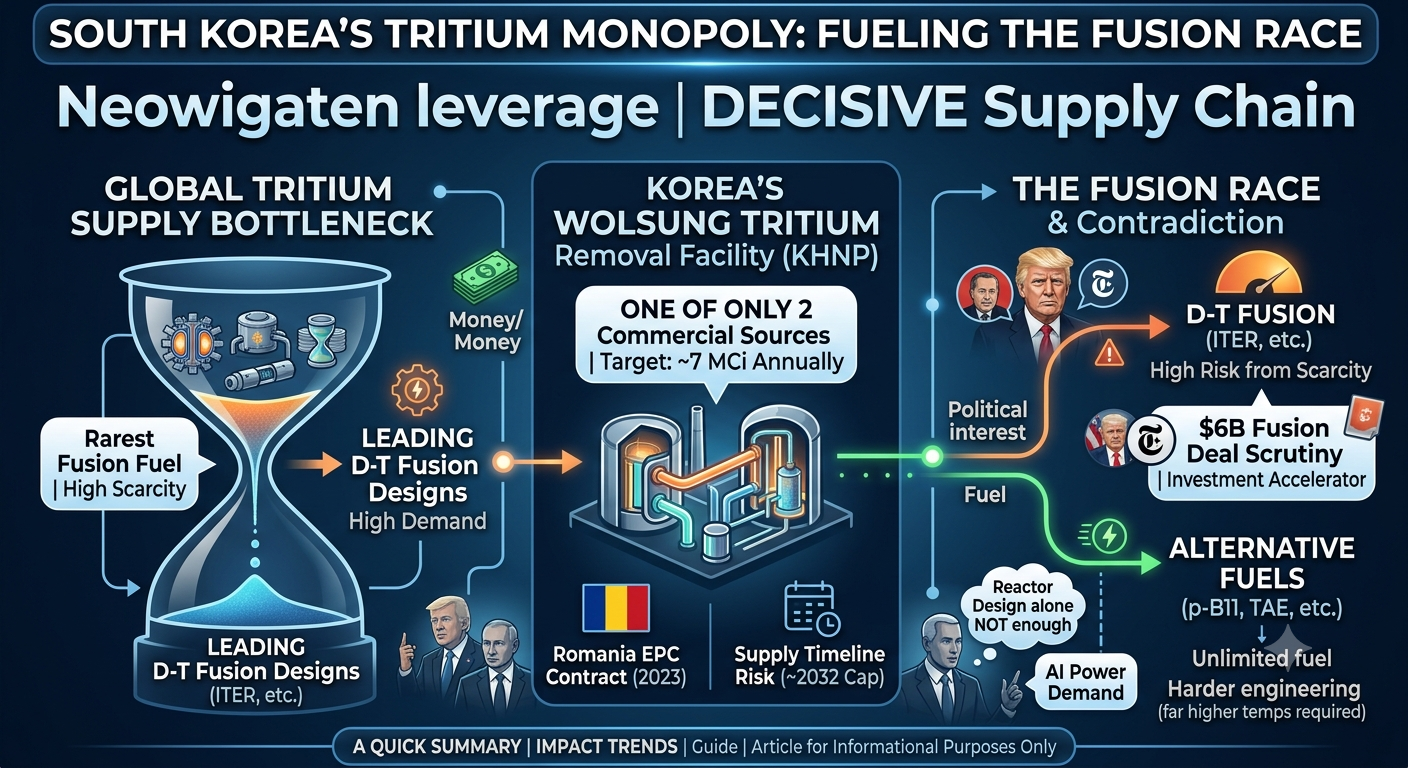 반응형
반응형Why Does This Matter for ITER and Fusion Startups?
ITER, the international fusion megaproject in France, is scheduled to begin deuterium-tritium burning no earlier than 2035, and will draw down a meaningful share of the world's existing tritium inventory just to start up. Independent supply modeling has flagged that once ITER is retired around 2038, the remaining CANDU-sourced tritium may not be sufficient to start a full-scale DEMO-class successor reactor without new supply sources — and that's before accounting for the wave of private fusion companies now racing toward their own pilot plants, each of which will need its own initial tritium inventory.
Do All Fusion Reactor Designs Even Need Tritium?
No — and this is a critical caveat to the scarcity story. The deuterium-tritium (D-T) reaction is the easiest to ignite and is the basis for ITER and most leading fusion companies' near-term designs, which is why tritium supply is treated as a binding constraint industry-wide. But alternative fuel cycles exist: TAE Technologies, for instance, is pursuing a boron-hydrogen (proton-boron, or "p-B11") reaction that requires no tritium at all, using fuel sources that are effectively unlimited. The tradeoff is that p-B11 fusion requires far higher plasma temperatures to ignite than D-T, making it a harder engineering problem even as it sidesteps the fuel scarcity issue entirely.
Why Is Fusion Suddenly Attracting This Much Political and Capital Attention?
The scale of capital now entering fusion illustrates how quickly the industry has shifted from pure research to commercial race. In December 2025, Trump Media & Technology Group announced a roughly $6 billion all-stock merger with TAE Technologies — the p-B11 developer described above — aiming to create one of the first publicly traded fusion companies and eventually site a 50-megawatt utility-scale plant. The New York Times and other outlets reported the deal drew scrutiny from ethics specialists, given that President Trump would hold a significant financial stake in a company operating in a sector subject to federal regulation and dependent on potential government support, while his administration simultaneously sets nuclear and energy policy. The White House rejected the conflict-of-interest characterization. Separate from the ethics debate, the deal itself signals that fusion, and the AI-driven electricity demand behind it, has moved from a speculative research bet to a mainstream capital markets story.
What Does This Mean for Korea's Position Going Forward?
⚠️ A Time-Limited Window
Korea's tritium leverage is real but has a clock attached to it. With the Wolsung CANDU fleet's tritium production capped around 2032, Korea's negotiating position in any future supply agreements — like the Romania deal — is strongest now, while D-T fusion remains the dominant approach and before alternative fuel cycles or new extraction sources scale up. Whether Korea signs additional long-term supply agreements before that window narrows is worth watching as a leading indicator of how seriously the country intends to monetize this position.
Frequently Asked Questions
Q1. Is tritium radioactive, and is that a safety concern for Korea's exports?
A. Yes, tritium is radioactive with a 12.35-year half-life, and its handling, storage, and transport are governed by nuclear materials regulations in both exporting and importing countries — a factor that shapes how these supply agreements are structured, though it hasn't prevented the Korea-Romania deal from proceeding.
Q2. Could North Korea's reactors also produce tritium relevant to this market?
A. North Korea's known reactor is a graphite-moderated design associated with weapons material production, not a commercial CANDU-style facility, and academic estimates of its tritium output (roughly 7-12 grams annually) are discussed in the context of weapons applications rather than civilian fusion fuel supply — an entirely separate track from the commercial market described here.
Q3. Are there Korean-listed companies with direct exposure to this tritium supply chain?
A. Korea Hydro & Nuclear Power, which operates Wolsung and the tritium extraction facility, is a subsidiary of Korea Electric Power Corporation (KEPCO), meaning KEPCO carries indirect exposure to this business line alongside its broader utility operations.
반응형'Global Markets > Supply Chain & Geopolitics' 카테고리의 다른 글
Korean Stock & Equity Research
Data-driven analysis of Korean listed companies, combining financial fundamentals with supply chain and operations insights. Not investment advice.