-
Global Markets/Supply Chain & Geopolitics
Nepal's Floods Just Wiped Out a $647M Korean Infrastructure Bet
2026. 8. 30.
Table
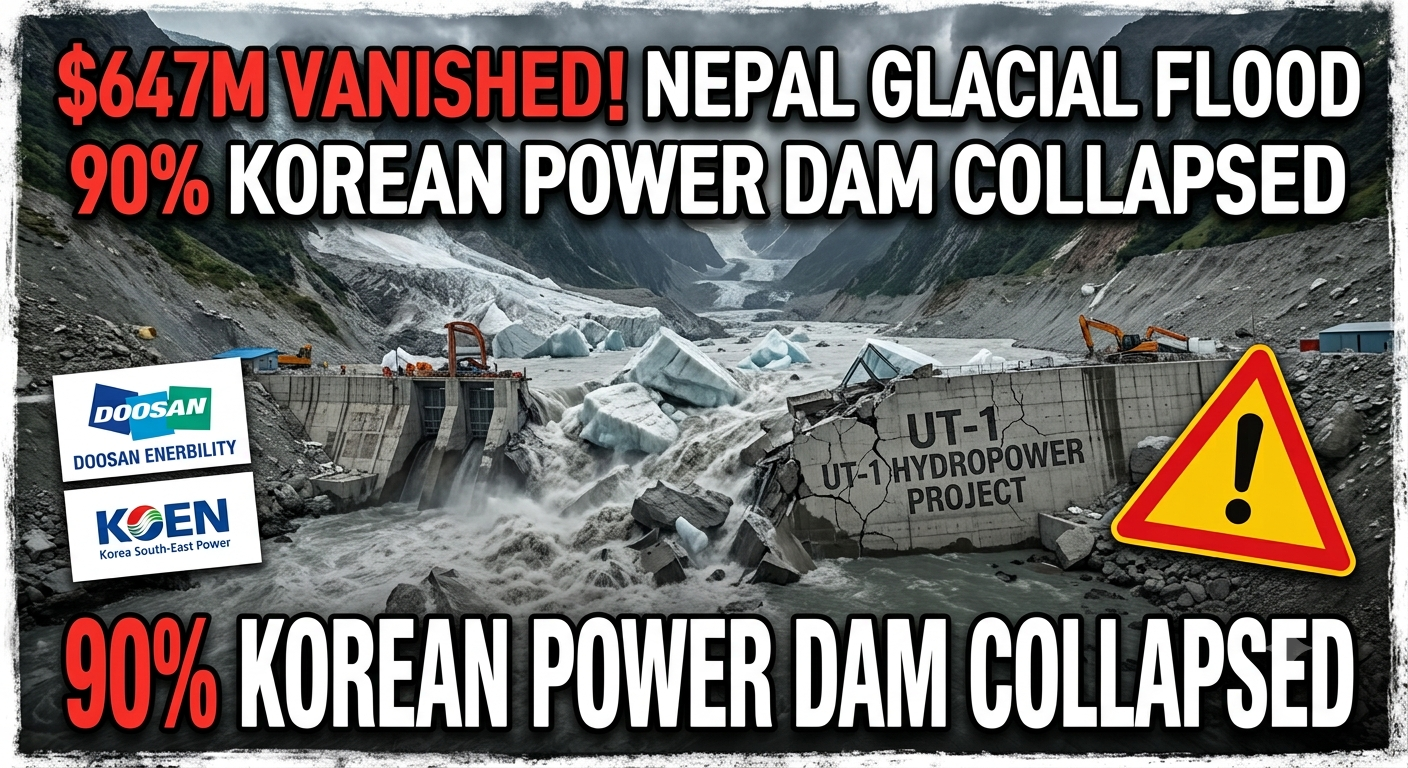
반응형A catastrophic flash flood in Nepal's Rasuwa district on August 26, 2026 destroyed more than 90% of the upper dam at the Upper Trishuli-1 hydropower project — a $647 million facility that was 84% complete and represents the largest foreign direct investment in Nepal's history — jointly led by Korea South-East Power and Doosan Enerbility. The disaster illustrates a risk category Korean overseas infrastructure investors rarely price explicitly: glacial flood exposure in high-altitude project sites.
What Happened to the Upper Trishuli-1 Project?
The 216-megawatt facility, under construction on the Trishuli River roughly 70 kilometers north of Kathmandu, was nearing completion when a glacial dam collapse upstream sent a debris-laden flood surge down the valley. More than 90% of the upper dam structure and roughly 90% of the workers' base camp were destroyed. Korea South-East Power holds the 30-year operating concession, under which it had contracted to sell 1,456 gigawatt-hours of electricity annually to Nepal's national utility; Doosan Enerbility was responsible for construction and turbine equipment supply.
How Did the Flood Actually Form?
Unlike a typical monsoon flood, this event originated from a glacial mass collapse upstream in Tibet, registering as a magnitude 5.2 seismic event. The falling ice, rock, and debris blocked the Lhende Khola river, forming a temporary natural dam. As river flow continued accumulating behind this debris blockage, the dam eventually gave way, releasing a sudden surge of water, rock, and mud downstream — mechanically similar to a Glacial Lake Outburst Flood (GLOF), though Nepali disaster authorities have described it more cautiously as a "glacier-inclusive flood" since it wasn't a pre-existing glacial lake that failed, but a lake formed suddenly by the collapse itself.
 반응형
반응형Why Wasn't This Risk Flagged in Advance?
⚠️ This Wasn't a Monitored Lake
Nepal tracks roughly 21 glacial lakes it considers potentially dangerous, and has previously conducted preemptive water-lowering operations on high-risk lakes like Imja and Tsho Rolpa. The lake that triggered this flood wasn't on that monitored list — it didn't exist as a standing lake before the glacial collapse created it. This points to a structural blind spot in glacial flood risk assessment for infrastructure sited in Himalayan river valleys: the danger isn't limited to known, monitored lakes.
Is This the Project's First Disaster Setback?
No. Development on Upper Trishuli-1 began in 2011 under joint leadership from Korea South-East Power and the International Finance Corporation, and the project was previously delayed in 2015 after a major earthquake damaged access routes to the site. This is now the second major natural disaster to disrupt the project's roughly 15-year development timeline — a pattern relevant to how investors should weigh delivery-timeline risk on any large-scale Himalayan infrastructure project, not just this one.
How Are Doosan Enerbility and Korea South-East Power Responding?
Company Response Doosan Enerbility Dispatched a field response team led by its Vice Chairman; pledged $5 million in humanitarian aid; activated a 24-hour emergency response headquarters Korea South-East Power Dispatched headquarters staff to establish a local rescue camp; coordinating with Nepali authorities on the missing-worker search South Korean government Dispatched a response team and approximately $1 million in humanitarian assistance to Nepal As of this writing, search and rescue operations remain active at the site, with the situation still developing. Readers seeking the latest confirmed casualty figures should consult official Nepali government and company disclosures directly, given how quickly initial estimates have changed since the disaster began.
What Should Investors in Doosan Enerbility Watch For?
- Insurance and cost recovery structure: whether builder's risk or political risk insurance covers reconstruction costs, and how much falls to Doosan Enerbility and Korea South-East Power directly versus insurers
- Revised completion timeline: given the project was 84% complete, the extent of damage to already-built infrastructure (versus equipment or camp facilities) will determine whether this is a multi-month or multi-year delay
- Wider regional damage: the same flood damaged six other Nepali hydropower and transmission facilities unrelated to this project, removing an estimated 431 megawatts from Nepal's grid — a reminder that single-project analysis should be read alongside the broader disruption to Nepal's hydropower sector as a whole
Frequently Asked Questions
Q1. Is Upper Trishuli-1 a joint venture, or fully Korean-owned?
A. It was developed jointly by Korea South-East Power and the International Finance Corporation beginning in 2011, with Korea South-East Power holding the long-term operating concession and Doosan Enerbility serving as the construction and equipment contractor.
Q2. How large is this project relative to Nepal's overall power grid?
A. At 216 megawatts, it represents a meaningful share of Nepal's hydropower capacity, and its planned 1,456 GWh in annual power sales made it a significant single contributor to national electricity supply once operational.
Q3. Does this disaster affect other Korean overseas infrastructure projects?
A. Not directly, but it raises a broader due-diligence question for Korean firms with infrastructure exposure in Himalayan or other glacially-fed river regions, where flood risk may extend beyond officially monitored glacial lakes.
반응형'Global Markets > Supply Chain & Geopolitics' 카테고리의 다른 글
Korean Stock & Equity Research
Data-driven analysis of Korean listed companies, combining financial fundamentals with supply chain and operations insights. Not investment advice.