-
Korean Equities/Dividend & Value-up
Understanding Korean Preferred Shares: Higher Yield, Lower Voting Power
2026. 8. 27.
Table
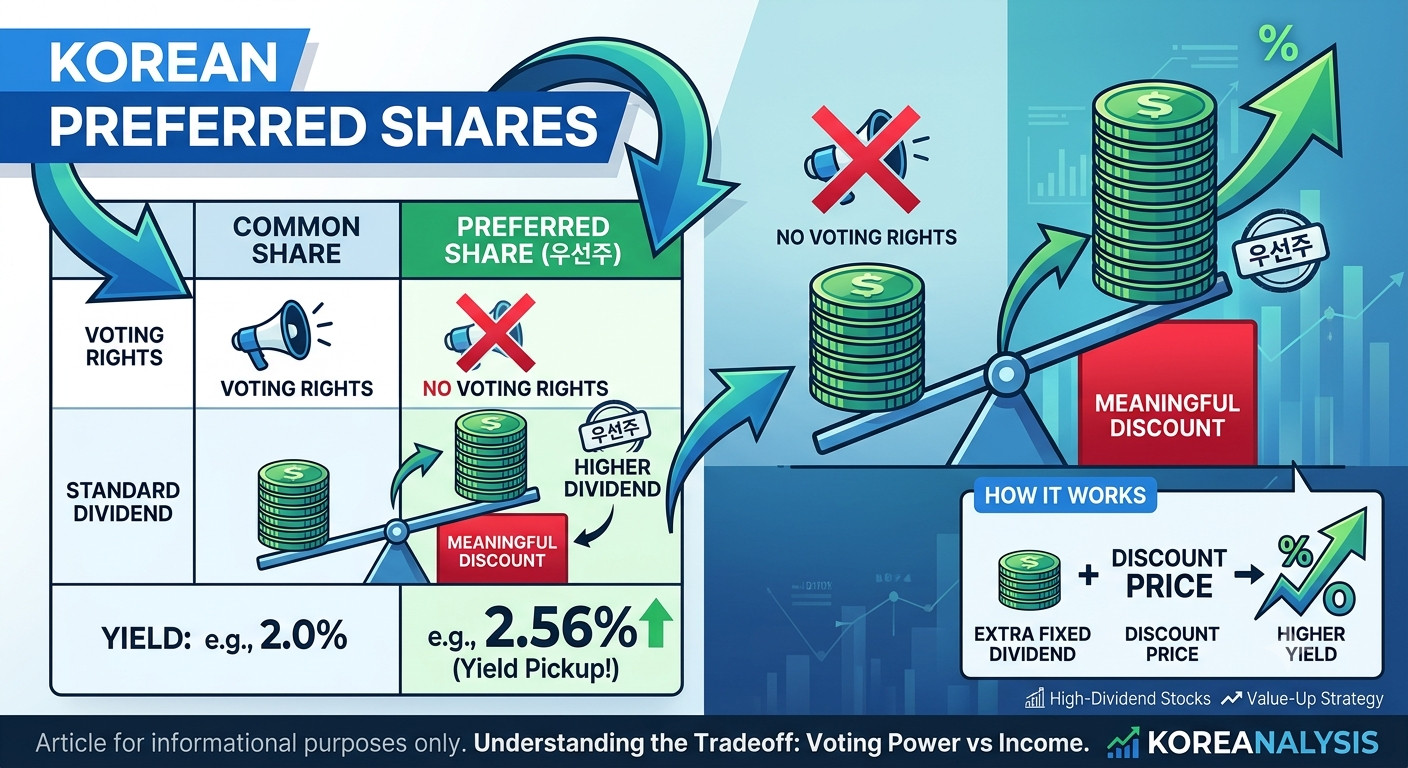
반응형Korean preferred shares (우선주) typically carry no voting rights but receive a small fixed additional dividend over common shares — usually just tens to a few hundred Won per share annually — and because they usually trade at a meaningful discount to the common share price, that fixed extra dividend translates into a noticeably higher percentage yield. This article is part of our Top High-Dividend Korean Stocks & Corporate Value-Up Strategy guide.
Why Do Korean Preferred Shares Trade at a Discount?
Korean preferred shares typically trade below their corresponding common share price, largely because they lack voting rights and tend to have lower trading volume and liquidity. This combination — a small fixed dividend premium over a discounted base price — is precisely why headline yields on preferred shares often look meaningfully higher than the common share's yield, even though the absolute Won amount received per share is only modestly larger.
How Does This Work in Practice?
✅ A Simplified Example
- Common share trades at 100,000 Won, pays a 2,000 Won dividend → 2.0% yield
- Preferred share (no voting rights) trades at 80,000 Won, pays 2,050 Won (50 Won extra fixed premium) → 2.56% yield
- The preferred share's higher yield here comes almost entirely from its lower price, not a dramatically larger dividend
This structural pattern is why headline preferred share yields, like NH Investment & Securities' preferred shares approaching a 9% yield covered in our securities firms guide, should be read alongside the underlying discount to common shares — not treated as a "free" extra return with no tradeoff.
Who Actually Buys Korean Preferred Shares?
Preferred shares tend to appeal specifically to income-focused investors who have no interest in voting rights (foreign portfolio investors fit this profile almost by definition, since most don't seek to influence Korean corporate governance directly) and who are comfortable accepting lower liquidity in exchange for yield pickup.
 반응형
반응형Frequently Asked Questions
Q1. Do Korean preferred shares ever convert to common shares?
A. Some do, depending on the specific terms set at issuance, but many Korean preferred shares are structured as permanent, non-convertible instruments; terms should be checked per issuance.
Q2. Is Samsung Electronics' preferred share (005935) different from its common share?
A. Yes — Samsung's preferred share follows the same general pattern: no voting rights, a small additional fixed dividend, and typically a discount to the common share price.
Q3. Are foreign ownership rules different for preferred vs. common shares?
A. Generally the same account access and foreign ownership framework applies to both share classes, though liquidity constraints on preferred shares can make execution more difficult for larger orders.
반응형'Korean Equities > Dividend & Value-up' 카테고리의 다른 글
Korean Stock & Equity Research
Data-driven analysis of Korean listed companies, combining financial fundamentals with supply chain and operations insights. Not investment advice.