-
Korean Equities/Dividend & Value-up
POSCO Holdings and Korea's Steel Sector Dividends Under Value-Up
2026. 8. 27.
Table
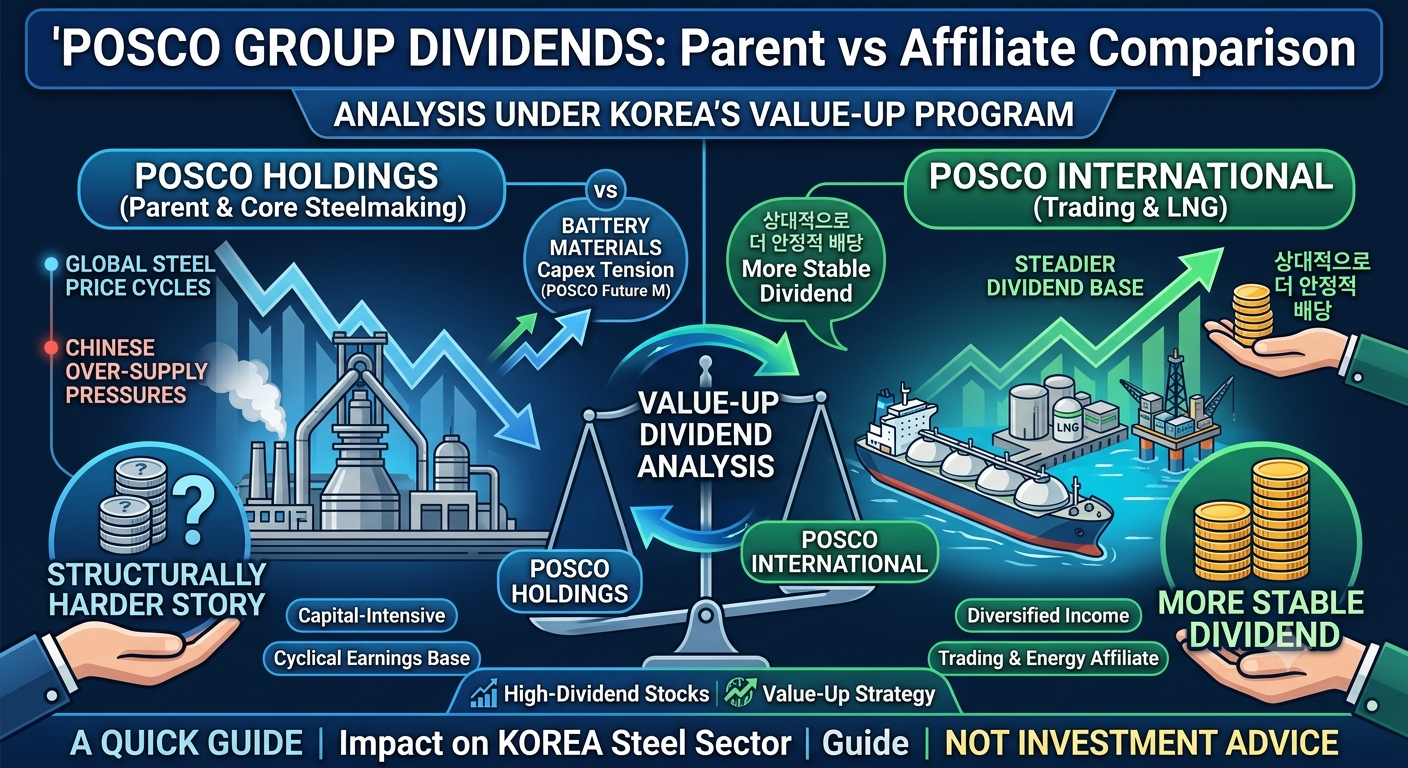
반응형POSCO Holdings, the group's parent company, faces a structurally harder dividend story than POSCO International, its trading and energy affiliate — steelmaking is capital-intensive and cyclical, tying dividend sustainability closely to global steel pricing and Chinese oversupply dynamics, while POSCO International's more diversified trading and LNG business has supported steadier distributions. This article is part of our Top High-Dividend Korean Stocks & Corporate Value-Up Strategy guide.
Why Does Steel Sector Dividend Sustainability Differ From Financials?
Unlike Korea's banking sector, which has benefited from a fee-income tailwind largely independent of global commodity cycles, POSCO Holdings' core steel business is directly exposed to global steel price swings and persistent oversupply from Chinese producers exporting at thin or negative margins. As covered in our POSCO International piece, the group's non-steel affiliates have provided a more stable base for shareholder distributions during periods when the core steel business faces margin pressure.
How Should Investors Think About Cyclical Value-Up Dividend Stocks?
⚠️ Cyclical Dividends Deserve Extra Scrutiny
A high current dividend yield in a cyclical sector can partly reflect a depressed share price rather than a genuinely sustainable payout — the same "high yield, low P/B" pattern noted for Industrial Bank of Korea in our Pillar guide can appear in cyclical industrials too. Before treating a steel or materials company's dividend as reliably durable, check payout ratio trends across a full commodity cycle, not just the most recent year.
Is POSCO's Battery Materials Business a Factor Here?
POSCO Holdings' battery materials subsidiary (POSCO Future M) represents a separate, higher-growth but currently less profitable segment within the group, reflecting broader capital allocation tension common across diversified Korean conglomerates under Value-Up: balancing near-term shareholder returns against long-term growth capital expenditure in newer business lines. Investors evaluating POSCO Holdings' dividend commitments should weigh this capital allocation tradeoff specifically, since capital directed toward battery materials expansion is capital not available for near-term shareholder distributions.
 반응형
반응형Frequently Asked Questions
Q1. Are POSCO Holdings and POSCO International the same stock?
A. No, they are separately listed entities within the same corporate group, with different business mixes and dividend profiles.
Q2. Does Chinese steel oversupply directly affect POSCO's dividend capacity?
A. Indirectly yes — sustained low-margin Chinese steel exports pressure global steel pricing, which affects POSCO's core earnings and, by extension, the earnings base available for shareholder distributions.
Q3. Is POSCO Future M a Value-Up dividend candidate?
A. Not currently a typical fit — as a higher-growth battery materials business still scaling capacity, it more closely resembles a growth investment than a dividend-focused holding at this stage.
반응형'Korean Equities > Dividend & Value-up' 카테고리의 다른 글
Korean Stock & Equity Research
Data-driven analysis of Korean listed companies, combining financial fundamentals with supply chain and operations insights. Not investment advice.