-
Korean Equities/Dividend & Value-up
Korea's Commercial Act Reform: Why Directors Now Owe a Duty to All Shareholders
2026. 8. 27.
Table
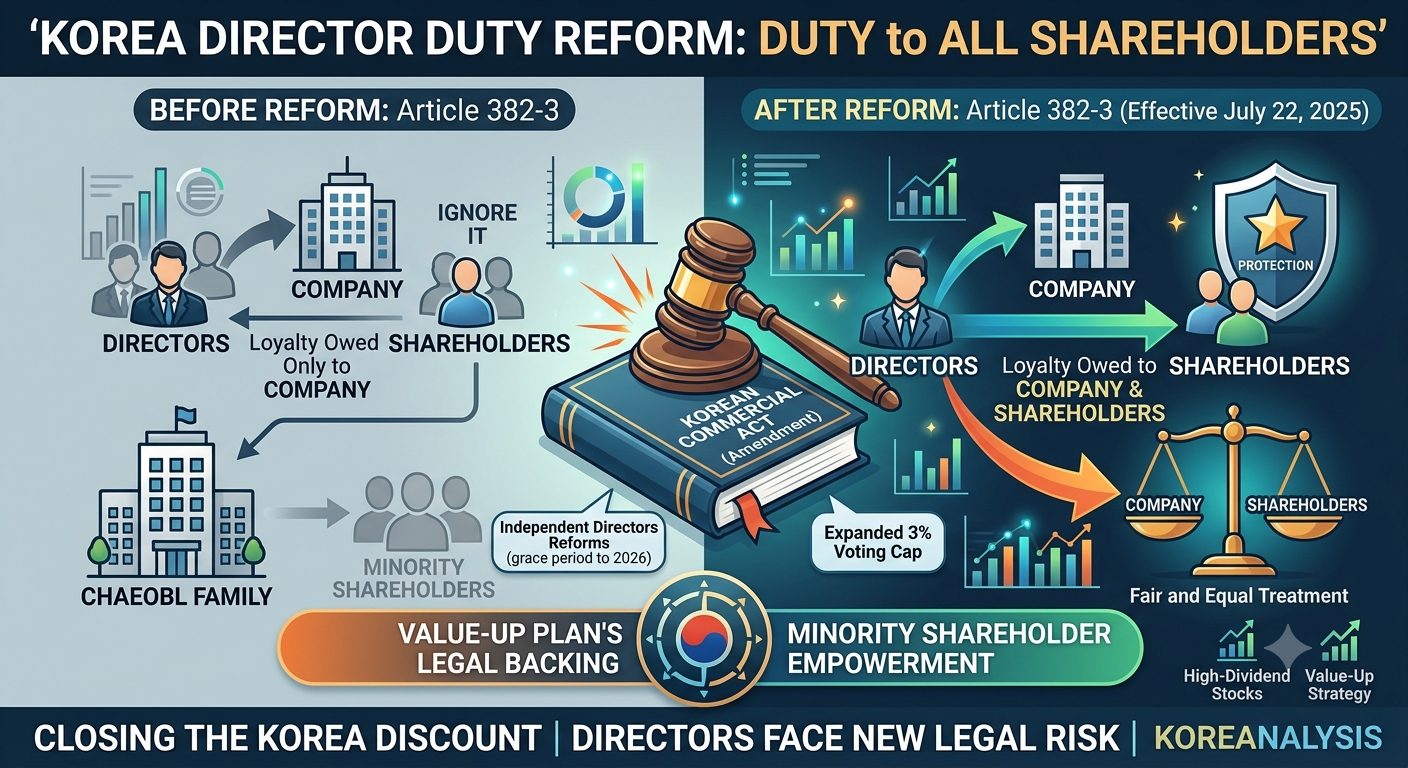
반응형Since July 22, 2025, Korean directors have owed a fiduciary duty directly to shareholders, not just to the company itself — a change to Article 382-3 of the Korean Commercial Code that gives the Value-Up Program's shareholder-protection goals actual legal backing for the first time. The amendment passed the National Assembly on July 3, 2025, following an earlier presidential veto in April, and was proclaimed into law weeks later.
What Exactly Changed Under Article 382-3?
Previously, Korean directors' duty of loyalty was owed only to "the company" as an abstract legal entity — a framing that, in practice, often aligned with the interests of controlling chaebol families rather than minority shareholders, since founding families frequently exercise effective control while holding relatively small direct ownership stakes. The amendment expands this duty to explicitly include "the company and its shareholders," requiring directors to protect shareholders' interests in general and treat all shareholders fairly and equally when making business decisions.
What Other Reforms Came in the Same Package?
Reform Effective Date Director fiduciary duty to shareholders (Art. 382-3) July 22, 2025 "Outside director" renamed "independent director," minimum board share raised to one-third July 22, 2026 (grace period for laggards) Expanded 3% controlling-shareholder voting cap (Art. 542-12) Applies to all audit committee member elections, including independent directors Mandatory virtual general shareholder meetings for listed companies Part of the same legislative package Does This Actually Solve the Korea Discount?
⚠️ Legal Scholars and Practitioners Flag Real Limits
Analysis from legal commentators has noted the reform doesn't address mandatory disclosure of related-party transactions between companies and controlling families — a mechanism through which profits can be diverted or losses hidden. Critics argue the amendment leaves Korea's core structural issues (opaque cross-shareholdings, concentrated chaebol control) largely intact, even as it strengthens the legal tools available to minority shareholders going forward. Academic commentary has also debated whether expanding fiduciary duty toward shareholders, framed narrowly, risks entrenching shareholder primacy at a time when global governance trends are moving toward broader stakeholder consideration.
Why Does This Matter for Value-Up Investors Specifically?
Before this reform, the Value-Up Program's shareholder-return commitments were voluntary corporate policy with no direct legal enforcement mechanism tied to director conduct. With Article 382-3 now in force, a director who clearly disregards shareholder interests in a major capital allocation decision — for instance, structuring a merger to benefit a controlling family at minority shareholders' expense — faces a legal duty that didn't explicitly exist before, adding a layer of enforceability behind the Value-Up Program's broader push for shareholder-friendly capital allocation.
 반응형
반응형Frequently Asked Questions
Q1. Does this reform give minority shareholders a direct right to sue directors?
A. The amendment strengthens the legal basis for such claims by explicitly naming shareholders as duty-holders, though enforcement in practice will depend on how Korean courts interpret and apply the new provision over time, since case-law precedent is still developing.
Q2. Is the independent director requirement already in effect?
A. No, the one-third independent director requirement takes effect July 22, 2026, with an additional grace period for companies not yet in compliance.
Q3. Was this reform tied to a specific political administration?
A. Yes, it was a prominent campaign pledge of President Lee Jae-myung, passed shortly after his June 2025 inauguration, though the underlying policy goal (closing the Korea Discount) has bipartisan support given its economic rather than purely partisan framing.
반응형'Korean Equities > Dividend & Value-up' 카테고리의 다른 글
Korean Stock & Equity Research
Data-driven analysis of Korean listed companies, combining financial fundamentals with supply chain and operations insights. Not investment advice.