-
Global Markets/Supply Chain & Geopolitics
Why Is Korea Stalling Its $350 Billion US Investment Deal?
2026. 9. 20.
Table
반응형Korea's $350 billion investment pledge to the US has stalled again, with a September 22, 2026 parliamentary briefing already pushed back once from its original date — and the delay is deliberate. Seoul is holding out for terms closer to what the European Union negotiated than what Japan already accepted, and a Federal Reserve Bank of St. Louis analysis of Japan's own $550 billion pledge shows exactly why that caution has real economic logic behind it.
반응형What's Actually Holding Up Korea's $350 Billion Deal?
Korea's Ministry of Trade, Industry and Energy was originally scheduled to brief the National Assembly on September 17, 2026, but that session was postponed because, according to reporting, "detailed consultations with Washington remained unfinished." The revised briefing is now set for September 22, with the Finance Committee separately seeking its own closed-door session the same day. Within the broader $350 billion figure, the overall structure is already settled: strategic investment is capped at $200 billion, and annual remittances out of Korea toward that investment are capped at $20 billion. Those caps are not in dispute. What is still being fought over is which specific projects count toward that $200 billion, on what terms, and with what guarantees attached.
Three concrete disputes are doing most of the damage to the timeline. The Encinal combined-cycle gas power plant project in Texas has seen its projected cost rise from roughly $19.8 billion to $22–22.3 billion, with Washington pushing Korea to absorb most of that increase while offering only soft "endeavor to" and "shall, when feasible" language instead of firm guarantees on power purchase arrangements and Korean vendor selection. Korea also wants a genuine equity stake — reportedly in the 15–20% range with board representation — in Westinghouse's nuclear business, while the US has offered only a 5–10% minority stake with no voting power. And Alaska LNG remains the most contentious item of all: Korean officials have stated plainly that "it has not yet been decided whether or not to pursue the Alaska project, and that it could change depending on the negotiation results," citing doubts about the project's commercial viability and Korea Gas Corporation's already-stretched balance sheet, which carries roughly $34 billion in debt.
Isn't Delaying the Deal Just Costing Korea Leverage?
That is the natural assumption — every month without a signed MOU is a month of continued tariff exposure and uncertainty for Korean exporters. Bank of Korea Governor Shin Hyun-song has even been asked directly whether the investment package poses a risk to the won; his answer was that the $20 billion annual cap is unlikely to meaningfully pressure the currency, which suggests officials see the financial risk of the deal itself as manageable.
But the case for patience gets much stronger once you look at what Japan's early signature has actually produced. Japan agreed to its $550 billion investment pledge with one structural feature that sounds minor but matters enormously: the US government, not Japan, gets to select where the investments are made. That single clause is the crux of the entire argument for why Korea is negotiating harder rather than simply following Japan's template.
Deal Structure Who Directs the Money Japan ($550B, already signed) Fixed government-to-government pledge US government selects projects EU (~$600B, softer terms) Private-company investment expectation EU companies choose, heavily conditional language Korea ($350B, still negotiating) $200B strategic cap / $20B annual cap Still being fought over, project by project 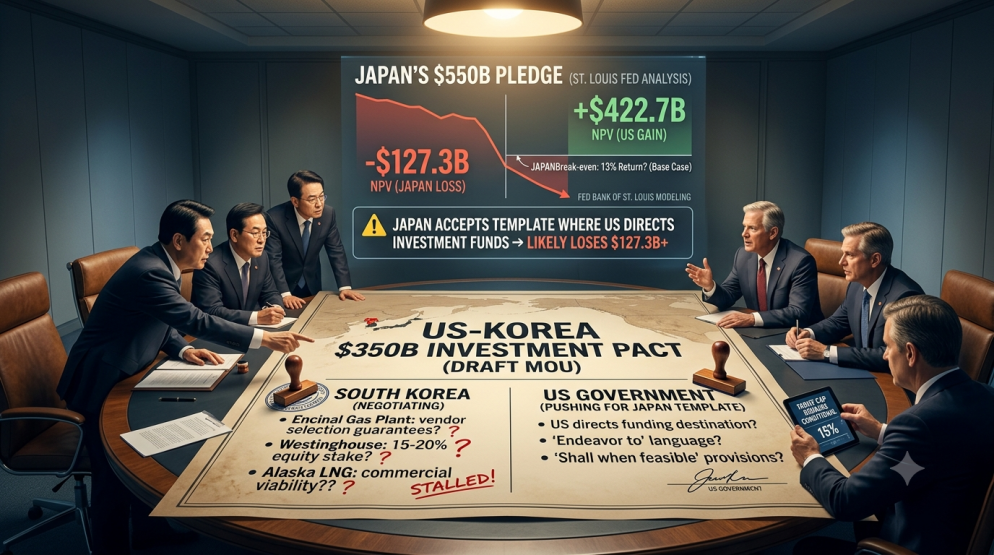
What Does the Math on Japan's $550 Billion Pledge Actually Show?
This is the part of the story that turns an abstract negotiating position into a hard numbers argument, and it comes from an unusually rigorous source: the Federal Reserve Bank of St. Louis published its own modeling of Japan's pledge, and the results are not flattering. Under the base-case scenario, the analysis finds Japan loses a net present value of roughly $127.3 billion on the deal, while the US gains roughly $422.7 billion. Under a more pessimistic "zero interest" scenario, Japan's loss widens to roughly $191.3 billion, with the US gain rising to roughly $486.8 billion. The analysis further estimates Japan would need to earn returns of about 13% per year on these investments just to break even — a difficult bar to clear on US-government-directed infrastructure and manufacturing projects that are not primarily chosen for their return profile.
⚠️ Don't assume a bigger, faster deal is automatically the better one
Signing early looks like progress, but the St. Louis Fed's own modeling shows Japan losing money on its $550 billion pledge under even relatively favorable assumptions, purely because the US — not Japan — controls where the funds actually go. A slower negotiation that preserves more control over fund allocation, as Korea appears to be attempting, is not necessarily the worse outcome. That said, delay carries its own costs, including continued tariff exposure and diplomatic friction, so this is a genuine trade-off rather than a one-sided argument.
Signing early didn't make Japan's $550 billion pledge profitable — the Federal Reserve Bank of St. Louis's own modeling shows Japan losing money on the deal under even relatively favorable assumptions, purely because the US, not Japan, controls where the money goes.
Is the EU's Deal Really That Much Softer Than Japan's?
Yes, structurally — and this is where Korea's negotiating strategy becomes clearer. Where Japan's $550 billion is a fixed government-directed pledge with Washington choosing the destination of the funds, the EU's roughly $600 billion figure is framed as an expectation that private European companies, not the EU government, will invest in US strategic sectors through 2028. The EU's language throughout is markedly softer: companies are "expected to invest," the EU "intends to" and "commits to working toward" various provisions, and several elements — tariff reductions contingent on EU legislation, aluminum provisions requiring separate "ringfencing" agreements — are explicitly conditional rather than locked in.
Korea is not in a position to simply copy the EU's deal wholesale; Korean exporters, autos above all, are watching the 15% auto tariff rate that both Japan and the EU secured as the new de facto benchmark they will need to match regardless. But on the investment-fund structure specifically, Korea's negotiators appear to be trying to import the EU's flexibility — softer language, more contingencies, less US discretion over fund allocation — onto a deal that otherwise resembles Japan's in scale. That hybrid approach is a reasonable explanation for why this negotiation is taking longer than Japan's did.
✅ What to watch before the deal is finalized
- The September 22 parliamentary briefing, where the Ministry of Trade, Industry and Energy is expected to lay out investment sizes and timelines for the Encinal plant, the nuclear reactor projects, and Alaska LNG specifically.
- Whether Korea's Westinghouse stake lands closer to its 15–20% ask or the US's 5–10% offer — a real signal of how much leverage Korea has left. Note that Westinghouse's valuation has been reported at both roughly $15–20 billion and, in more recent and directly-sourced reporting, at a $30 billion threshold that triggers the US government's own IPO-demand right — the higher figure appears to be the more current one.
- Whether Korea ultimately commits to Alaska LNG at all, given Korea Gas Corporation's roughly $34 billion debt load and still-unresolved questions about the project's commercial viability.
What Should Investors Watch Next?
The most immediate checkpoint is the September 22 parliamentary briefing itself. Beyond that, the Westinghouse equity negotiation and the final call on Alaska LNG are likely to be read by markets as the clearest signals of how much real leverage Korea managed to preserve. It's also worth staying cautious about any single reported figure in this negotiation — some details circulating about exact remittance timing and dollar amounts for specific tranches have not been consistently corroborated across independent reporting as of this writing, and should be treated as provisional until confirmed in the signed text. Related to this, Koreanalysis has also been tracking the broader US Treasury-market and Fed-policy backdrop shaping how the won is trading through this period, which is worth keeping in view alongside the MOU talks themselves.
Frequently Asked Questions
Q1. Why hasn't Korea signed its $350 billion investment deal with the US yet?
A. Korea is negotiating harder than Japan did on specific terms — particularly cost-sharing on the Encinal gas plant, the size and voting rights of its Westinghouse equity stake, and whether to commit to the Alaska LNG project at all — rather than accepting a Japan-style structure where the US government selects where the investment funds are spent.
Q2. Did Japan lose money on its $550 billion investment pledge to the US?
A. According to a Federal Reserve Bank of St. Louis analysis, Japan's pledge produces a negative net present value for Japan under both a base-case scenario (roughly -$127.3 billion) and a more pessimistic zero-interest scenario (roughly -$191.3 billion), while the US gains substantially in both cases. Japan would need annual returns near 13% to break even.
Q3. How is the EU's US trade and investment deal different from Japan's?
A. Japan's deal is a fixed, government-directed $550 billion pledge with Washington choosing where the money goes. The EU's roughly $600 billion figure is framed as an expectation that private European companies will invest, using much softer, more conditional language with multiple built-in renegotiation points, making it a less binding, more flexible template.
Signing early didn't make Japan's $550 billion pledge profitable — the Federal Reserve Bank of St. Louis's own modeling shows Japan losing money on the deal under even relatively favorable assumptions, purely because the US, not Japan, controls where the money goes.
반응형'Global Markets > Supply Chain & Geopolitics' 카테고리의 다른 글
Korean Stock & Equity Research
Data-driven analysis of Korean listed companies, combining financial fundamentals with supply chain and operations insights. Not investment advice.