-
Macro & Policy/Currency & Rates
Yen Carry Trade Unwind Risk Is Rising Again — Korea Should Watch
2026. 9. 25.
Table
반응형The Bank of Japan raised its policy rate to 1.0% at its September 17-18, 2026 meeting, narrowing the US-Japan interest rate gap that has funded the yen carry trade for years — and Korea's own markets have already shown, in August 2024, how violently that kind of narrowing can spill over even when Korea's direct exposure to Japanese capital is small. The trade itself isn't dead: with the Federal Reserve's target range still at 3.50-3.75% against Japan's 1.0%, a meaningful funding advantage remains. But the direction of travel matters more than the absolute level, and that direction is now pointed toward less carry, not more.
반응형What Is the Yen Carry Trade, and Why Does It Keep Coming Back Up?
The mechanics are simple even when the consequences aren't: investors borrow yen at Japan's near-zero-to-low interest rates, convert the proceeds to dollars or other higher-yielding currencies, and invest in assets — US Treasuries, emerging-market debt, equities — that pay a higher return than the cost of the yen loan. As long as the yen stays roughly stable or weakens further, the investor pockets the rate differential as pure profit. This dynamic has been in place in some form since the 1990s, most famously associated with Japanese retail investors nicknamed "Mrs. Watanabe," though institutional and hedge-fund carry trades dwarf the household version in scale.
The trade has unwound violently twice in recent memory in ways that rippled far beyond Japan. In 1998, amid the Asian financial crisis and Russia's debt moratorium, panicked deleveraging sent the yen up 13% against the dollar in just three days and helped sink Long-Term Capital Management, a hedge fund that had been running over $140 billion against a capital base of roughly $4.7 billion. In August 2024, a smaller but still sharp version played out: the Bank of Japan's rate hike that month, combined with a weak US jobs report, triggered a rapid unwind that hit global equity markets — including, notably, Korea's.
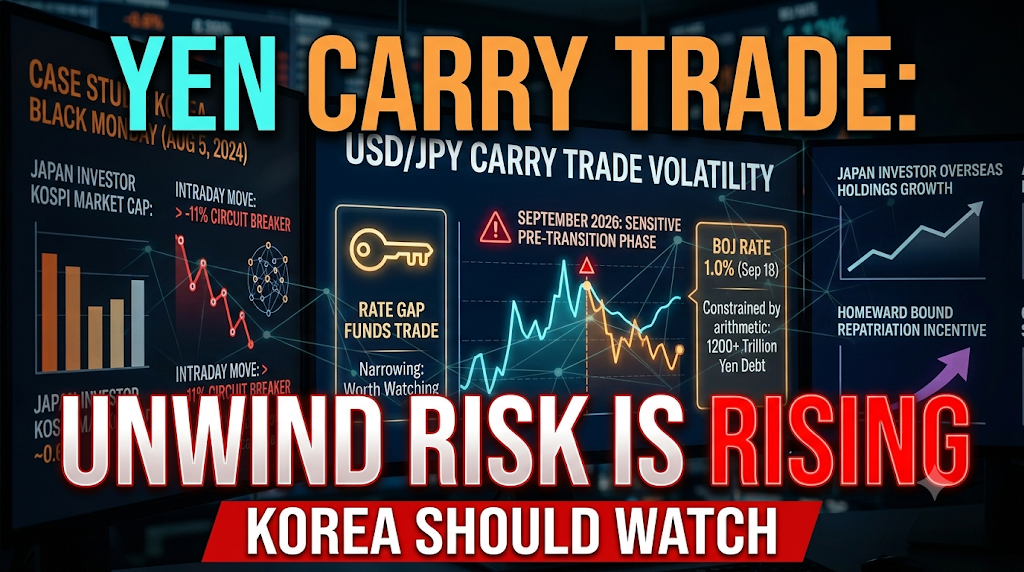
How Badly Did Korea Get Hit in the Last Unwind?
On August 5, 2024 — since nicknamed Korea's own "Black Monday" — the KOSPI suffered a midday crash of more than 11%, triggering a 20-minute circuit breaker. The index recovered sharply the next day, closing up 3.3% at 2,522.15, and a five-minute "sidecar" trading halt was triggered on the way back up when KOSPI 200 futures gained more than 5% in a single minute.
What makes this episode a useful case study rather than just a scary headline is what Korean regulators said about it afterward. The Financial Supervisory Service's governor noted at the time that Japanese investment accounted for only about 0.6% of KOSPI's total market capitalization and just 0.03% of Korea's bond market — meaning Korea's direct financial exposure to unwinding Japanese carry positions was genuinely small. The 11% intraday move happened anyway, driven by global risk-off momentum and automated selling rather than any large direct Japan-to-Korea capital flow. That's arguably the more important lesson for Korean investors: you don't need heavy direct exposure to get hit hard when a carry unwind triggers a broader deleveraging cascade.
⚠️ A narrowing rate gap doesn't mean an imminent crash
It's tempting to read every BOJ hike as a countdown to the next carry unwind, but the 2024 episode and the quieter years since show that the relationship isn't mechanical. The rate differential has narrowed gradually over the past year without triggering a repeat of August 2024's volatility, and analysts covering the trade in 2026 generally describe the current environment as a "sensitive pre-transition phase" — elevated risk accumulating gradually — rather than an imminent trigger. The BOJ has also historically preferred small, telegraphed moves specifically to avoid shocking carry positions into a disorderly unwind, which cuts against the idea that any single hike forces a crisis.
The Rate Gap That Funds the Trade
Period US Rate BOJ Rate 1996 (pre-1998 unwind) 5.25% 0.25% Early 2024 (pre-hike) 5.25-5.50% -0.10% September 2026 (current) 3.50-3.75% 1.0% What's Actually Constraining the Bank of Japan Here?
The BOJ's caution isn't just about market psychology — it's balance-sheet arithmetic. Japan carries government debt well above 1,200 trillion yen, and its own budget arithmetic is tight enough that a sharp rise in borrowing costs would be genuinely difficult to absorb: a meaningful share of Japan's annual tax revenue already goes toward servicing existing government debt. That's the structural reason the BOJ has moved in small, telegraphed steps — from negative rates in early 2024, to 1.0% by September 2026 — rather than in the kind of larger moves that would more decisively close the gap with US rates but risk destabilizing both Japan's own bond market and the carry trades funded by cheap yen.
Japanese investors' overseas holdings have grown substantially over the low-rate decade, and IMF analysis has flagged that if Japanese long-term yields rise enough, some of that capital has an incentive to come home — pulling yen-funded positions out of assets in the US, Europe, Australia, and emerging markets like Korea in the process. That's the mechanism to watch, more than any single BOJ meeting in isolation.
✅ What to watch from here
- Further BOJ policy moves — another hike this cycle would narrow the US-Japan gap further and is worth watching for its effect on USD/JPY and, by extension, risk sentiment in Korean markets.
- Yen volatility itself, not just the rate gap — carry trades depend as much on currency stability as on the rate differential, and a spike in FX volatility can trigger unwinds even without a rate change.
- Korean regulators' own commentary on foreign capital flows, given the Financial Supervisory Service's track record of publishing exposure data quickly after the August 2024 episode.
Korea doesn't need large direct exposure to Japanese capital to feel a yen carry unwind — August 2024 showed a KOSPI move of over 11% in a single session despite Japanese investors holding well under 1% of Korea's market.
What Should Investors Watch Next?
This story sits alongside Koreanalysis's broader coverage of how US Federal Reserve policy transmits into Korean markets through channels like National Pension Service FX hedging — the yen carry trade is a related but distinct transmission mechanism, running through global risk sentiment and cross-border leverage rather than direct Korea-US flows. Both are worth tracking together as the Fed, the BOJ, and the Bank of Korea each move through their own rate cycles over the coming months.
Frequently Asked Questions
Q1. What is the yen carry trade?
A. It's a strategy where investors borrow yen at Japan's low interest rates, convert it to another currency, and invest in higher-yielding assets abroad, profiting from the interest rate gap as long as the yen doesn't strengthen sharply. When the yen does strengthen, or the rate gap narrows, investors rush to close these positions, which is called an "unwind."
Q2. Did the yen carry trade unwind affect Korea before?
A. Yes. On August 5, 2024, the KOSPI fell more than 11% intraday amid a global carry-trade-driven selloff, triggering a circuit breaker, before recovering 3.3% the next day. Korean regulators noted Japanese investors held only about 0.6% of KOSPI's market cap at the time, showing the selloff was driven by broader risk sentiment rather than direct Japanese capital withdrawal from Korea.
Q3. Is another yen carry trade unwind likely in 2026?
A. The Bank of Japan raised its policy rate to 1.0% in September 2026, narrowing the gap with the US Federal Reserve's 3.50-3.75% range, which reduces the carry trade's attractiveness at the margin. Analysts generally describe conditions as gradually more sensitive rather than pointing to an imminent, specific trigger, and the BOJ has historically moved in small, telegraphed steps to avoid shocking positions into a disorderly unwind.
Korea doesn't need large direct exposure to Japanese capital to feel a yen carry unwind — August 2024 showed a KOSPI move of over 11% in a single session despite Japanese investors holding well under 1% of Korea's market.
반응형'Macro & Policy > Currency & Rates' 카테고리의 다른 글
Why Brazil's Election Runoff Matters for Korean Investors (0) 2026.10.11 Korea and the Fed Are Both Hiking Rates — So Why Did the Won Fall? (0) 2026.09.17 US Treasury Yields Hit 4.9% — Why It Moves the Korean Won (0) 2026.09.13 The 1997 Asian Financial Crisis: How a Currency Peg Became a Target (0) 2026.08.26 How to Convert USD to KRW for Korean Stock Investing (0) 2026.08.20
Korean Stock & Equity Research
Data-driven analysis of Korean listed companies, combining financial fundamentals with supply chain and operations insights. Not investment advice.