-
Macro & Policy/Currency & Rates
US Treasury Yields Hit 4.9% — Why It Moves the Korean Won
2026. 9. 13.
Table
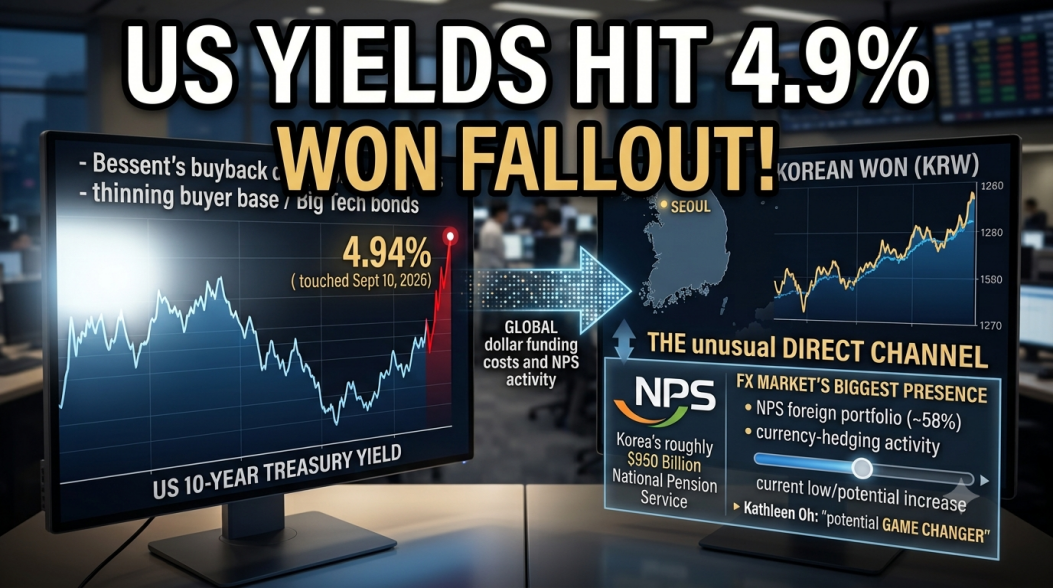
반응형The US 10-year Treasury yield touched 4.94% on September 10, 2026 — its highest level since October 2023 — after Treasury Secretary Scott Bessent's expanded bond buyback operation fell short of what markets had priced in, while oil pushed back above $100 a barrel on the widening Iran conflict. The connection to Korea runs through an unusual but direct channel: Korea's roughly $950 billion National Pension Service (NPS), which Korea's own finance minister has called the single biggest presence in the won's foreign-exchange market.
반응형Why Are US Long-Term Yields Spiking Now?
The US Treasury market has grown from roughly $4.5 trillion in 2007 to about $31 trillion today, and the buyer base that used to absorb it has been thinning. Traditional large foreign holders like Japan have pulled back — Japanese investors were net sellers of US Treasuries in the first quarter of 2026 — while domestic demand faces new competition: US corporations, led by Big Tech, issued a record wave of corporate bonds in the first half of 2026 (Amazon alone raised roughly $54 billion) to fund AI infrastructure buildouts, pulling the same pool of pension and insurance capital that would otherwise buy Treasuries. Layer on roughly $3.46 trillion of Treasury debt maturing in 2026 that must be refinanced at today's higher rates instead of the near-zero rates it was issued at, and the mechanics compound: higher rates raise the government's interest bill, a higher interest bill widens the deficit, a wider deficit means more bond issuance, and more issuance pushes rates higher still.
Dallas' own reading is that this isn't primarily an inflation-expectations story — breakeven inflation rates have stayed relatively contained even as yields climbed — but rather a story about real borrowing costs and term premium: investors demanding more compensation to hold long-duration government debt at all, given how much of it there now is and how much more is coming.
What Has the Treasury Tried, and Why Isn't It Working?
Secretary Bessent has run through most of the tools available to a treasury secretary short of the Federal Reserve itself: blocking Japan from selling down its Treasury holdings to defend the yen, relaxing bank capital rules (the Supplementary Leverage Ratio, or SLR) so large banks can hold more Treasuries, and running a bond buyback program — repurchasing older, less-liquid long-dated bonds funded by new short-term issuance — whose per-operation size has been raised repeatedly this year, from a $2 billion cap to $4 billion in August and then to $6 billion on September 9. Dealers had reportedly wanted $7 billion or more to be genuinely reassured, especially after Bessent had floated drawing down the Treasury's cash account (the TGA) to fund even larger buybacks; when $6 billion turned out to be the actual number, yields rose rather than fell.
Tool What It Does Why It's Limited Bond buyback Swaps old long bonds for new short bills to shrink long-bond supply Changes debt maturity, not total debt — critics compare it to paying a mortgage with a credit card SLR relaxation Lets large banks hold more Treasuries without new capital Creates capacity to buy, doesn't compel banks to actually buy Yen-intervention limits Discourages Japan from selling Treasuries to fund its own currency defense Defensive — prevents one source of selling, doesn't add new buying Real Fed policy (QE) Central bank creates money to buy long bonds directly, shrinking net supply The one tool with real firepower — but current Fed Chair Kevin Warsh has a long public record opposing QE ⚠️ The Fed chair's own philosophy is arguably the bigger wildcard than anything the Treasury does
Kevin Warsh, sworn in as Fed Chair in May 2026, has a long paper trail as a QE skeptic — he publicly doubted the Fed's 2010 bond-buying round even while voting for it, then left the Board in 2011. As chair, his stated framework pairs rate cuts with continued balance-sheet runoff, betting that AI-driven productivity growth lets the Fed ease without reigniting inflation. Critics point out the mechanical problem with that combination: shrinking the balance sheet pushes the Fed's own bond holdings back into the market, which pressures long yields upward even as short-term rates fall. That's a steeper yield curve, not a lower one across the board — a different outcome than what Treasury officials and the White House are hoping for, and it isn't guaranteed to change even if the Fed does eventually cut its policy rate.
✅ What Korean investors specifically should watch
- Korea's National Pension Service and its currency-hedging activity — Finance Minister Koo Yun-cheol has called the roughly 1,400 trillion won (~$950 billion) fund the single biggest presence in the won's FX market, and its hedging decisions increasingly matter as much for KRW as domestic Bank of Korea policy does.
- Whether the CLARITY Act (US stablecoin regulation) passes the Senate — stablecoin growth would create structural new demand specifically for short-term Treasury bills, one of the few demand-side fixes that doesn't depend on the Fed or foreign buyers.
- Whether Fed Chair Warsh's actual policy actions match his stated anti-QE philosophy once real stress shows up — rhetoric and action haven't always matched historically.
When the US Treasury doubled its buyback program in August, the Korean won rallied to an 11-month high within days — a reminder that Korea's currency increasingly trades on US Treasury-market mechanics as much as on anything happening domestically.
How Does US Treasury Stress Actually Reach the Korean Won?
The mechanism isn't abstract. On August 20, 2026, the day after the Treasury doubled its per-operation buyback cap from $2 billion to $4 billion, the Korean won strengthened to an 11-month high of roughly 1,392.6 against the dollar — a move that tracked the buyback-driven slide in long US yields and the dollar index, reinforced by a same-day KOSPI rally. That's the direct evidence that Korean FX is trading off US bond-market signals, not just domestic factors like the Bank of Korea's own policy stance. The National Pension Service sits at the center of the longer-running version of this story: as Korea's largest overseas investor, with roughly 58% of its portfolio held abroad and historically near-zero currency hedging on that exposure, any shift in its hedging ratio can move the won on its own. Morgan Stanley's Korea economist Kathleen Oh has called a prospective change to that hedging policy a potential "game changer" for the currency in 2026 — which is why NPS behavior gets watched almost as closely as the Bank of Korea itself.
What Should Investors Watch Next?
One more wildcard sits on top of all this: at a September 2026 Republican midterm convention in Texas, President Trump pledged a $5,000 "dividend" payment to Americans if Republicans hold Congress — a proposal reportedly costing over $1 trillion if enacted, and one that would add directly to the same deficit dynamics driving long yields higher in the first place. It faces immediate bipartisan pushback and is far from law, but it's a useful marker of how much fiscal pressure is still building on top of an already-strained Treasury market. Korea's own currency and bond markets, and NPS's overseas hedging behavior specifically, are worth continued attention as this plays out.
Frequently Asked Questions
Q1. Why does the Korean won react to US Treasury bond buybacks?
A. A larger buyback signals the US Treasury working to hold down long-term yields, which affects global dollar-funding costs and risk appetite broadly. Separately and more directly, Korea's National Pension Service — described by Korea's finance minister as the biggest single force in the won's FX market — actively hedges its large foreign holdings, and its hedging activity responds to the same global rate environment these buybacks are meant to influence.
Q2. Could the Federal Reserve just fix this with QE?
A. Quantitative easing (the Fed directly buying long-term bonds with newly created money) is the one tool with enough scale to meaningfully lower long yields. However, Kevin Warsh — sworn in as Fed Chair in May 2026 — has a long public record as a QE skeptic dating back to his 2011 departure from the Fed board, making a return to QE a less likely near-term option than it might otherwise be.
Q3. Is Trump's proposed $5,000 "dividend" payment related to rising Treasury yields?
A. Indirectly, yes — the pledge, announced at a September 2026 Republican convention and contingent on the GOP holding Congress after the midterms, would reportedly cost over $1 trillion if enacted, adding to the same deficit and issuance pressures already pushing long-term yields higher. It faces immediate bipartisan pushback and is not enacted law.
When the US Treasury doubled its buyback program in August, the Korean won rallied to an 11-month high within days — a reminder that Korea's currency increasingly trades on US Treasury-market mechanics as much as on anything happening domestically.
반응형'Macro & Policy > Currency & Rates' 카테고리의 다른 글
Korean Stock & Equity Research
Data-driven analysis of Korean listed companies, combining financial fundamentals with supply chain and operations insights. Not investment advice.