-
Macro & Policy/Currency & Rates
Korea and the Fed Are Both Hiking Rates — So Why Did the Won Fall?
2026. 9. 17.
Table
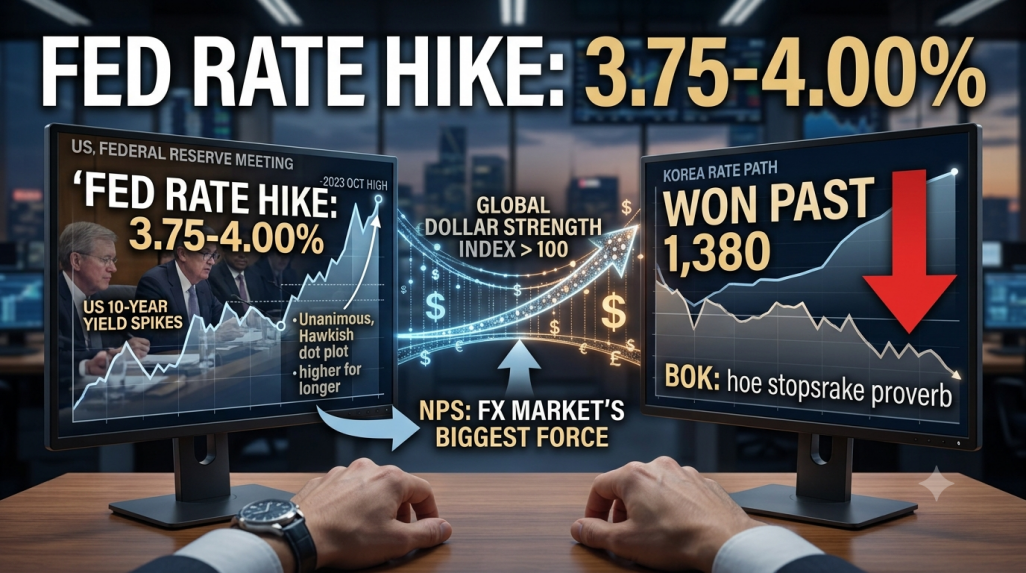
반응형On September 16-17, 2026, the Federal Reserve raised its policy rate a quarter point to 3.75-4.00% — its first hike since 2023 — in a unanimous, more-hawkish-than-expected vote, with its dot plot signaling further tightening through 2027. The Bank of Korea had already hiked twice this year, to 3.0% by late August. The intuitive read is that two central banks hiking together should be a wash for the won. Instead, the Korean won weakened past 1,380 per dollar within hours of the Fed's decision, because the US-Korea rate gap actually widened to roughly a full percentage point — a reminder that what moves currencies is the surprise relative to what was priced in, not simply who is or isn't raising rates.
반응형Why Did the Fed Hike for the First Time Since 2023?
The immediate trigger was an August core CPI reading that came in hotter than expected on a monthly basis: core prices (excluding food and energy) rose 0.3% month-over-month against a 0.2% forecast, even though the year-over-year figure matched expectations at 2.4% — its lowest reading since March 2021. Fed Chair Kevin Warsh had set the bar explicitly at his August Jackson Hole remarks, saying he'd hold rates steady only if inflation kept falling toward target "and if that's not happening, there's more work to do." The August data gave hawks the opening they needed, and Warsh backed a hike he had effectively pre-committed to.
The result was a genuine surprise on two fronts. First, the vote was unanimous — all 12 voting members backed the hike, when markets had expected a closer split given a Fed committee that reporting has described as roughly three committed hawks, four swing votes, and four members leaning toward holding steady. Second, the dot plot came in more hawkish than the market had priced: of 18 projections for end-2026 (Warsh, as chair, again declined to submit his own dot — a practice he's followed at prior meetings), 12 pointed to one more hike this year and 4 to two more, with zero projecting a cut. The 2027 median held at 4.1% rather than declining, which is the "higher for longer" signal that actually moved markets — not the widely-expected rate hike itself.
How Does Korea's Own Rate Path Compare?
Korea's central bank was already ahead of this story. The Bank of Korea raised its base rate a quarter point to 3.0% on August 27, 2026 — its second consecutive hike after July — with only one of seven board members dissenting in favor of holding. Governor Shin Hyun-song framed the move as preemptive, invoking a Korean proverb that translates roughly to "what could be stopped with a hoe shouldn't be left until it takes a rake" — acting early and cheaply rather than waiting and paying more later. The BOK also sharply raised its growth forecasts (2026: 2.6% to 3.3%; 2027: 2.1% to 2.9%), which matters because strong growth forecasts can offset some of the valuation drag that higher discount rates normally put on stocks.
Signal Bank of Korea (Aug 27) US Federal Reserve (Sept 16-17) Rate level after decision 3.00% 3.75-4.00% Vote 6-1 in favor 12-0 unanimous Forward dots 21 dots (3 per member); 10 cluster at 3.25% six months out 18 dots; 12 see one more 2026 hike, 4 see two more, none see a cut Stated rationale Get ahead of inflation, housing prices, household debt Hot monthly core CPI print against Warsh's own pre-set conditions ⚠️ "Both central banks are hiking" doesn't mean the won should be stable
The intuitive assumption — that synchronized tightening is currency-neutral — misses how FX actually prices policy: what matters is the surprise relative to what was already priced in, not the fact that both central banks moved. Korea's August hike was widely anticipated and largely priced in advance. The Fed's September hike was also expected in isolation, but the unanimous vote and the more-hawkish-than-forecast dot plot were not — and that gap between expectation and outcome is what sent the dollar index back above 100 and pushed the won past 1,380, with some analysts flagging 1,400 as a real near-term risk if dollar strength persists. The US-Korea policy rate gap, meanwhile, actually widened to roughly a full percentage point despite Korea's own tightening, because the Fed moved into a higher range than the BOK has reached.
✅ What Korean investors specifically should watch
- Whether the Bank of Korea delivers a third hike, with markets currently leaning toward a November move rather than October, as the BOK assesses the lagged effects of its July-August hikes before committing further.
- Korean bank stocks (KB, Hana, Shinhan, Woori financial holding companies all rose 0.4-2.0% on the Fed decision) versus rate-sensitive growth and bio names, as global rate hikes have started rotating Korean market leadership away from the semiconductor-heavy first-half rally toward value plays.
- Korea's household debt, which has climbed past 2,000 trillion won, alongside still-elevated Seoul apartment prices — both cited directly by the BOK as reasons for hiking now rather than later.
Governor Shin Hyun-song's own explanation for hiking preemptively — "what could be stopped with a hoe shouldn't be left until it takes a rake" — captures why both the Fed and the Bank of Korea chose to move now rather than wait for clearer data.
Is the Inflation Picture Really as Clear-Cut as the Rate Hikes Suggest?
Not entirely, and this is worth sitting with before assuming more hikes are a foregone conclusion on either side. In the US, the case for hiking rested heavily on one month's 0.3% core reading, while the year-over-year core rate actually fell to a five-year low and the three-month annualized pace ran near 2.0% — arguably closer to target than the headline "hot" narrative suggested. Which measure you trust changes the conclusion: MoM-focused hawks saw confirmation that inflation is reaccelerating; YoY- and trend-focused doves saw a economy that's already mostly disinflated, with one noisy month. Something similar is true in Korea, where a strong upward revision to growth forecasts complicates a purely hawkish read of the BOK's move — a central bank confident about growth has more room to tighten without worrying as much about choking off the recovery, which is a different story than a central bank hiking purely out of inflation alarm.
What Should Investors Watch Next?
The next real test is Korea's own board meeting, with November looking more likely than October for a follow-up move as policymakers weigh the lagged impact of two hikes already delivered. On the US side, keep in mind the Fed's next meeting falls close to the midterm elections, a timing dynamic that has historically made central bankers reluctant to make dramatic moves right before a vote. Both the Fed's cadence and the BOK's response to a still-widening rate gap are worth tracking together rather than in isolation, since — as this piece has tried to show — the relationship between the two is not the simple "both are hiking, so it's a wash" story it might first appear to be.
Frequently Asked Questions
Q1. If both the Fed and the Bank of Korea are raising rates, why did the won weaken?
A. Currency moves track the surprise relative to what markets had already priced in, not simply whether a central bank is hiking. Korea's August hike was widely expected in advance; the Fed's September hike came with an unexpectedly unanimous vote and a more hawkish dot plot than forecast, which widened the US-Korea rate gap to roughly a full percentage point and drove a broad dollar rally that pushed the won past 1,380.
Q2. Will the Bank of Korea hike again to close the gap with the Fed?
A. Analysts see it as more a question of timing and pace than whether the BOK moves again, given persistent inflation, high household debt, and Seoul housing prices. Current market expectations lean toward a November decision rather than October, as the BOK assesses the effects of its back-to-back July-August hikes first.
Q3. Which Korean stocks benefit from this rate environment?
A. Korean bank stocks (KB, Hana, Shinhan, and Woori financial holding companies) rose on the Fed's decision, as higher rates widen lending margins, and the rally has been read partly as capital rotating away from the semiconductor-heavy first-half leadership toward value plays. Rate-sensitive growth and biotech names face the opposite pressure from higher discount rates, though Korea's sharply upgraded growth forecasts partly offset that drag.
Governor Shin Hyun-song's own explanation for hiking preemptively — "what could be stopped with a hoe shouldn't be left until it takes a rake" — captures why both the Fed and the Bank of Korea chose to move now rather than wait for clearer data.
반응형'Macro & Policy > Currency & Rates' 카테고리의 다른 글
Korean Stock & Equity Research
Data-driven analysis of Korean listed companies, combining financial fundamentals with supply chain and operations insights. Not investment advice.