-
Macro & Policy/Currency & Rates
CPI Cooled, Oil Spiked, and SK Hynix Traded 49% Higher in New York: Inside July
2026. 8. 13.
Table
반응형Two CPI prints in five weeks briefly convinced markets the Fed's inflation fight was largely over. Then Middle East tensions pushed oil up 20% in two weeks, Fed Chair Kevin Warsh publicly warned against declaring victory, and SK Hynix's new Nasdaq-listed shares traded 49% above their Seoul price with no easy way to close the gap. July 2026 was a useful reminder that in interconnected markets, a single data point rarely tells the whole story.
Table of Contents
- June CPI: A Bigger-Than-Expected Cooldown
- Warsh's Warning: "That's Not My View"
- July CPI: Progress, With Energy Risk Still Lurking
- Trump's Hormuz Strait "Protection Fee" — Announced and Withdrawn
- Jackson Hole: A Brief History, and Why Trout Fishing Matters
- Kevin Warsh's Debut and the "Blank Piece of Paper"
- Meanwhile: SK Hynix's ADR Premium and the Limits of Arbitrage
- Bottom Line
June CPI: A Bigger-Than-Expected Cooldown
On July 14, 2026, June CPI data showed prices falling 0.4% month-over-month, the sharpest monthly decline in six years and well below the -0.2% consensus estimate. Core CPI, excluding food and energy, came in flat versus May, also below the +0.2% expected. Much of the headline decline traced to a June 17 ceasefire between the US and Iran, which pushed gasoline prices down 9.7% and dragged broader energy costs lower. But the flat core reading mattered too — transportation services and used car prices also softened, suggesting the disinflation wasn't purely an energy story.
The immediate market reaction was straightforward: lower inflation reduces the odds of further rate hikes, which lifts existing bond values and pushes yields lower. The 10-year Treasury yield fell sharply on the release, and US equities rallied.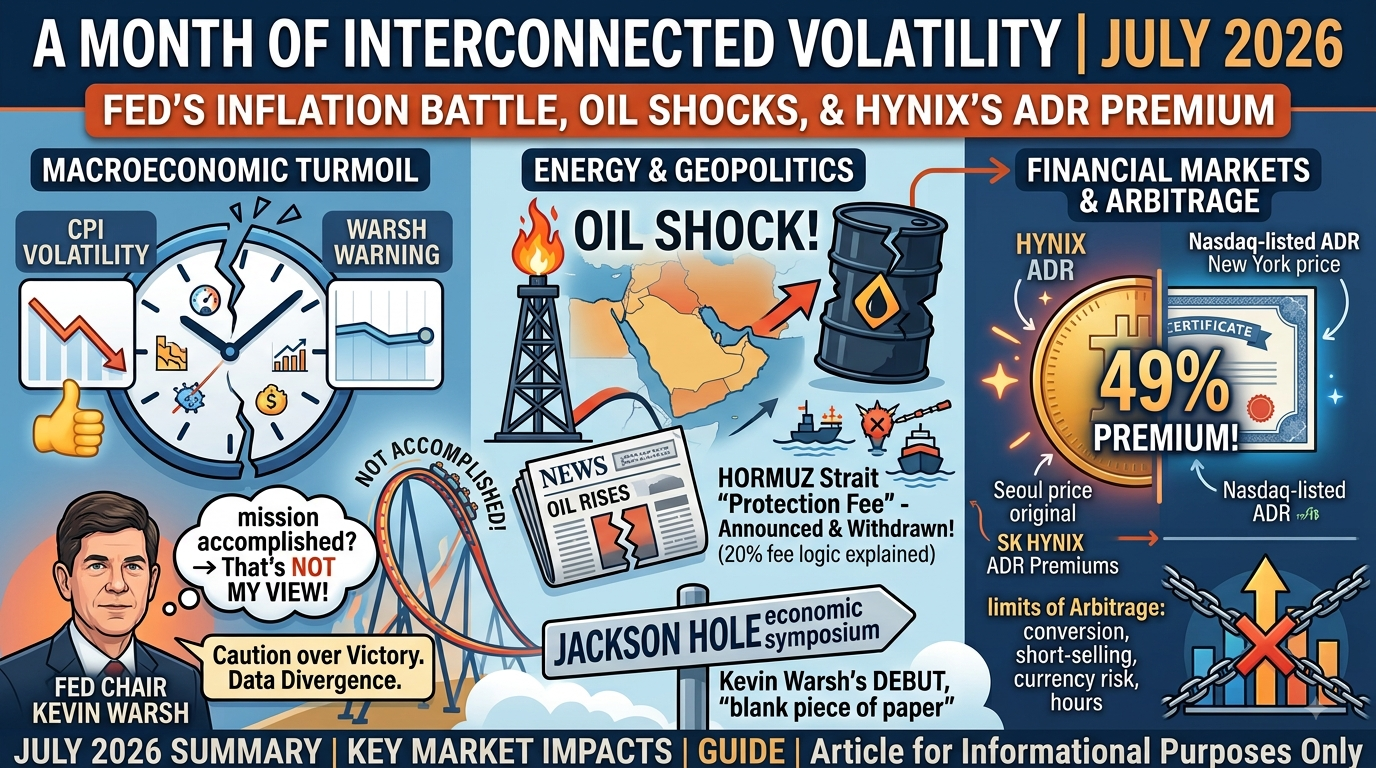 반응형
반응형Warsh's Warning: "That's Not My View"
Fed Chair Kevin Warsh moved quickly to temper the market's enthusiasm, stating plainly: "Someone might look at this morning's data and say 'mission accomplished, everything's fine.' That's not my view." The caution proved warranted almost immediately — the June data reflected price conditions gathered before mid-July, and events in the weeks following the release moved in the opposite direction.
July CPI: Progress, With Energy Risk Still Lurking
The subsequent July CPI reading, released August 12, showed prices up 3.4% year-over-year, decelerating from June's 3.5% and matching market expectations. Core CPI similarly eased to 2.5% year-over-year from June's 2.6%. Odds of a Fed rate hold at the September FOMC meeting rose from 52% to 58% following the release.
The energy picture had already shifted by the time this data was published, however. Continued US strikes on Iran from July 8 onward, followed by an announced naval blockade of Iran-bound shipping on July 13, pushed Brent crude from below $70 on July 1 to above $85 by mid-month — a swing of more than 20% in roughly two weeks. With both PCE and August CPI still pending, the disinflation narrative remained provisional rather than settled.Trump's Hormuz Strait "Protection Fee" — Announced and Withdrawn
Adding to oil market uncertainty, President Trump proposed charging a fee equal to 20% of cargo value for shipments passing through the Strait of Hormuz. The economics were striking: a VLCC tanker carrying 2 million barrels of $80 oil represents roughly $160 million in cargo value, meaning a 20% fee would total $32 million per voyage — compared to Iran's own reported $1-per-barrel transit fee, or $2 million on the same cargo, a sixteen-fold difference that would have made simply paying Iran's fee the more rational choice for shippers.
The proposal was withdrawn within a day, with Trump stating on Truth Social that "very productive conversations with Middle East leadership" had led to replacing the fee with a trade and investment deal from Gulf states instead. Trump has characterized the broader military engagement with Iran as a "military skirmish," suggesting an ongoing preference for limited pressure aimed at eventually returning to negotiations rather than sustained escalation.Jackson Hole: A Brief History, and Why Trout Fishing Matters
With no FOMC meeting scheduled in August, market attention has shifted to the Kansas City Fed's annual economic symposium in Jackson Hole, Wyoming, running August 27-29, 2026 — Kevin Warsh's first appearance as Fed Chair. This year's symposium theme, "Financial Innovation: Implications for Payments and Policy," signals central bankers' focus on how to handle the growth of stablecoins.
Jackson Hole's rise to prominence has an unusual origin story. The Kansas City Fed began hosting the symposium in 1978, rotating between Kansas City, Vail, and Denver with little attention paid to it. To boost attendance, organizers sought to invite then-Fed Chair Paul Volcker, who was in the midst of an unprecedented and deeply unpopular rate-hiking campaign that had pushed unemployment above 10%. Knowing Volcker was an avid trout fisherman, the Kansas City Fed relocated the symposium to Jackson Hole specifically to entice him with access to prime fishing. Volcker attended, and his presence drew global central bank governors and prominent economists, cementing the symposium's importance. Attendance remains deliberately restricted today — fewer than 100 attendees, mostly central bank governors, senior officials, and Nobel-caliber economists, with minimal press access to preserve open discussion. Notably, Jackson Hole is considered one of the least popular venues among central bankers themselves, given its remote setting and traditional "spouses required" attendance policy — a contrast to the closed-door, spouse-free Bank for International Settlements meetings in Basel, which bankers reportedly far prefer.Kevin Warsh's Debut and the "Blank Piece of Paper"
When asked at the July FOMC press conference how he intended to use his first Jackson Hole address — traditionally a venue Fed chairs use to reset monetary policy communication — Warsh responded that he currently has "a blank piece of paper," adding that internal task forces are still discussing what to present. Given the absence of forward guidance heading into the symposium, there's genuine risk of outsized market volatility if Warsh's remarks diverge meaningfully from current market consensus.
Meanwhile: SK Hynix's ADR Premium and the Limits of Arbitrage
Separately from the macro data, SK Hynix's newly listed Nasdaq ADR delivered its own volatility. After debuting at $168.01 on July 10, the ADR fell 9.32% to $152.35 on July 13 alongside a 15.4% drop in the Seoul-listed shares, then surged 27.29% in a single session to $193.92 — a move reportedly driven by a Barclays note projecting a $330 price target based on an expected memory supply shortage extending through 2027, with 2027 DRAM supply growth of 20% falling well short of projected demand growth of 35%.
The result was a striking cross-market gap: Seoul-listed shares closed at 1,941,000 Won while the ADR closed at $193.92, implying a 49% premium for the New York-listed shares over the Seoul original. In textbook terms, a 49% price gap for the same underlying asset should invite risk-free arbitrage — buying the cheaper Seoul shares, converting them to ADRs through the depositary bank, and delivering them against a short ADR position, similar to buying a Gucci bag in Seoul for less than its New York price and reselling it there for a profit.
In practice, several structural factors blocked this arbitrage from closing the gap: the ADR conversion process remained unresolved with regulators shortly after listing, limiting share conversion; ADR shares available for short-selling were scarce, since only 2.5% of total shares were issued as ADRs and a portion of those remained under lock-up restrictions; and the two listings trade in different currencies (Won and Dollars) across non-overlapping market hours, adding currency risk on top of execution risk. With clean arbitrage effectively blocked, the more likely pattern going forward is Seoul's shares playing catch-up to New York's price action with a one-day lag, rather than the gap closing through direct arbitrage.Bottom Line
July 2026 delivered a genuinely volatile stretch for Korea-linked markets: two consecutive CPI reports pointed toward disinflation even as Middle East tensions pushed oil up over 20% in two weeks, Fed Chair Warsh headed into his first Jackson Hole address with no fixed script, and SK Hynix's Nasdaq debut produced a 49% cross-listing premium that structural constraints prevented arbitrage from closing. Each of these threads — rate policy, energy prices, and cross-border equity pricing — remains unresolved heading into the fall.
This article is for informational purposes only and does not constitute investment, tax, or legal advice. Readers should consult a licensed professional before making investment decisions.
반응형'Macro & Policy > Currency & Rates' 카테고리의 다른 글
Korean Stock & Equity Research
Data-driven analysis of Korean listed companies, combining financial fundamentals with supply chain and operations insights. Not investment advice.