-
Macro & Policy/Currency & Rates
Korea Approved 2x Leveraged ETFs to Defend the Won. The Data Says It Didn't Work
2026. 8. 10.
Table
반응형In May 2026, Korean regulators approved single-stock leveraged ETFs tracking Samsung Electronics and SK Hynix, hoping the move would pull Korean investment capital back from Hong Kong and help defend the Won. Two months later, Korea's own financial regulator publicly acknowledged the plan hadn't worked as intended. The data behind that admission is a useful case study in what happens when policy is built on an incomplete read of capital flows.
Table of Contents
- Hong Kong's First-Mover Advantage
- Why SK Hynix Outperformed Samsung
- The Regulatory Logic Behind Korea's Approval
- Where the Calculation Went Wrong
- What Actually Happened
- Why This Matters Beyond the Won
- Bottom Line
Hong Kong's First-Mover Advantage
In May 2025, CSOP Asset Management, Hong Kong's second-largest ETF manager, listed the world's first leveraged ETF based on a single Korean stock: a 2x leveraged product tracking Samsung Electronics, alongside a -2x inverse version, on the Hong Kong Stock Exchange. While single-stock leveraged products already existed in the US for names like Tesla and Nvidia, this marked the first time a major Korean large-cap stock received similar treatment.
The listing happened in Hong Kong rather than Seoul for a specific regulatory reason: Korean rules cap any single stock's weight within an ETF at 30% and require a minimum of 10 constituent stocks, making a single-stock 2x leveraged product structurally impossible to launch domestically. Hong Kong carries no such restriction. The Samsung 2x product returned 170% within its first five months of trading.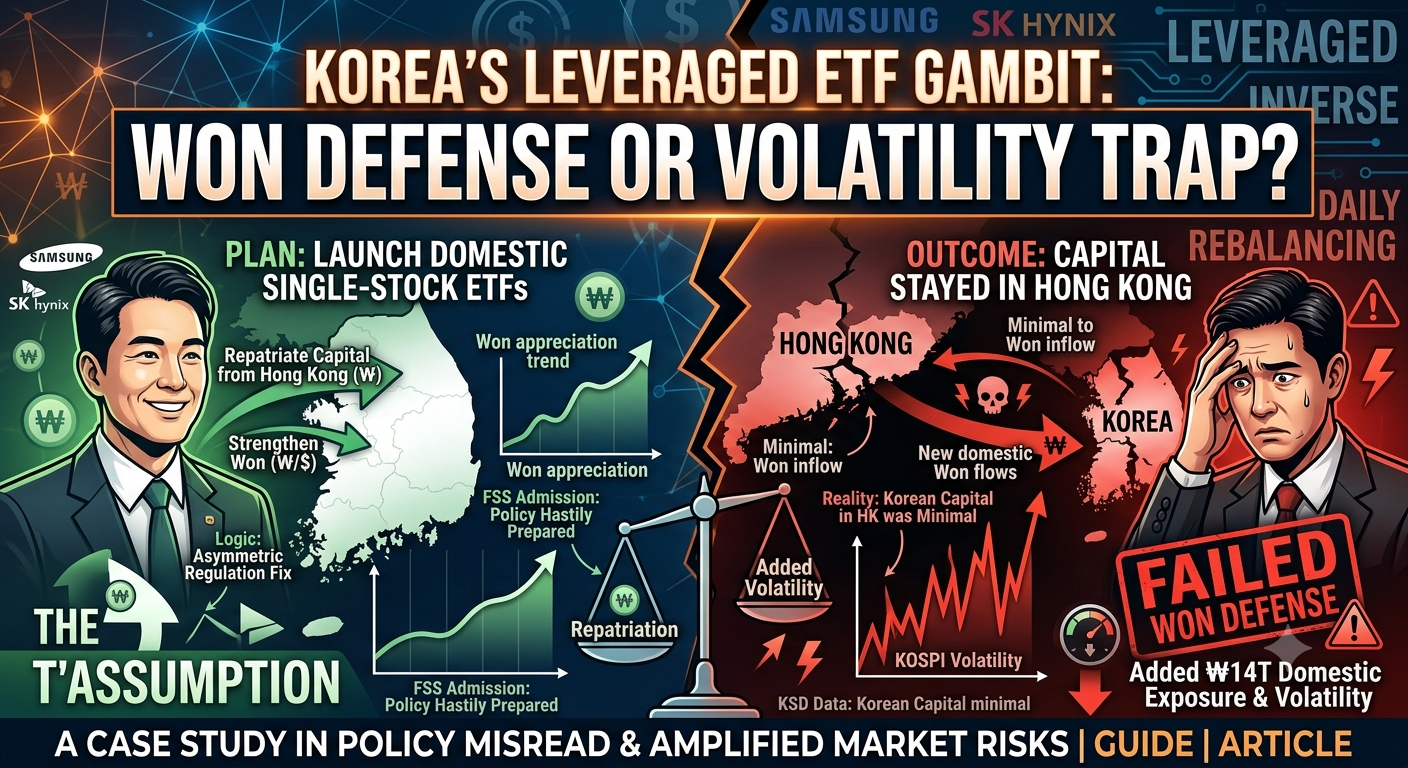 반응형
반응형Why SK Hynix Outperformed Samsung
Following Samsung's success, CSOP launched an SK Hynix 2x product on October 16, 2025. Despite launching later, the SK Hynix product became the bigger hit: assets under management reached $16.8 billion (roughly 26 trillion Won) for SK Hynix, compared to $10.8 billion (roughly 15 trillion Won) for Samsung. Post-listing returns told a similarly lopsided story — 261% for Samsung's 2x product versus 1,305% for SK Hynix's.
The explanation traces to business mix: Samsung Electronics spans memory, foundry, mobile, and consumer electronics, while SK Hynix is a more concentrated pure-play on HBM and DRAM — effectively a focused AI memory bet. For investors specifically seeking leveraged exposure to AI semiconductor demand, SK Hynix was the cleaner instrument, and its concentrated exposure amplified both the upside and the leveraged return differential. The SK Hynix 2x product went on to become the largest ETF on the Hong Kong exchange and the largest single-stock leveraged or inverse product globally.The Regulatory Logic Behind Korea's Approval
As the Won continued weakening, Korean foreign exchange authorities reportedly concluded that bringing Korean capital invested in these Hong Kong products back onshore could help stabilize the exchange rate — under the theory that Korean investors were routing through Hong Kong specifically because no domestic single-stock leveraged product existed, and that creating one would repatriate that capital and support the Won. Domestic securities firms echoed this logic; one brokerage's May 22 research report projected that Korean-held positions in the Hong Kong products would "quickly return" to the domestic market. Korea's Financial Services Commission announced a plan to resolve the asymmetric regulation between domestic and overseas-listed ETFs on January 30, 2026, followed by an April 28 amendment to enforcement rules under Korea's capital markets law, formally permitting single-stock leveraged and inverse ETFs domestically for the first time.
Where the Calculation Went Wrong
The policy appears to have rested on a data misread. According to Korea Securities Depository figures, Korean-sourced capital in the Hong Kong Samsung and SK Hynix 2x products totaled just $320 million combined ($140 million in Samsung, $180 million in SK Hynix) — a small fraction of the products' total assets. The overwhelming majority of capital came from Hong Kong local investors, mainland Chinese investors, and US and European funds seeking AI semiconductor exposure, none of whom had any structural reason to shift from a familiar, liquid Hong Kong-listed product into a new Won-denominated Korean equivalent.
What Actually Happened
Post-launch data appears to confirm the miscalculation. Roughly only 500 billion Won returned to Korea following the launch of the domestic products, with the large majority of Hong Kong-held capital remaining in place. Analysis suggests most capital flowing into the new domestic 2x products came not from Hong Kong repatriation, but from existing Korean investors selling other domestic equity holdings to rotate into the new leveraged products. The practical result: Hong Kong's roughly 41 trillion Won in existing exposure stayed largely intact, while Korea simply added a new, separate 14 trillion Won pool of domestic leveraged exposure on top.
Korea's Financial Supervisory Service Governor later acknowledged this outcome publicly, stating that the effort to draw capital back from Hong Kong "wasn't particularly effective, while the side effects turned out to be much larger," adding that the policy had been prepared "somewhat hastily" at the time.Why This Matters Beyond the Won
As covered in our earlier piece on VaR and Sharpe ratios driving foreign selling of Korean equities, these same single-stock leveraged products require daily rebalancing to maintain their 2x exposure — buying more as prices rise and selling more as they fall, mechanically amplifying volatility in both Samsung Electronics and SK Hynix. Since the two stocks together represent roughly a third of KOSPI's total market capitalization, this creates a direct link between a currency-defense policy that added a new pool of domestic leveraged exposure and the broader volatility dynamics now weighing on institutional foreign investment in Korean equities.
Bottom Line
Korea's approval of domestic single-stock leveraged ETFs was built on the assumption that Korean capital invested in Hong Kong's Samsung and SK Hynix 2x products would repatriate and support the Won. Depository data shows Korean-sourced capital in those Hong Kong products was minimal to begin with, and the policy's own regulator has since acknowledged the currency-defense goal largely failed while adding a new source of domestic market volatility.
This article is for informational purposes only and does not constitute investment, tax, or legal advice. Readers should consult a licensed professional before making investment decisions.
반응형'Macro & Policy > Currency & Rates' 카테고리의 다른 글
Korean Stock & Equity Research
Data-driven analysis of Korean listed companies, combining financial fundamentals with supply chain and operations insights. Not investment advice.