-
Macro & Policy/Currency & Rates
How Hong Kong Beat the Hedge Funds That Broke Korea and Thailand
2026. 8. 14.
Table
반응형When hedge funds smell a currency defense running low on ammunition, they move as a coordinated pack. In 1997, that pack took down Thailand's currency peg, tried and failed twice against Hong Kong, and pushed Korea to the brink of default within weeks. The mechanics behind that crisis — and the behavioral finance principle about buying during panic that market veterans still apply today — offer a useful pairing: one explains how currency crises unfold, the other explains what disciplined investors do when markets are in free fall.
Table of Contents
- The Trigger: China's 1994 Currency Devaluation
- Thailand Falls First
- Hong Kong's First Defense
- How Korea Ran Out of Dollars
- Hong Kong's Second, Successful Defense
- The Core Lesson: Reserves Matter More Than Policy
- What History Says About Buying Into Panics
- Bottom Line
The Trigger: China's 1994 Currency Devaluation
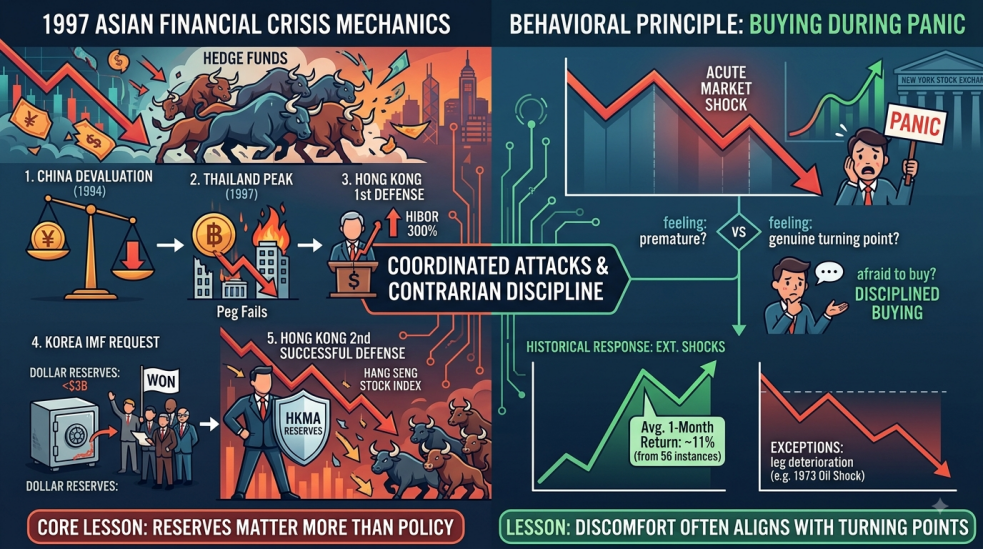
In January 1994, China unified its dual exchange rate system, moving from roughly 5.8 to 8.6 Yuan per Dollar overnight — an effective 40% devaluation. This made Chinese exports dramatically more price-competitive against other labor-intensive manufacturing economies in Southeast Asia, particularly Thailand, Indonesia, and Malaysia, which had been competing on price in similar export categories. As these countries lost export competitiveness, their trade balances weakened and Dollar reserves began drying up — while several were simultaneously operating fixed or tightly managed exchange rate regimes, spending scarce Dollars to defend currency pegs they could no longer easily sustain.
 반응형
반응형Thailand Falls First
Hedge funds identified Thailand's weakening Dollar reserves and began shorting the Thai Baht, betting the fixed exchange rate couldn't hold. Thailand's central bank spent down its reserves defending the peg but couldn't sustain it, and on July 2, 1997, Thailand abandoned its fixed exchange rate and let the Baht float. The currency collapsed immediately, delivering hedge funds substantial profits and validating the strategy for a larger target.
Hong Kong's First Defense
Emboldened by Thailand, hedge funds turned to Hong Kong, then Asia's dominant financial center, operating a fixed exchange rate of 7.7 Hong Kong Dollars per US Dollar. Hong Kong's monetary authority, having built deep financial market expertise under British administration, identified a structural weakness in the hedge funds' own strategy: these funds typically borrowed short-term at low rates (around 6%) to fund large short positions, meaning they were vulnerable to a sudden spike in the cost of that borrowed capital. On October 23, 1997, the Hong Kong Monetary Authority raised the interbank lending rate (HIBOR) from roughly 6% to as high as 300%, making it prohibitively expensive to maintain short positions. Hedge funds were forced to unwind and retreat — successfully defending the currency peg, though at a real cost: Hong Kong's stock market fell by roughly half over the following two months as a side effect of the sharp rate spike.
How Korea Ran Out of Dollars
Hong Kong's stock market decline had ripple effects. US funds holding Hong Kong positions faced losses and sold US equities to raise cash, contributing to a 554-point (7.2%) Dow Jones decline on October 27, 1997 — large enough to trigger circuit breakers twice in a single session. Rebuffed in Hong Kong, hedge funds turned to Southeast Asia and Korea, where a combination of weak export competitiveness (again, largely due to China's earlier devaluation) and fragile short-term financing structures created real vulnerability.
In Korea's case, a wave of newly licensed merchant banking corporations had built up large foreign-currency lending books, borrowing short-term from Japanese banks at low rates and lending longer-term to Korean conglomerates at a spread. When Japanese banks began recalling loans — partly due to their own capital adequacy pressures following losses tied to the broader regional crisis — Korean merchant banks faced a funding mismatch they couldn't cover, since Korean conglomerates carried average debt-to-equity ratios exceeding 500% and lacked ready cash to repay accelerated loan calls. A wave of merchant bank failures followed, and as foreign capital exited Korea and converted back to Dollars, Korea's foreign exchange reserves were depleted rapidly. Despite the government spending $11.8 billion defending the currency in October and November 1997 alone, reserves that were officially reported at $25 billion on the morning of November 20 turned out to be under $3 billion by that evening — and Korea formally requested IMF assistance that night.
The consequences were substantial. The Won, which traded around 800 per Dollar before the crisis, spiked to nearly 1,960 by December 23, 1997, before stabilizing after the IMF and G7 nations agreed to accelerate financial support. Korea ultimately drew $19.5 billion of a $55 billion IMF facility and repaid it in full within four years — but not before a wave of Korean corporate assets changed hands to foreign buyers during the crisis, including Daewoo Motors (to GM) and various divisions of Samsung and other conglomerates sold to international buyers at distressed valuations.
Hong Kong's Second, Successful Defense
Hedge funds, having profited substantially from Thailand and Korea, returned to Hong Kong with a different strategy — shorting Hong Kong equities directly rather than attacking the currency peg through interest rates. Hong Kong's Hang Seng Index fell from roughly 30,000 to 6,600 in 1998 as this pressure built. This time, Hong Kong's monetary authority intervened directly in equity and futures markets, absorbing the stock and futures positions hedge funds were dumping, and separately buying up Hong Kong Dollars being sold to defend the currency peg. After roughly a month of sustained intervention, hedge funds had lost an estimated $70 billion attacking Hong Kong and withdrew, giving back most of the gains made in Thailand and Korea. Hong Kong spent roughly $145 billion defending its markets across both episodes, but preserved its currency peg and financial center status.
The Core Lesson: Reserves Matter More Than Policy
The 1997 Asian Financial Crisis illustrates a consistent pattern: when hedge funds identify a currency defense with insufficient reserves to sustain it, coordinated attacks can succeed regardless of a country's underlying economic policy quality. Hong Kong's successful second defense worked specifically because it had deep enough reserves and market infrastructure to outlast the attackers' own funding costs — a lesson that remains directly relevant to how central banks think about foreign exchange reserve adequacy today.
What History Says About Buying Into Panics
Separate from the currency crisis mechanics, a related behavioral finance principle concerns how markets recover from acute, externally-driven shocks. Looking at roughly 56 instances over 70 years where the S&P 500 moved sharply due to external, non-economic shocks, one widely cited analysis found that buying immediately after such a shock and holding for one month produced average returns of roughly 11% — an annualized rate exceeding 130% if the pattern could be repeated consistently, though such shocks are by definition irregular and not reliably repeatable.
This isn't a universal rule — the analysis itself notes exceptions, including periods like the 1973 Yom Kippur War and subsequent oil shock, where markets entered extended bear markets rather than recovering. The pattern applies specifically to genuine external shocks that trigger disproportionate fear relative to underlying economic fundamentals, not to declines driven by legitimate deterioration in fundamentals themselves. A commonly cited heuristic among experienced investors: if a decline feels like "it's dropped enough, now's a good time to buy," the timing may still be premature; when the prevailing feeling is closer to "I'm afraid to buy stocks at all," that discomfort has often coincided more closely with genuine turning points historically.
Bottom Line
The 1997 Asian Financial Crisis demonstrates that currency defenses succeed or fail based on reserve depth relative to speculative attack capacity — Thailand and Korea lacked sufficient reserves and fell, while Hong Kong's deeper reserves ultimately prevailed in a costly but successful defense. Separately, historical data on market reactions to acute external shocks suggests that buying during periods of maximum fear — not immediately after initial declines, but once panic has largely subsided — has historically produced strong average returns over a one-month holding period, though this pattern carries real exceptions and isn't a guaranteed outcome.
This article is for informational purposes only and does not constitute investment, tax, or legal advice. Historical statistics are illustrative and do not guarantee future results. Readers should consult a licensed professional before making investment decisions.
반응형'Macro & Policy > Currency & Rates' 카테고리의 다른 글
Korean Stock & Equity Research
Data-driven analysis of Korean listed companies, combining financial fundamentals with supply chain and operations insights. Not investment advice.