-
Macro & Policy/Currency & Rates
How Korea's Pension Fund Went From Currency Brake to Bystander — And What Filled the Gap
2026. 8. 15.
Table
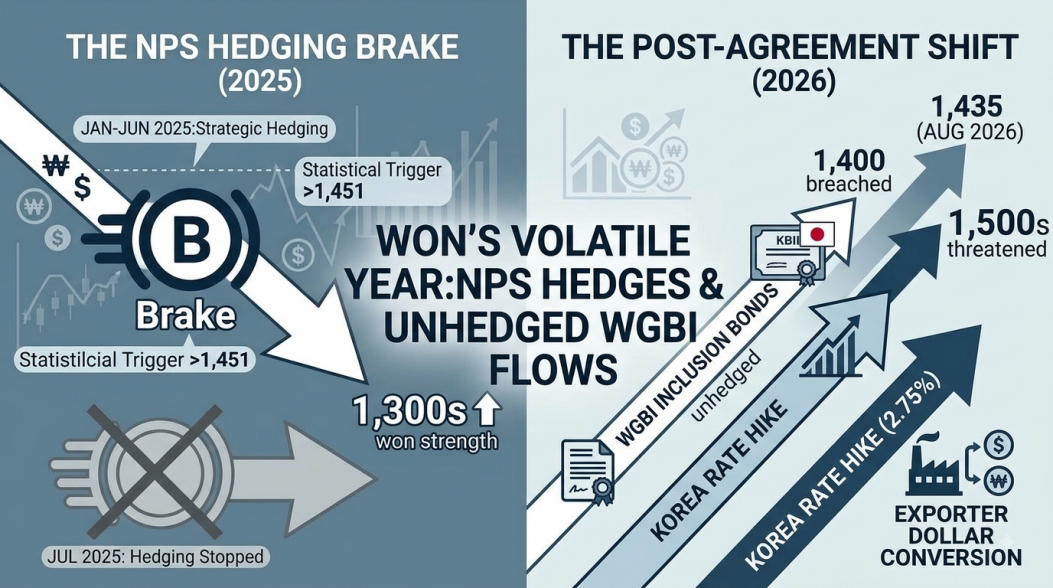
반응형In January 2025, Korea's National Pension Service quietly executed a currency hedge that helped pull USD/KRW back from a threatened 1,500 toward the 1,300s. In June 2025, it stopped. By September, the Won had breached 1,400 again — vindicating a July prediction that drew public skepticism at the time. And by August 2026, the currency had reversed sharply again, this time strengthening from above 1,550 to 1,435 in a matter of weeks. Understanding the NPS's currency hedging mechanics is essential to following each of these moves.
Table of Contents
- How NPS Currency Hedging Actually Works
- The Trigger: A 24-Year Statistical Threshold
- January 2025: Hedging Begins, the Won Strengthens
- June 2025: Why the NPS Stopped Hedging
- The Contested Prediction That Came True
- Why the NPS No Longer Functions as a Brake
- August 2026: The Won Reverses Course
- The WGBI Wrinkle: Why Hedged vs. Unhedged Flows Matter
- Bottom Line
How NPS Currency Hedging Actually Works
When Korea's National Pension Service invests abroad, it must convert Won to Dollars, temporarily creating Dollar scarcity in the market and pushing USD/KRW higher. When that overseas investment matures and converts back to Won, the exchange rate at that time determines whether the fund books a currency gain or loss. Currency hedging locks in today's exchange rate for that future conversion, removing this uncertainty.
The NPS can execute this hedging directly with commercial banks, or through a currency swap with the Bank of Korea, where the central bank lends Dollars from its own reserves in exchange for Won, to be reversed at maturity. If the NPS hedges $10 billion at 1,471 Won per Dollar for one year, and the exchange rate falls to 1,371 by maturity, the fund receives 14.71 trillion Won instead of the 13.71 trillion Won it would have gotten unhedged — a 1 trillion Won currency gain. The reverse applies if the rate rises instead.
 반응형
반응형The Trigger: A 24-Year Statistical Threshold
The NPS operates two hedging tiers: tactical hedging, capped at 5% of overseas investment and managed at the fund's own discretion, and strategic hedging, capped at 10% of overseas investment but only activated under a specific statistical trigger — when the exchange rate moves beyond a 99% confidence interval (2.58 standard deviations) relative to its historical distribution since 2001, sustained for five consecutive trading days. In practice, this threshold works out to roughly 1,451-1,452 Won per Dollar, a level that has remained fairly stable given it's based on 24 years of data.
January 2025: Hedging Begins, the Won Strengthens
USD/KRW crossed the 1,451 threshold and held for five trading days at the end of December 2024, triggering strategic hedging. On January 7, 2025, the NPS began executing hedges, and the exchange rate — which had opened around 1,470 and threatened to approach 1,500 — moved to the 1,300s over the following months, with the NPS's hedging activity widely credited as a contributing factor.
June 2025: Why the NPS Stopped Hedging
Around June 24, 2025, the NPS halted new hedging activity, driven by two factors. Internally, the exchange rate had fallen back into the 1,300s, resolving the statistical trigger condition. Externally, the US Treasury's currency report placed Korea on a monitoring list, specifically flagging NPS hedging activity: the report noted the NPS's overseas assets had grown by roughly $46 billion over four quarters to $470 billion, and stated the Treasury would examine "the potential for trading partners to use pension funds to influence exchange rates going forward" — notably, a currency manipulation concern typically applied to countries weakening their own currency, here applied to Korea's pension fund strengthening the Won instead.
The Contested Prediction That Came True
The implications of this halt were significant enough to prompt a July 2025 prediction that the Won could revisit the 1,400 level — a call that drew public pushback at the time, including a reader comment stating "no way that happens" and a follow-up exchange debating whether "never" was ever an appropriate word in financial markets. Less than two months later, in September 2025, USD/KRW crossed back above 1,400, a move that coincided with Fed Chair Powell signaling a slower pace of rate cuts, strengthening the Dollar broadly against a backdrop where the Bank of Korea was leaning dovish.
Why the NPS No Longer Functions as a Brake
The structural change went further. On October 1, 2025, Korea and the US announced a currency policy agreement that explicitly included language restraining the use of NPS hedging as a currency management tool. Starting around July 2025, the NPS began conducting overseas investment without hedging entirely. With domestic equity allocation already near its allowed ceiling (roughly 17.5% against an effective cap near 17.9%), continued growth in overseas investment — an estimated 50 trillion Won planned for the second half of 2025 — implied steadily rising Dollar demand with no hedging-based offset, a structural change from the mechanism that had previously acted as a brake on Won weakness.
August 2026: The Won Reverses Course
By August 2026, the picture had shifted again. USD/KRW fell sharply from above 1,550 in early July to 1,435 by month-end, even as the Dollar Index moved only marginally and the Japanese Yen sat near 40-year lows — pointing to Won-specific strength rather than broad Dollar weakness. Korea posted a record current account surplus of $141.3 billion in the first five months of 2026 alone, already exceeding all of 2025's $123 billion annual surplus. However, a current account surplus doesn't automatically mean Dollars enter Korea — Korean corporations had been accumulating Dollar earnings offshore for US investment rather than converting them, while foreign investors sold a net $110.2 billion in Korean equities in the first half of 2026 and converted proceeds to Dollars leaving the country.
Foreign equity selling paused starting the third week of July, giving the underlying current account surplus more room to support the Won. This coincided with several policy moves: a July 16, 2026 Bank of Korea rate hike from 2.50% to 2.75% — the first hike in roughly three and a half years, with negative real rates (2.75% policy rate against 3.2% inflation) and above-forecast GDP growth (0.6% versus a 0.2% projection) supporting the case for further tightening — alongside government measures including smoothing operations, extended exemptions on foreign exchange soundness levies to ease short-term Dollar borrowing, joint inter-agency inspections pressuring exporters to convert accumulated Dollar holdings, and a temporary easing of foreign-currency liquidity stress test requirements to free up bank-held Dollar liquidity.
The WGBI Wrinkle: Why Hedged vs. Unhedged Flows Matter
A more technical factor compounded these moves. Following Korean government bonds' inclusion in the World Government Bond Index (WGBI) on April 1, 2026, index-tracking funds began purchasing roughly $52 billion in Korean bonds through November, with Japanese investors representing over 30% of this flow.
Critically, whether this flow affects the exchange rate depends on whether it's hedged or unhedged. When a foreign investor buys Korean bonds with a currency hedge, the hedge counterparty bank takes an offsetting position in the market to avoid its own currency exposure, effectively neutralizing the exchange rate impact of the original purchase. Only unhedged flows create genuine Won demand. Reuters reported that Japanese investors have increasingly bought Korean bonds unhedged — a preference driven by hedging costs. With Japan's policy rate at 1.0% versus Korea's 2.75%, the roughly 1.75 percentage point hedging cost would reduce the yield on Korea's 4.25% 10-year bond to around 2.5%, actually below Japan's own 10-year yield of 2.78%. Going unhedged instead exposes Japanese investors to Won/Yen movements — a bet that has paid off further given the Yen's persistent weakness and the Bank of Japan's July 31, 2026 decision to hold rates steady, reinforcing incentives for continued unhedged Korean bond buying.
Bottom Line
Korea's National Pension Service functioned as an effective, if unofficial, brake on Won depreciation through early-to-mid 2025 via its strategic currency hedging program — until US pressure and a formal bilateral currency agreement restrained that tool starting mid-2025, contributing directly to the Won's move back above 1,400 by September. By August 2026, a different combination of factors — a Bank of Korea rate hike, paused foreign equity selling, government pressure on exporters to convert Dollar holdings, and a shift toward unhedged Japanese bond buying tied to WGBI inclusion — drove the Won's sharpest appreciation of the year, illustrating how the currency's direction has depended on a shifting mix of structural and policy-driven flows rather than any single consistent driver.
This article is for informational purposes only and does not constitute investment, tax, or legal advice. Readers should consult a licensed professional before making investment decisions.
반응형'Macro & Policy > Currency & Rates' 카테고리의 다른 글
Korean Stock & Equity Research
Data-driven analysis of Korean listed companies, combining financial fundamentals with supply chain and operations insights. Not investment advice.