-
Korean Equities/Company Deep Dives
CXMT's $8.5 Billion IPO: State Capital, Stolen Patents, and a Threat to Samsung and SK Hynix
2026. 8. 7.
Table
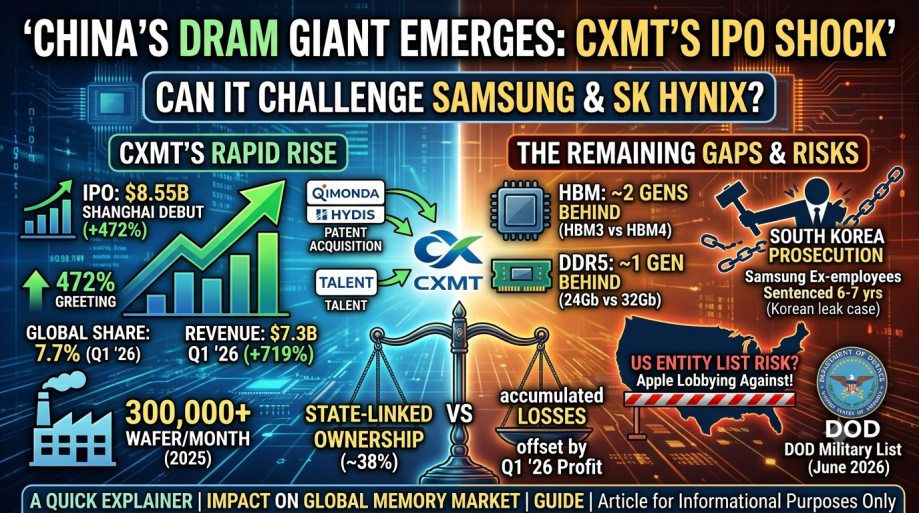
반응형When China's CXMT listed in Shanghai on July 27, 2026, its shares surged 472% on debut, briefly making it the largest company by market cap on the STAR board. The IPO raised roughly $8.55 billion — the largest semiconductor listing in Chinese history — and came at a moment when, as covered in our earlier piece on China's TRS crackdown, capital that had been flowing offshore into Korean and US tech stocks was being redirected toward exactly this kind of domestic listing. Understanding CXMT's origin story, and how much ground it still needs to close, matters directly for anyone tracking Samsung Electronics and SK Hynix.
China Just Cut Off a Back Channel Into Korean Semiconductor Stocks
On June 23, 2026, China's securities regulator quietly moved to shut down a financial mechanism that had let wealthy Chinese investors bypass capital controls to buy foreign tech stocks — including Korean semiconductor names. The move offers one plausibl
koreanalysis.com
Table of Contents
- State Capital Behind a "Private" Company
- The Hefei Playbook: A City That Bets Big
- How CXMT Acquired Its Core DRAM Technology
- Talent Acquisition and a Trade Secrets Case
- Where CXMT Stands Today
- The IPO and What Comes Next
- Bottom Line
State Capital Behind a "Private" Company
CXMT emerged from a deliberate national strategy. After the 2018 US-China trade war began, China's leadership pushed semiconductor self-sufficiency as a strategic priority, backing Huawei and SMIC in logic chips while channeling support into CXMT for memory.
Despite being technically classified as a private company, CXMT's ownership structure tells a different story. Its top three shareholders — Hefei Jianghuai Jicheng Circuit (21.67%), Chuangxin Jicheng (11.71%), and the National Integrated Circuit Industry Investment Fund (8.73%) — combine for roughly 42% ownership, and all three trace back to state capital, whether through the Hefei municipal government or the national semiconductor fund. Even after IPO dilution, state-linked ownership remains around 38%, making CXMT effectively a state-backed enterprise in practice. Alibaba holds a 4% stake, acquired largely through its cloud division's purchases of CXMT memory — one of several Chinese tech giants that turned to CXMT as a workaround after being cut off from Nvidia's most advanced chips by US export controls.
How China Built a DRAM Challenger: Inside CXMT's Rise to a Record IPO 반응형The Hefei Playbook: A City That Bets Big
CXMT's backing traces to Hefei's municipal government, known in China as one of the most successful state-level venture investors. Hefei's signature success story involves BOE, now the world's largest LCD panel maker. In 2002, a Chinese company later folded into BOE acquired Hynix's (then Hyundai Electronics') distressed LCD subsidiary Hydis for $380 million, relocated its production lines and key researchers to China, then abandoned the subsidiary once the transfer was complete — leaving Hydis to collapse while the resulting Chinese factory grew into BOE using the transferred technology and workforce. Hefei invested $2.2 billion into BOE at a time when the city's entire annual budget was $4.3 billion — essentially half the city's budget on a single bet. Having seen that bet pay off, Hefei committed nearly 80% of the funding for CXMT's first $2.7 billion project in 2016.
How CXMT Acquired Its Core DRAM Technology
Much as BOE's rise traced back to acquired Hydis technology, CXMT's DRAM foundation traces back to Qimonda, once Europe's leading DRAM maker before its 2009 bankruptcy following the 2008 financial crisis. Qimonda, spun out of Siemens and Infineon, held extensive DRAM patents. CXMT quietly acquired roughly 7,000 Qimonda patents through intermediary transactions involving a Canadian patent holding company.
Among those patents was foundational IP behind "buried wordline" technology — a structural innovation where the wordline controlling a DRAM cell's transistor is embedded within the silicon rather than sitting on its surface, reducing current leakage and enabling denser cell packing. Though Qimonda went bankrupt before fully commercializing the innovation, buried wordline design became the industry standard used across modern DRAM. CXMT also recruited Karlheinz Küsters, who had led Qimonda's advanced development division — including the buried wordline research — during a 24-year career spanning Siemens, Infineon, and Qimonda, along with a portion of Qimonda's roughly 500-person R&D team based in Xi'an, China.
Talent Acquisition and a Trade Secrets Case
CXMT's talent acquisition extended well beyond former Qimonda staff, drawing hundreds of engineers from Taiwanese memory makers as well as from Samsung Electronics and SK Hynix. This included a documented trade secrets case: South Korean prosecutors found that a group of former Samsung employees, some hired by CXMT in its early years starting in 2016, had leaked detailed DRAM process information. South Korea's National Intelligence Service referred the case to prosecutors in May 2023, and in April 2026, a first-instance court sentenced several former Samsung employees to 6–7 years in prison for transcribing and leaking hundreds of stages of DRAM process data. Prosecutors described the case as involving dozens of individuals across Samsung and its suppliers, with estimated damages reaching into the tens of trillions of Won — among the largest technology leak cases on record in Korea.
Where CXMT Stands Today
US export controls introduced in October 2022 blocked CXMT from acquiring cutting-edge EUV lithography equipment, pushing the company toward refurbished, lower-spec DUV tools instead. This has proven less limiting than it might sound: even Micron, which has access to EUV, continued relying primarily on DUV for DRAM production through 2025. Using only lower-spec DUV also helped CXMT avoid the stricter entity list restrictions applied to SMIC, YMTC, and Huawei, as US regulators judged in 2022 that CXMT's technology level didn't yet pose a significant threat — and that CXMT's low-cost memory competing on price wasn't necessarily unfavorable to US interests at the time.
Metric Detail DDR4 capacity growth 40,000 wafers/month (2020) → 300,000+ (2025) → 420,000 target (2027) DDR5 status 24Gb density in mass production as of May 2026; one generation behind Samsung/SK Hynix/Micron's 32Gb Global DRAM market share 4.1% (Q1 2025) → 7.7% (Q1 2026), ranking 4th behind Samsung (38.6%), SK Hynix (28.8%), Micron (22.4%) HBM status Currently HBM2-class; targeting HBM3 within 2026, roughly two generations behind Samsung/SK Hynix's HBM4 development Revenue growth $3.3B (2024) → $8.6B (2025) → $7.3B in Q1 2026 alone (+719% YoY) The IPO and What Comes Next
After a decade of accumulated losses totaling roughly $5.4 billion, CXMT's revenue jumped sharply on the back of the broader AI-driven memory upcycle. First-quarter 2026 results alone reportedly generated enough profit to offset the company's entire cumulative historical losses, positioning the IPO to coincide with its transition to profitability. Demand for the offering was substantial, with retail subscription oversubscribed 212 times and institutional demand oversubscribed 462 times — roughly four times the demand seen in SMIC's 2020 listing.
Regulatory risk remains a live variable. The US Department of Defense kept CXMT on its list of Chinese military-linked companies as of June 2026, a designation that mainly restricts US government procurement and carries limited direct impact. The more consequential risk is potential addition to the US Commerce Department's Entity List, which would impose far broader restrictions — something CXMT avoided in 2022–2024 unlike SMIC and Huawei, but now faces rising odds of in 2026. Notably, Apple has reportedly lobbied the White House and Commerce Department against adding CXMT to the Entity List, as it seeks approval to purchase CXMT chips — a variable that could meaningfully affect the outcome.
Bottom Line
CXMT's Shanghai debut secured over $8.5 billion in fresh capital backed by a state-linked ownership structure and technology assembled through patent acquisitions, targeted hiring, and — in at least one documented case — trade secret theft from Samsung. Despite its rapid rise to a 7.7% global DRAM share, CXMT remains roughly one generation behind in DDR5 and two generations behind in HBM relative to Samsung and SK Hynix, and its regulatory future now hinges partly on whether the US adds it to the Entity List — a decision Apple is reportedly lobbying to prevent.
This article is for informational purposes only and does not constitute investment, tax, or legal advice. Details regarding the referenced legal case reflect first-instance court findings as reported and may be subject to appeal. Readers should consult a licensed professional before making investment decisions.
반응형'Korean Equities > Company Deep Dives' 카테고리의 다른 글
Korean Stock & Equity Research
Data-driven analysis of Korean listed companies, combining financial fundamentals with supply chain and operations insights. Not investment advice.