-
Korean Equities/Company Deep Dives
Is Propofol Legal? Why South Korea Is the Only Country That Classifies It as a Narcotic
2026. 8. 9.
Table
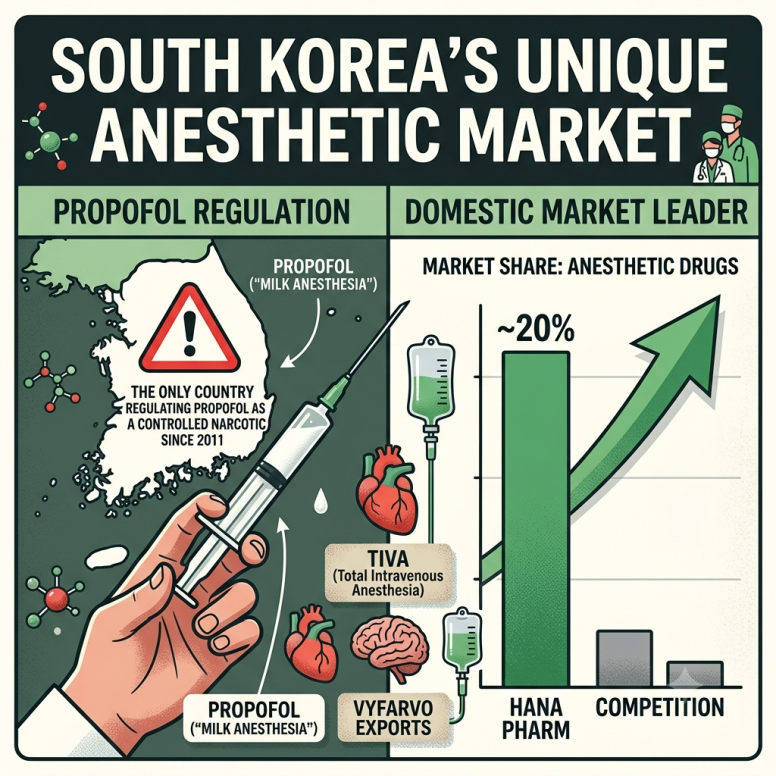
반응형Since 2011, South Korea has been the only country in the world to formally classify propofol as a controlled narcotic — a regulatory choice most other countries, including the US, have never made. That unusual classification sits at the center of a niche but highly profitable corner of Korea's pharmaceutical industry, dominated by a single mid-cap company holding roughly 20% of the domestic anesthetic drug market.
Table of Contents
- The Rise of Total Intravenous Anesthesia (TIVA)
- Propofol: A Rediscovered Molecule With a Regulatory Twist
- Remifentanil: Solving the Timing Problem
- Hana Pharm: Korea's Anesthetic Market Leader
- Why Korea's Regulatory Approach Matters for the Sector
- Bottom Line
The Rise of Total Intravenous Anesthesia (TIVA)
General anesthesia has historically relied on two broad approaches: inhaled anesthesia, using gas delivered through a mask or breathing tube, and intravenous anesthesia, delivered through an IV line. Total Intravenous Anesthesia (TIVA) uses IV medication exclusively, with no inhaled gas at any point in the procedure. TIVA has been steadily displacing inhaled anesthesia across a growing range of procedures — from short sedation for endoscopies to lengthy surgeries — due to advantages including reduced post-operative nausea, cleaner recovery, and the elimination of gas-related air contamination in operating rooms.
Is propofol legal? In most countries, yes — it's a standard prescription drug. South Korea is the exception. Here's why, and which company dominates the market. 반응형Propofol: A Rediscovered Molecule With a Regulatory Twist
Propofol's development traces back to 1972, when researchers at ICI (now part of AstraZeneca) were searching for an intravenous anesthetic that acted quickly without accumulating in the body. The compound had originally been set aside for being poorly water-soluble, until a researcher on the team suggested revisiting previously discarded candidates — leading to propofol's rediscovery. The solubility problem was eventually solved by dissolving propofol in soybean oil and dispersing it as microscopic emulsified droplets in water, creating a milky-white liquid — the origin of propofol's nickname as "milk anesthesia." Propofol launched in the UK in 1986 and went on to become the top-selling anesthetic drug globally following FDA approval, valued for fast onset, quick recovery, and low nausea rates, though it carries no pain-relief properties and can cause respiratory depression and low blood pressure.
Propofol's rapid, clean recovery effect led to non-medical recreational use in some countries, prompting South Korea to become the first country in the world to formally classify it as a controlled narcotic substance in 2011. Propofol remains outside UN international narcotics control treaties, and few other countries regulate it as a narcotic — most treat it as a standard prescription drug requiring physician oversight, without the additional controlled-substance tracking framework Korea applies.
Remifentanil: Solving the Timing Problem
Because propofol provides no pain relief, it's typically paired with a narcotic analgesic. Remifentanil, developed in 1991 by a research team at Glaxo Wellcome, addressed a longstanding limitation of opioid analgesics: traditional opioids like fentanyl are cleared primarily by the liver, at a pace that varies significantly between patients, making recovery timing difficult to predict. Remifentanil's molecular design incorporates an ester bond — a chemical linkage that breaks down easily — allowing it to be metabolized by esterase enzymes present throughout the bloodstream, rather than relying on the liver. This allows the drug to clear from the body within 3-5 minutes of stopping the infusion, giving anesthesiologists precise, real-time control over anesthesia depth, with pain relief roughly 100 times more potent than morphine. Managing the transition to longer-acting pain medication before remifentanil wears off post-surgery is considered one of the more technically demanding aspects of modern anesthesiology practice.
Hana Pharm: Korea's Anesthetic Market Leader
Hana Pharm (하나제약), founded in 1978, holds roughly 20% market share in Korea's anesthetic and narcotic drug segment, the largest of any domestic manufacturer, with products spanning propofol, fentanyl-based analgesics, and inhaled anesthetics. The company reported 2024 revenue of approximately 225.3 billion Won, with anesthetic and narcotic products accounting for roughly 23% of total sales alongside a cardiovascular product line making up the largest single category.
Metric Detail Domestic anesthetic market share ~20%, ranked #1 2024 revenue ~225.3B KRW Anesthetic/narcotic product revenue share ~23% of total sales Key growth product Vyfarvo (remimazolam besylate), licensed from Germany's Paion in 2013 Export expansion Licensing deals across Singapore, Indonesia, Philippines; ongoing talks in Thailand, Vietnam, Malaysia Hana Pharm's growth strategy increasingly centers on export expansion for Vyfarvo, a newer anesthetic considered the first meaningful new agent in the sedation space since propofol's launch roughly three decades earlier. The company has also begun contract manufacturing (CMO) operations, expanding production capacity alongside its export push.
Why Korea's Regulatory Approach Matters for the Sector
Korea's unusually strict narcotic classification for propofol — including individual patient dosage tracking through the Ministry of Food and Drug Safety's medication history system — creates both a compliance burden and, arguably, a moat. Manufacturers operating in this space navigate a stricter domestic regulatory environment than most global peers, which raises barriers to entry while giving incumbents like Hana Pharm deep operational experience in narcotic drug compliance that can support its international licensing and export ambitions.
Bottom Line
South Korea's status as the sole country classifying propofol as a controlled narcotic reflects a regulatory response to past misuse, and has shaped a niche pharmaceutical segment now dominated by Hana Pharm, which holds roughly 20% of the domestic anesthetic market and is increasingly focused on exporting its newer sedation drug Vyfarvo across Southeast Asia.
This article is for informational purposes only and does not constitute investment, tax, or medical advice. Readers should consult a licensed professional before making investment decisions.
반응형'Korean Equities > Company Deep Dives' 카테고리의 다른 글
Korean Stock & Equity Research
Data-driven analysis of Korean listed companies, combining financial fundamentals with supply chain and operations insights. Not investment advice.