-
Korean Equities/Company Deep Dives
How One Share of SK Hynix Triggered a $57 Million Crypto Liquidation
2026. 8. 6.
Table
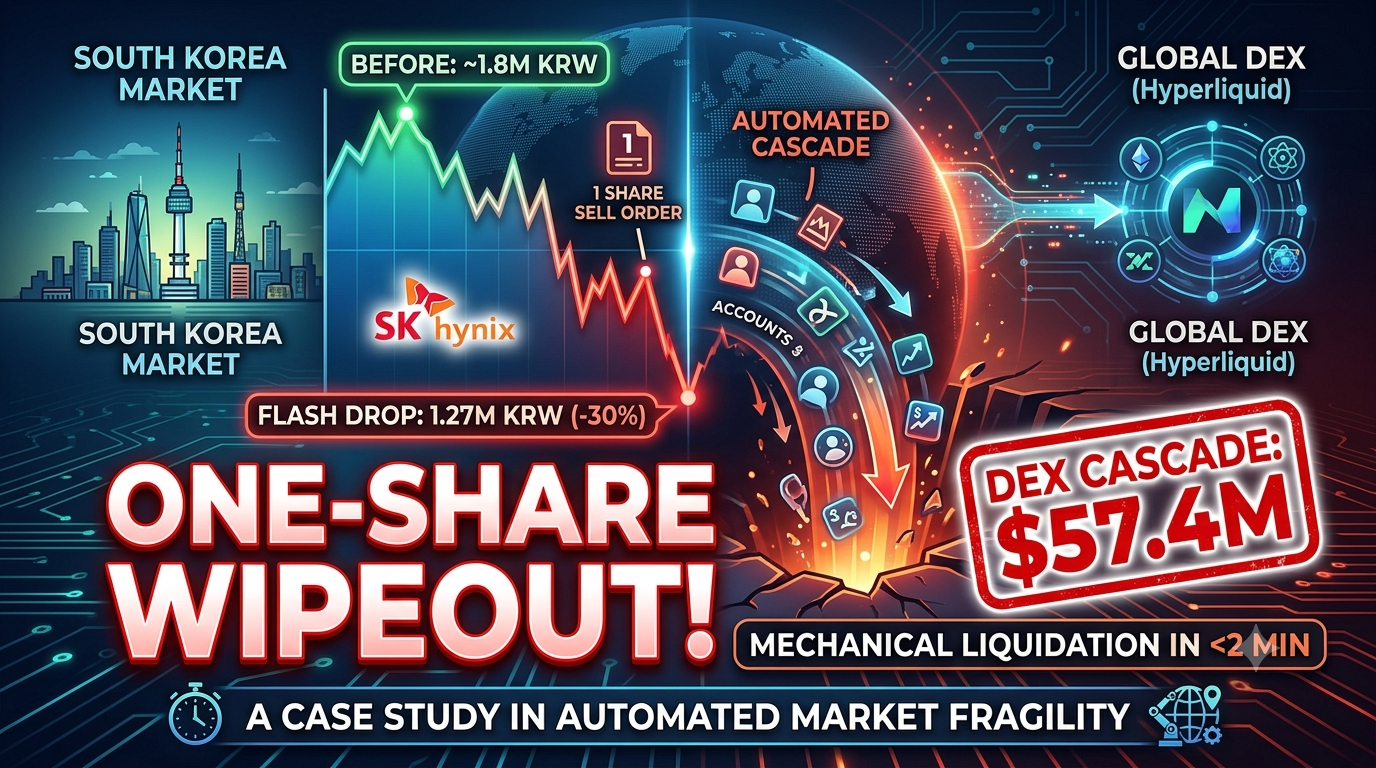
반응형At 8:00 AM on July 28, 2026, a single-share sell order for SK Hynix triggered South Korea's daily lower price limit — a 29.96% flash drop that domestic markets absorbed and corrected within seconds. But halfway around the world, on a decentralized derivatives exchange with no human oversight, that same price signal triggered an automated liquidation cascade wiping out $57.4 million in leveraged positions within two minutes. This is a case study in how thin, mechanical, and interconnected modern financial infrastructure has become.
Table of Contents
- The Trigger: A Single Share at the Lower Price Limit
- The Chain Reaction on Decentralized Perpetual Futures
- The Automated Liquidation Cascade
- Key Takeaways
- Bottom Line
The Trigger: A Single Share at the Lower Price Limit
At market open on July 28, 2026, a sell order for just one share of SK Hynix executed at 1,272,000 KRW — a 29.96% drop from the previous day's close of 1,816,000 KRW, hitting South Korea's daily lower price limit. In the domestic equity market, this barely registered as an event: ordinary buying demand absorbed the order almost immediately, and the price recovered to the 1.7 million KRW range within moments.
A Single Trade, a Global Cascade: Inside the SK Hynix DeFi Liquidation Event 반응형The Chain Reaction on Decentralized Perpetual Futures
An Automated, Human-Free Market
Unlike a traditional brokerage staffed by people who can pause trading or flag anomalies, decentralized exchanges (DEXs) run continuously through pre-programmed smart contracts. A third-party trading pool on the Hyperliquid exchange offered perpetual futures on SK Hynix, syncing its real-time reference price from South Korean price oracles.
High Leverage, Thin Margins
The pool allowed traders to take positions with up to 10x leverage. At that leverage level, maintenance margin requirements sit around just 5% — meaning a 5% adverse price move is enough to trigger automatic liquidation and protect the protocol from insolvency.
The Automated Liquidation Cascade
A Drop Far Beyond the Threshold
Even accounting for Hyperliquid's internal price-smoothing mechanism, which registered the move as roughly an 18.7% decline rather than the full 29.96%, the drop still vastly exceeded the roughly 5% threshold needed to trigger forced liquidations.
960 Accounts Liquidated in Two Minutes
Within two minutes of market open, smart contracts mechanically liquidated 960 accounts holding a combined $57.4 million in positions. Because accounts were closed out before collateral fell to zero, estimated net investor losses came to roughly $17.3 million (about 23 billion KRW) — while traders holding short positions at 10x leverage captured outsized, unplanned gains from the flash move.
Key Takeaways
- Financial automation has no discretion built in. Multi-million-dollar contracts are increasingly executed by algorithms with no capacity to pause, question, or apply human judgment to an obviously anomalous input.
- Markets are more interconnected — and more fragile — than they appear. A single-share order in a domestic equity market, corrected in seconds locally, was enough to cascade into tens of millions of dollars in losses on an entirely separate, cross-border financial system hours later.
Bottom Line
A one-share sell order that barely registered in South Korea's stock market triggered a $57.4 million automated liquidation event on a decentralized derivatives platform — a reminder that as trading infrastructure becomes more automated and more interconnected across borders, small local anomalies can produce outsized global consequences.
This article is for informational purposes only and does not constitute investment, tax, or legal advice. Readers should consult a licensed professional before making investment decisions.
반응형'Korean Equities > Company Deep Dives' 카테고리의 다른 글
Korean Stock & Equity Research
Data-driven analysis of Korean listed companies, combining financial fundamentals with supply chain and operations insights. Not investment advice.