-
Investing Guides/Account & Access
EWY ETF vs. Direct Korean Stocks: Which Wins in 2026?
2026. 8. 18.
Table
반응형EWY (iShares MSCI South Korea ETF) is the simpler choice for most foreign investors, but direct KOSPI ownership offers better tax treatment on dividends and access to stocks outside the index. The right choice depends primarily on how concentrated you're willing to be in Samsung Electronics and SK Hynix.
Table of Contents
- What Is EWY?
- How Concentrated Is EWY in Two Stocks?
- EWY vs. Direct Ownership: Full Comparison
- Which Has Better Tax Treatment?
- When Does EWY Make More Sense?
- When Does Direct Ownership Make More Sense?
- FAQ
What Is EWY?
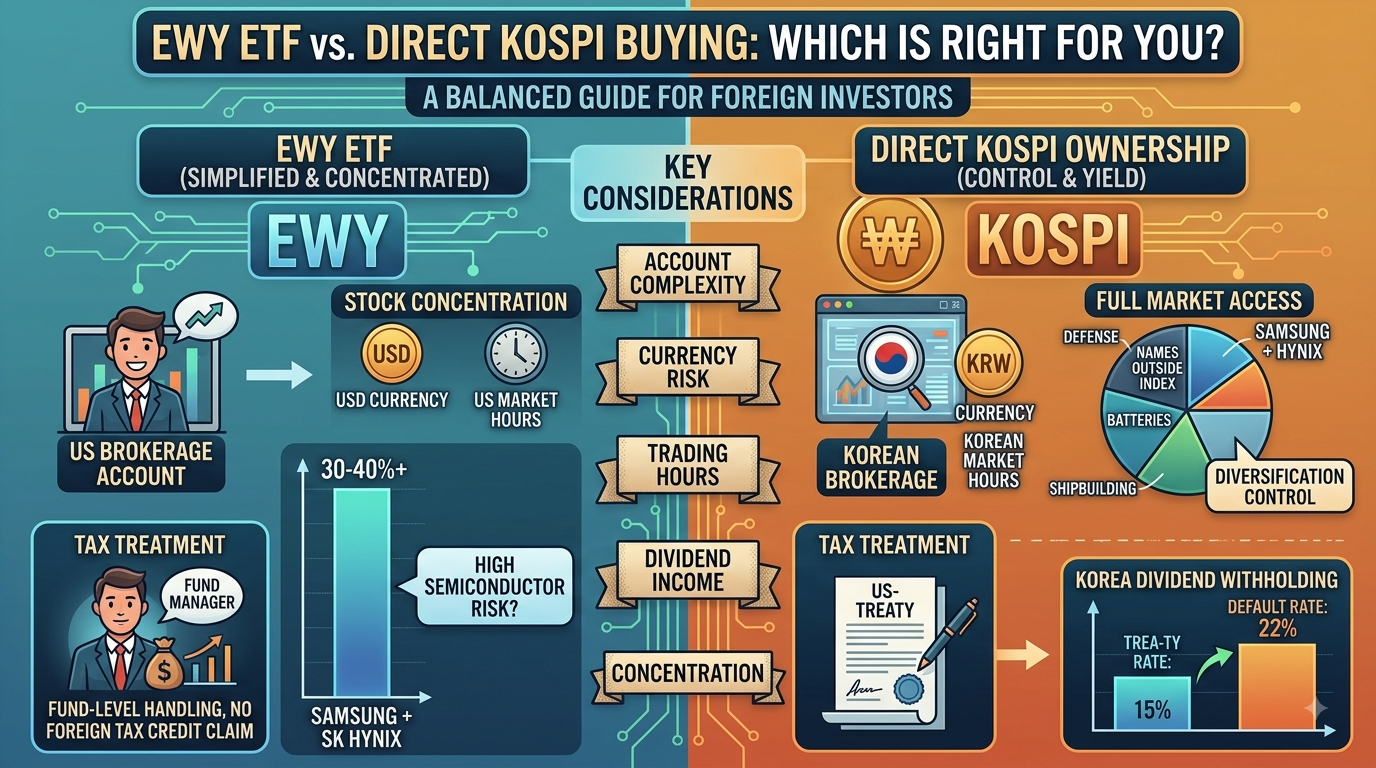
EWY is BlackRock's iShares MSCI South Korea ETF, listed on the NYSE and trading in US Dollars during standard US market hours. It tracks the MSCI Korea 25/50 Index, giving investors single-ticket exposure to a broad basket of Korean large- and mid-cap stocks without needing a Korean brokerage account, LEI, or any Korea-specific tax filings.
 반응형
반응형How Concentrated Is EWY in Two Stocks?
Because Samsung Electronics and SK Hynix together represent a large share of total KOSPI market capitalization — a dynamic amplified further by Korea's ongoing memory chip upcycle — EWY's top holdings are typically dominated by these two names, often combining for somewhere in the 30-40% range of total fund weight depending on relative price performance. This means EWY investors get less diversification benefit than the ETF's broad name count might suggest; the fund's performance is disproportionately a bet on Korean semiconductor cycles.
EWY vs. Direct Ownership: Full Comparison
Account needed Standard US brokerage Korean or international broker with Korea access Currency USD KRW (currency risk exposure) Trading hours US market hours Korean market hours (overnight for US investors) Dividend withholding US fund-level tax treatment, no Korean treaty filing needed 15% under US-Korea treaty (with W-8BEN filed) Stock selection Fixed basket, no individual control Full market access, including names outside the index Expense ratio Annual fund fee applies Per-trade brokerage commissions only Concentration risk High (Samsung + SK Hynix often 30-40%+) Investor-controlled Which Has Better Tax Treatment?
This is often the deciding factor for income-focused investors. Direct ownership under the US-Korea tax treaty caps dividend withholding at 15% (versus Korea's 22% non-treaty default), provided the correct treaty form is filed with your broker. EWY, as a US-domiciled fund, handles underlying foreign withholding at the fund level, and US investors typically can't claim an individual foreign tax credit the same way they could with direct shares — the exact tax efficiency depends on your specific tax situation and should be confirmed with a tax professional, but many investors find direct ownership marginally more tax-efficient for dividend-focused strategies. See our full breakdown in KOSPI Dividend Tax Rates for US Residents, Explained.
When Does EWY Make More Sense?
- You want Korea exposure without opening a new international brokerage relationship
- You're comfortable with the semiconductor-heavy concentration inherent to the index
- You prefer trading during standard US market hours
- You want to avoid any Korea-specific tax filing complexity
When Does Direct Ownership Make More Sense?
- You want targeted exposure to specific sectors (defense, batteries, shipbuilding) underweighted in the broad index
- You're pursuing a dividend income strategy where the treaty withholding rate materially matters
- You want to screen and select stocks using Korea Value-Up Index membership as a governance-quality filter
- You're comfortable managing KRW currency exposure and Korean market-hours trading
FAQ
Is EWY riskier than a typical broad-market ETF?
EWY carries more concentration risk than diversified global ETFs due to its heavy semiconductor-sector weighting, though this isn't unique to Korea — many single-country ETFs show similar sector concentration reflecting their home market's economic structure.
Can I hold both EWY and individual Korean stocks?
Yes, and many investors do — using EWY for baseline diversified exposure while adding direct positions in specific names for targeted conviction bets.
Does EWY pay dividends?
Yes, EWY distributes dividends from its underlying holdings, subject to standard US fund taxation rules, which differ from direct Korean share dividend treatment.
반응형'Investing Guides > Account & Access' 카테고리의 다른 글
Samsung and SK Hynix ADRs vs. Direct KOSPI Shares: Which Should You Buy? (0) 2026.08.22 KOSPI 200 vs. KOSPI Composite: What's the Difference for Investors? (0) 2026.08.22 KOSPI vs. KOSDAQ: What's the Difference for Foreign Investors? (0) 2026.08.19 Best Brokers for Foreign Investors in Korean Stocks (2026) (0) 2026.08.19 How to Open a Korean Brokerage Account in 2026 (No IRC) (0) 2026.08.18
Korean Stock & Equity Research
Data-driven analysis of Korean listed companies, combining financial fundamentals with supply chain and operations insights. Not investment advice.