-
Investing Guides/Account & Access
Samsung and SK Hynix ADRs vs. Direct KOSPI Shares: Which Should You Buy?
2026. 8. 22.
Table
반응형ADRs offer US-listed, dollar-denominated exposure to Korean companies without a Korean brokerage account, but ADR pricing can diverge meaningfully from the underlying Seoul-listed shares — SK Hynix's Nasdaq ADR traded at a 49% premium to its Seoul shares within weeks of its July 2026 debut, a gap structural constraints prevented arbitrage from closing. This article is part of our Ultimate Guide to Investing in South Korean Stocks for Foreigners.
What Is an ADR, and Why Do Korean Companies Use Them?
An American Depositary Receipt (ADR) is a US-listed, dollar-denominated certificate representing shares of a foreign company, issued by a depositary bank that holds the underlying local shares. ADRs let US investors trade during standard US market hours in USD, without opening a Korean brokerage account or handling KRW conversion directly.
 반응형
반응형Why Did SK Hynix's ADR Trade at Such a Large Premium?
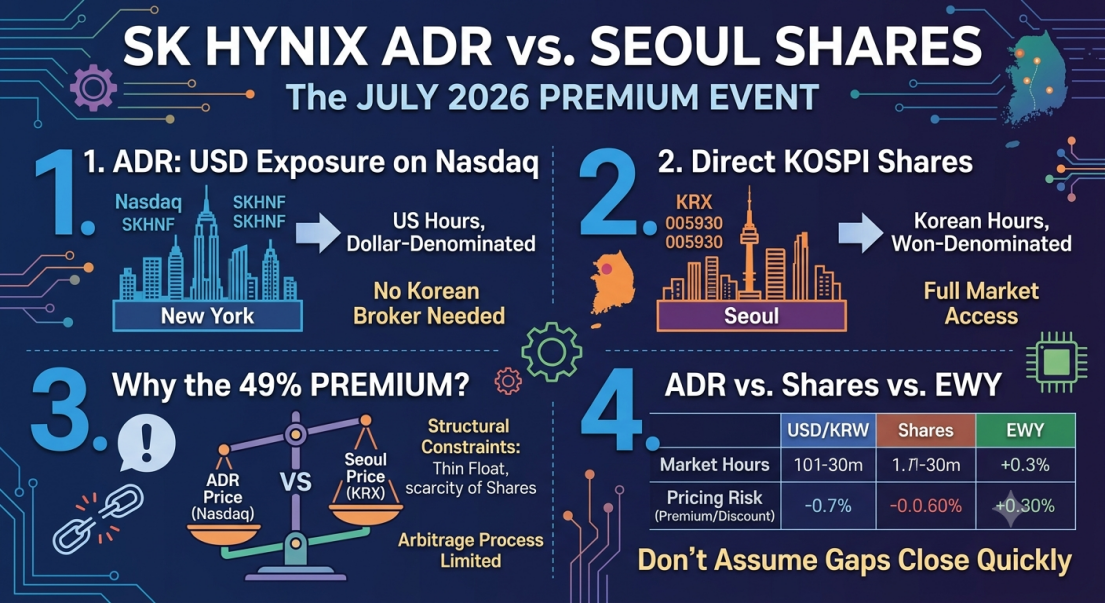
As covered in our earlier piece on the July 2026 ADR premium event, SK Hynix's ADR closed at $193.92 while the Seoul-listed shares closed at 1,941,000 Won — a 49% implied premium for the New York-listed shares. In a textbook-efficient market, this gap should invite arbitrage (buying the cheaper Seoul shares, converting to ADRs, and delivering against a short ADR position). In practice, several structural factors prevented this: the ADR conversion process wasn't yet fully operational with regulators shortly after listing, ADR shares available for short-selling were scarce (only 2.5% of total shares were issued as ADRs), and the two listings trade in different currencies across non-overlapping market hours, adding execution risk on top of currency risk.
⚠️ ADR Premiums and Discounts Aren't Always Temporary
While arbitrage theory suggests ADR and local-share pricing should converge, structural constraints — thin ADR float, conversion process limitations, and currency/market-hours mismatches — can allow meaningful, sustained gaps to persist, particularly for newly listed or thinly traded ADRs. Don't assume a large premium or discount will close quickly.
ADR vs. Direct Shares vs. EWY: Full Comparison
Factor ADR Direct KOSPI Shares EWY Currency USD KRW USD Trading hours US hours Korean hours (overnight for US investors) US hours Availability Limited to companies with ADR programs Full market access Fixed basket, no individual selection Pricing risk Can diverge from underlying (premium/discount) Direct market price Tracks index methodology, not individual stock price Frequently Asked Questions
Q1. Do all major Korean companies have US-listed ADRs?
A. No, ADR availability varies by company; not every KOSPI-listed name has established an ADR program, and available programs can differ in structure (sponsored vs. unsponsored).
Q2. Should I expect ADR premiums or discounts to always be small?
A. No — as SK Hynix's 2026 example shows, structural factors like float scarcity and conversion limitations can produce large, sustained gaps, particularly for newly listed ADRs.
Q3. Do ADRs pay dividends the same way as direct shares?
A. ADR holders generally receive dividends converted to USD by the depositary bank, though fees and currency conversion mechanics can differ slightly from direct KRW dividend receipt.
반응형'Investing Guides > Account & Access' 카테고리의 다른 글
Korean Stock & Equity Research
Data-driven analysis of Korean listed companies, combining financial fundamentals with supply chain and operations insights. Not investment advice.