-
Investing Guides/Account & Access
KOSPI 200 vs. KOSPI Composite: What's the Difference for Investors?
2026. 8. 22.
Table
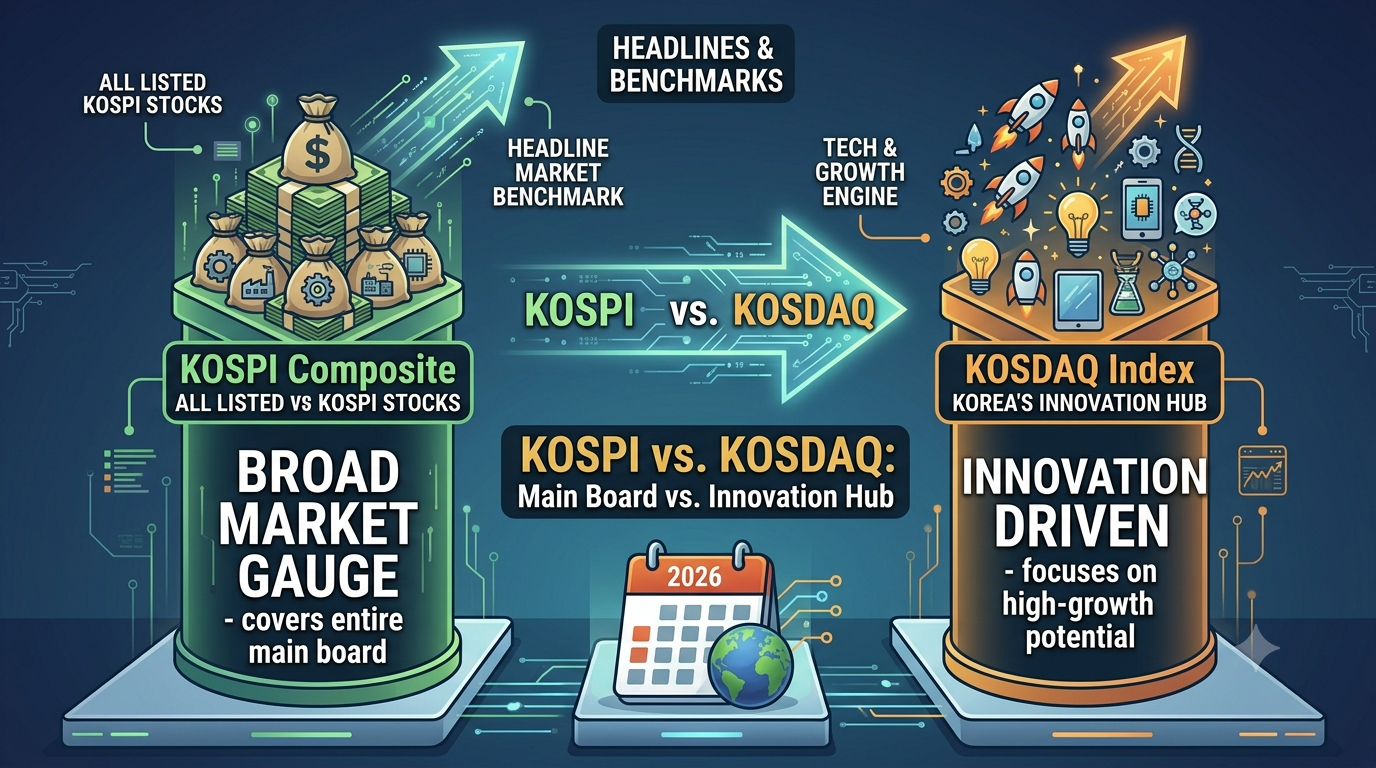
반응형The KOSPI Composite Index tracks all stocks listed on Korea's main board, while the KOSPI 200 tracks only the 200 largest and most liquid of those companies by market capitalization and trading volume. When people casually say "KOSPI is up 2%," they're almost always referring to the Composite; the KOSPI 200 exists primarily as the basis for derivatives products like index futures and options. This article is part of our Ultimate Guide to Investing in South Korean Stocks for Foreigners.
How Do the Two Indices Differ?
Feature KOSPI Composite KOSPI 200 Constituents All KOSPI-listed stocks 200 largest, most liquid KOSPI stocks Primary use Headline market benchmark ("KOSPI") Basis for index futures and options What EWY tracks Neither directly — EWY tracks MSCI Korea 25/50 Neither directly Volatility gauge N/A Basis for VKOSPI (Korea's "fear index") Why Does This Distinction Matter for Foreign Investors?
Most retail-facing Korea ETFs, including EWY, don't track either index directly — EWY tracks the MSCI Korea 25/50 Index, a separate methodology run by MSCI rather than the Korea Exchange. If you're comparing "KOSPI performance" reported in financial news against your EWY returns, you're comparing two related but distinct benchmarks, which can diverge meaningfully depending on sector weighting differences and index rebalancing timing.
 반응형
반응형What Is VKOSPI?
VKOSPI is Korea's implied volatility index, calculated from KOSPI 200 index option prices — functioning similarly to the VIX for the S&P 500. A rising VKOSPI signals the options market is pricing in greater expected volatility, and levels above 50 are generally considered "extreme fear" territory in Korean markets. As covered in our earlier piece on foreign selling in Korean equities, sustained elevated volatility can mechanically force institutional investors managing fixed risk budgets to reduce position sizes, independent of their actual view on individual stocks.
Frequently Asked Questions
Q1. When news says "KOSPI closed at 5,500," which index is that?
A. That's almost always the KOSPI Composite Index, the headline benchmark covering all KOSPI-listed stocks.
Q2. Can I invest directly in the KOSPI 200 as a foreigner?
A. You can't buy the index itself, but Korean-listed ETFs tracking KOSPI 200 exist, along with index futures and options for investors with derivatives access.
Q3. Does EWY performance closely match KOSPI Composite performance?
A. Generally correlated but not identical, since EWY follows MSCI's own index methodology and constituent selection rather than tracking KOSPI Composite directly.
반응형'Investing Guides > Account & Access' 카테고리의 다른 글
Korea Short Selling Rules: What Foreign Investors Need to Know (2026) (0) 2026.08.23 Samsung and SK Hynix ADRs vs. Direct KOSPI Shares: Which Should You Buy? (0) 2026.08.22 KOSPI vs. KOSDAQ: What's the Difference for Foreign Investors? (0) 2026.08.19 Best Brokers for Foreign Investors in Korean Stocks (2026) (0) 2026.08.19 EWY ETF vs. Direct Korean Stocks: Which Wins in 2026? (0) 2026.08.18
Korean Stock & Equity Research
Data-driven analysis of Korean listed companies, combining financial fundamentals with supply chain and operations insights. Not investment advice.