-
Macro & Policy/Tax & Fiscal Policy
Korea's Central Bank Just Ended a 13-Year Gold Boycott — Here's Why It Stopped Buying
2026. 8. 12.
Table
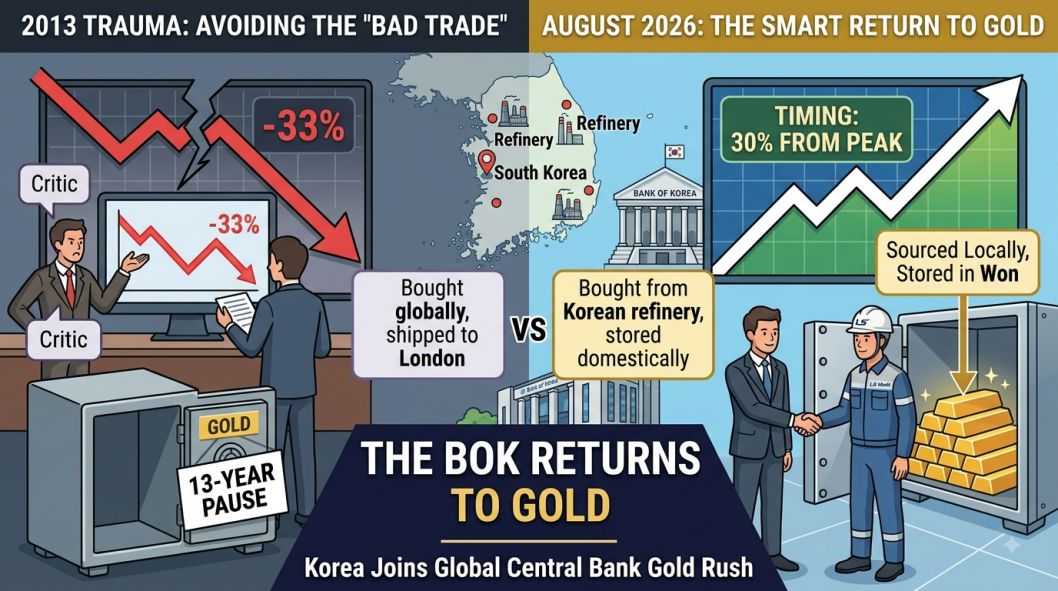
반응형In 2013, South Korea's central bank stopped buying gold entirely after a purchasing spree left it staring at a 33% paper loss and years of public criticism in parliamentary audits. It didn't buy another gram for 13 years. On August 3, 2026, the Bank of Korea broke that silence — and this time, it's buying differently.
Table of Contents
- The 2011-2013 Purchase and the Backlash That Followed
- How the "Bad Trade" Became a Winning One
- Thirteen Years of Silence
- Where Korea's Gold Sits — And Its Own Risk
- August 2026: A Different Approach to Buying Gold
- China Is Doing the Same Thing, Faster
- Bottom Line
The 2011-2013 Purchase and the Backlash That Followed
Between July 2011 and February 2013, the Bank of Korea (BOK) purchased 90 tons of gold across five separate transactions, starting with 25 tons at $1,544 per ounce and continuing through $1,606 per ounce, for an average purchase price of roughly $1,628 per ounce. That 90 tons still makes up the large majority of the BOK's current 104.4-ton total gold reserve.
The timing proved unfortunate. Gold prices peaked in September 2011, just as the BOK's buying program was underway, and fell steadily afterward. By the 2013 parliamentary audit, the central bank faced sharp criticism for what lawmakers characterized as buying gold without any sense of where prices were headed, and the "bought at the top" narrative persisted in legislative hearings and financial press for years. By late 2015, gold had fallen to roughly $1,091.50 per ounce, putting the BOK's position at an estimated 33% unrealized loss, equivalent to roughly 1.886 trillion Won.
From Parliamentary Scandal to Vindication: The Bank of Korea's Gold Trade, Explained 반응형How the "Bad Trade" Became a Winning One
Starting in 2018, the US-China trade war and slowing global growth weakened the Dollar and pushed investors toward safe-haven assets, and gold entered a sustained rally. The same 90 tons that had drawn years of criticism and reportedly led to internal staff reassignments away from gold-related roles saw its value climb from roughly $4.7 billion at cost to roughly $12.6 billion.
Thirteen Years of Silence
Despite the eventual recovery, the episode left a lasting institutional scar. The BOK didn't purchase a single additional gram of gold for the next 13 years. As a result, Korea's total gold holdings remain essentially frozen at 104.4 tons, ranking 41st globally, behind even Venezuela's 161.2 tons. Gold makes up an average of roughly 27% of foreign exchange reserves across global central banks; for Korea, that figure sits at just 1.1%.
Where Korea's Gold Sits — And Its Own Risk
Korea's 104.4 tons of gold — roughly 8,380 gold bars of 11-13kg each — is stored at the Bank of England in London. The Bank of England generates income by lending out portions of the gold it custodies to global investment banks, with Korea receiving a share of that lending revenue to help offset storage fees. This arrangement carries its own tail risk: if a central bank needed to withdraw its gold and the loaned-out portion couldn't be recalled quickly enough, it could face a shortfall — a scenario sometimes referred to as a "gold run," analogous to a bank run but for physical reserves held offsite.
August 2026: A Different Approach to Buying Gold
On August 3, 2026, the Bank of Korea resumed gold purchases for the first time in 13 years, but with a notably different structure than its 2011-2013 program. Korea is a net gold exporter: domestic refiners including LS MnM and Korea Zinc produce roughly 40-45 tons of gold annually as a byproduct of copper and zinc smelting, of which 35-40 tons is consumed domestically and 4-5 tons exported. The BOK's new purchase program targets this domestically produced gold specifically, buying directly from LS MnM in a newly established partnership.
This structural shift carries several practical differences from the 2011-2013 program: purchases are made in Won rather than Dollars, since the gold is sourced domestically rather than internationally; the gold is stored within Korea rather than shipped to London; and the purchases began after gold had already pulled back roughly 30% from its recent peak, a timing choice that appears deliberately designed to avoid repeating the "bought at the top" criticism from 2013. The BOK has also begun purchasing overseas-listed physical gold ETFs alongside direct bullion purchases, a diversification in approach not used in the earlier program.
China Is Doing the Same Thing, Faster
Korea isn't acting in isolation. China's central bank has also accelerated its own gold buying, purchasing 640,000 ounces (roughly 20 tons) in July 2026 alone, its largest monthly purchase since October 2023, marking five consecutive months of increasing purchase volume since March 2026. China faces a similar structural gap to Korea: gold represents just 8.8% of its foreign exchange reserves against the roughly 27% global central bank average, meaning it likely has substantial further buying ahead of it if it aims to close that gap, a shift that has coincided with reduced US Treasury purchases in recent years.
Bottom Line
The Bank of Korea's return to gold buying after a 13-year pause driven by the trauma of a poorly timed 2011-2013 purchase reflects a broader pattern among global central banks, with China also accelerating its own gold accumulation as both countries work to close a substantial gap versus the roughly 27% average gold allocation held by central banks globally. Total central bank gold purchases reached 863 tons in 2025, with 2026 volumes tracking above 900 tons as more central banks, including Korea's, re-enter the market.
This article is for informational purposes only and does not constitute investment, tax, or legal advice. Readers should consult a licensed professional before making investment decisions.
반응형'Macro & Policy > Tax & Fiscal Policy' 카테고리의 다른 글
Korean Stock & Equity Research
Data-driven analysis of Korean listed companies, combining financial fundamentals with supply chain and operations insights. Not investment advice.