-
Macro & Policy/Tax & Fiscal Policy
Why Korea's Tax-Free ISA Still Trails Japan and the UK
2026. 9. 7.
Table
반응형South Korea's Individual Savings Account (ISA) just went through a month of policy whiplash: a July 31 tax-reform proposal that would have shortened contract terms and killed contribution carryover, followed by a September 1 cabinet reversal that restored both. The back-and-forth is a useful window into why Korea's version of the tax-advantaged retail investment account has never generated the enthusiasm its UK and Japanese counterparts have, and what the government is now trying — awkwardly — to do about it. This analysis is part of Koreanalysis's coverage of Korea's tax and fiscal policy for retail investors.
반응형What Is Korea's ISA, and Why Has It Underperformed?
Korea launched its ISA in March 2016, modeled on the UK's Individual Savings Account, which the UK created in 1999 by merging two earlier tax-exempt vehicles (PEP for equities, TESSA for deposits) into a single account that could hold cash, stocks, bonds, and funds free of tax on the returns. The UK version worked: according to industry figures compiled by wealth platform AJ Bell, more than 22 million adults now hold an ISA, and the accounts collectively hold hundreds of billions of pounds. Japan copied the model in 2014 as NISA (Nippon Individual Savings Account) and, after a slow start, overhauled it in 2024 into "new NISA" — unlimited holding period, an annual cap raised to ¥3.6 million, and a lifetime cap of ¥18 million, with eligible assets extended to funds tracking the S&P 500 and Nasdaq. Monthly new NISA sign-ups reportedly jumped from roughly 180,000 to 530,000 after the overhaul.
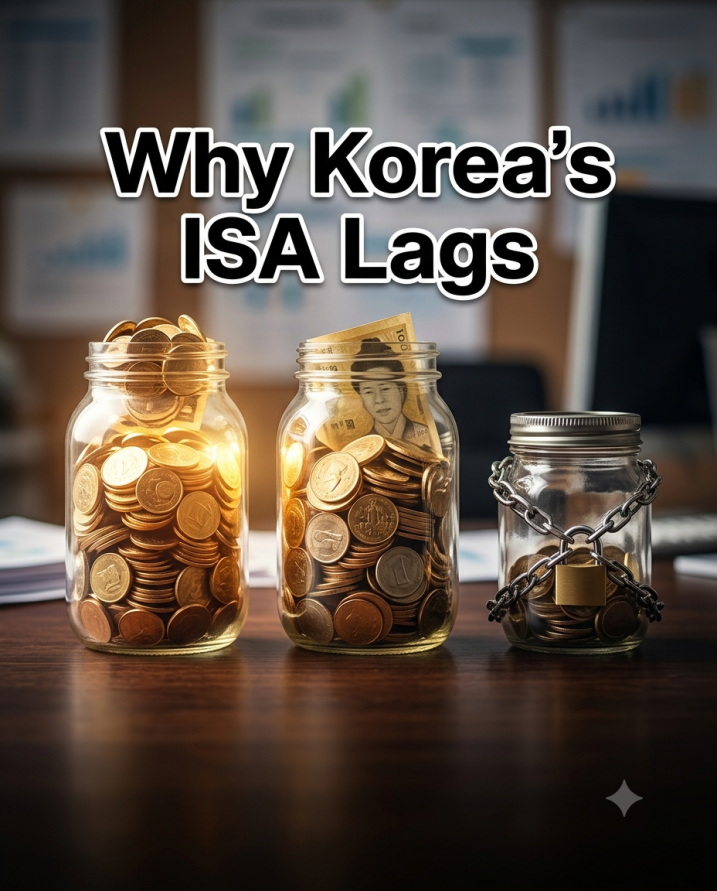
Korea's ISA, by contrast, started with an annual contribution cap of 20 million won, tax-free treatment on only the first 2 million won of gains, 9.9% separate taxation above that, and a mandatory five-year lock-up. Adoption was correspondingly modest — around 2.13 million accounts three years after launch, versus the tens of millions the UK and Japan eventually reached.
Feature UK ISA Japan New NISA (2024) Korea ISA (standard) Holding period cap None None (unlimited, as of 2024) 5 years (mandatory) Annual contribution cap ≈£20,000 (≈₩34 million) ¥3.6 million (≈₩33 million) ₩20 million Lifetime cap None ¥18 million (≈₩165 million) ₩100 million Overseas assets eligible Yes Yes (S&P 500, Nasdaq funds, etc.) Yes (standard ISA only) Tax-free gains threshold Unlimited within contribution cap Unlimited within contribution cap ₩2–4 million, then 9.9% tax Why Doesn't Korea Just Copy the UK Model?
The straightforward answer would be to strip out the caps and lock-up periods the way Japan did in 2024. Korea's policymakers have resisted that for a structural reason that doesn't apply to the UK or Japan: Korean retail investors already pay no capital gains tax on listed stock and fund gains, outside of a small pool of "major shareholders" who cross specific ownership thresholds. The UK and Japan tax stock gains and dividends at roughly 20%, so an ISA or NISA wrapper that removes that tax is a large, visible benefit. In Korea, an ISA only shelters interest and dividend income — the gains most retail investors care about were never taxed to begin with. That structurally caps how generous a Korean ISA can ever feel, no matter how the caps are set.
⚠️ Don't compare headline caps in isolation
A reader scanning the table above might conclude Korea's ISA is simply stingier than the UK's or Japan's. The more complete picture is that Korea is retrofitting a UK-style wrapper onto a tax base that was already largely exempt for retail stock gains, which is also why any expansion of ISA benefits draws "tax break for the wealthy" criticism in the Korean National Assembly — there's less room to make the account generous without it reading as a giveaway on dividend and interest income specifically, which skews toward higher-income, larger-balance households.
What Changed in the 2026 Reform, and Why Did It Reverse So Fast?
The July 31 tax-reform announcement introduced a new "productive finance ISA" (생산적금융 ISA) aimed squarely at directing household savings into the domestic stock market: interest and dividend income fully tax-exempt, an annual cap of 20 million won and a lifetime cap of 200 million won, plus a 10% income-tax deduction on contributions for investors aged 15–34. The catch was that it restricted eligible holdings to domestic stocks, domestic equity funds, and government-backed growth funds — explicitly excluding the overseas-listed ETFs (S&P 500, Nasdaq trackers) that Korean retail investors, sometimes called "seohak-gaemi" (서학개미, "overseas-studying ants"), have increasingly used inside their existing ISAs.
The same proposal would have tightened the existing standard ISA for all 9.73 million current holders: eliminating the ability to carry unused annual contribution room into future years, and capping the contract term at five years even for accounts that previously had no such limit. Both changes would have made long-term, lump-sum contribution patterns — putting in a large amount in a bonus year, for instance — harder to execute, which cuts against the compounding logic that makes these accounts valuable in the first place.
That drew enough pushback that, per the September 1 cabinet meeting, the government withdrew both changes: contribution carryover and open-ended contract terms remain in place for the standard ISA, and the new productive finance ISA also dropped its originally proposed maximum term. The government additionally agreed to let the youth version of the productive finance ISA be held alongside the separate youth futures savings account, rather than forcing a choice between them.
✅ What this episode signals about Korean capital-markets policy
- The government is actively trying to use tax policy to pull household savings toward domestic equities — consistent with the broader "Korea Value-up" push to lift chronically low valuations.
- The National Assembly and public pushback moved fast: a restrictive proposal announced August 3 was substantially reversed by September 1, a rare pace for Korean tax legislation.
- The exclusion of overseas ETFs from the new productive finance ISA remains in place — the reversal fixed the standard ISA's terms, not the domestic-only restriction on the new product, so the tension between "grow domestic markets" and "let households diversify globally" is unresolved.
Korea's ISA keeps getting redesigned around the edges because its core constraint — a retail capital-gains tax base that was mostly zero to begin with — means the account can never offer the same headline tax win the UK's or Japan's version does.
What Should Investors Watch Next?
The productive finance ISA's domestic-only restriction still has to clear the National Assembly before it takes effect, and lawmakers who objected to the standard ISA's tightening may take a similar run at the overseas-asset exclusion. Separately, a related set of "stock price support" measures floated alongside this reform — reportedly still under legislative discussion as of early September — could matter more directly for index-level flows than the ISA changes themselves. For readers tracking how Korean retail money moves between domestic and overseas assets, this reform is worth revisiting once the National Assembly session concludes and the final rules are locked in.
Frequently Asked Questions
Q1. Is Korea's ISA available to foreign residents?
A. ISA eligibility in Korea is generally tied to Korean tax residency and having a resident registration record with a domestic brokerage or bank, rather than nationality — but the specific documentation requirements for foreign nationals vary by institution, so this is worth confirming directly with a Korean brokerage rather than assuming eligibility either way.
Q2. Why is Korea's ISA less generous than Japan's or the UK's if the government wants more retail investment?
A. Largely because Korean retail investors already don't pay capital gains tax on most listed stock and fund gains, so an ISA-style wrapper only has interest and dividend income left to exempt — a structurally smaller benefit than in the UK or Japan, where stock gains themselves are taxed and the account removes that tax.
Q3. Does the new productive finance ISA allow overseas ETFs like S&P 500 or Nasdaq trackers?
A. No. As proposed, the productive finance ISA restricts holdings to domestic stocks, domestic equity funds, and government-backed growth funds; overseas-listed ETFs remain eligible only in the standard ISA, whose terms were left unchanged by the September 1 reversal.
Korea's ISA keeps getting redesigned around the edges because its core constraint — a retail capital-gains tax base that was mostly zero to begin with — means the account can never offer the same headline tax win the UK's or Japan's version does.
반응형'Macro & Policy > Tax & Fiscal Policy' 카테고리의 다른 글
Korean Stock & Equity Research
Data-driven analysis of Korean listed companies, combining financial fundamentals with supply chain and operations insights. Not investment advice.