-
Macro & Policy/Tax & Fiscal Policy
Why Korea's CPI Looks So Calm While Seoul Apartment Prices Soar
2026. 8. 17.
Table
반응형South Korea's official inflation rate sits comfortably around 2.4%, even as Seoul apartment prices have risen sharply this year. That gap isn't a mystery — it's a direct consequence of what Korea's CPI basket does and doesn't measure, and a new housing finance package could be about to test that gap's limits.
Table of Contents
- Comparing Korean and US CPI Baskets
- The Missing Piece: Owners' Equivalent Rent
- How Korea Measures Housing Costs Instead
- Why Korea Excludes Home Prices From CPI
- The August 13 Housing Finance Package
- How Easier Credit Could Still Reach CPI
- What This Means for Bank of Korea Policy
- Bottom Line
Comparing Korean and US CPI Baskets
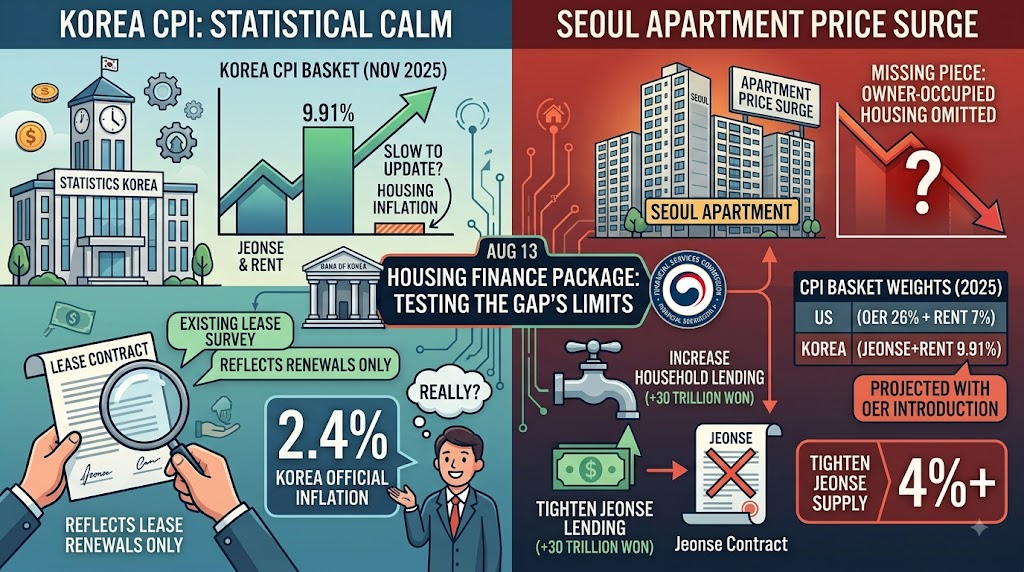
Korea's Statistics Korea (as of November 2025) and the US Bureau of Labor Statistics (as of September 2025) weight their CPI baskets quite differently. Housing-related costs make up roughly 34% of the US basket, split between owners' equivalent rent (roughly 26%) and actual rent (roughly 7%). In Korea's CPI, there is no equivalent housing-price category at all — the closest analog, combined jeonse (lump-sum deposit lease) and monthly rent, totals only about 9.91% of the basket.
 반응형
반응형The Missing Piece: Owners' Equivalent Rent
The US concept of Owners' Equivalent Rent (OER) asks what a homeowner would need to pay if renting their own home from themselves — essentially imputing a rental value for owner-occupied housing, adjusted against actual market rent survey data collected by the BLS. This means home price appreciation gets indirectly captured in US inflation data through the implied rental value of that appreciation, even for homeowners who aren't actually paying rent.
Korea's CPI has no equivalent OER concept. The stated rationale is that Korean housing functions more as an investment asset than a consumption good, and therefore doesn't belong in a consumer price index. Only Korea, France, and Italy among major economies currently exclude owner-occupied housing costs from their CPI in this way.
How Korea Measures Housing Costs Instead
The only housing-related costs Korea's CPI captures are jeonse and monthly rent payments — and even these are captured slowly. Korean jeonse and rental contracts typically run for two years, and Statistics Korea surveys existing contracts rather than new market rates, meaning rent increases don't show up in the CPI data until individual leases actually renew. A landlord raising asking rent today may not affect the CPI for up to two years, until that specific unit's lease comes up for renewal.
Why Korea Excludes Home Prices From CPI
The Bank of Korea has reportedly advocated for years to incorporate owner-occupied housing costs into the CPI more directly, and policymakers are generally aware of the resulting gap between headline CPI and how expensive housing actually feels to consumers. But incorporating OER-style measurement has historically been avoided specifically because it would push headline CPI meaningfully higher during periods of home price appreciation — a politically unwelcome outcome regardless of which party holds power. Analysis of the 2019 period, when Seoul home prices rose sharply, suggests incorporating OER-style measurement then would have added over 2 percentage points to headline CPI. Given comparable or larger home price gains in Seoul in 2026, a similar adjustment today could plausibly push reported CPI from the 2% range toward or above 4%.
The August 13 Housing Finance Package
On August 13, 2026, Korea's Financial Services Commission announced a "Comprehensive Financial Package for Real Estate Market Stability," alongside a related housing supply acceleration plan. The centerpiece was doubling the annual household loan growth target from 1.5% to 3.0% — based on total household loan balances of roughly 1,853 trillion Won at year-end 2025, this translates to available new lending capacity rising from roughly 30 trillion Won to roughly 60 trillion Won for the year.
The immediate trigger was a lending bottleneck: strong first-half stock market performance drove a surge in margin-style credit lending that ate into banks' loan quotas, while rising home transactions further strained available capacity. By July, Korea's five largest banks (Kookmin, Shinhan, Hana, Woori, NongHyup) had exhausted their quotas, leaving roughly 70,000 households scheduled to move into new homes in the second half unable to secure the interim and balance loans (jandeum) needed to complete their purchases — producing widely reported "loan opening runs," where prospective borrowers lined up before bank branches opened to secure a spot before daily quotas filled. Separately, the package expanded project financing (PF) support for construction from 26.3 trillion Won to 47.8 trillion Won, and explicitly carved housing-supply-linked loans (relocation costs, interim, and balance loans for new developments) out of banks' regular household loan quotas entirely, rather than just adjusting the overall cap — meaning these loans no longer compete with other household lending capacity at all.
How Easier Credit Could Still Reach CPI
The roughly 30 trillion Won in expanded lending capacity is directed at home purchases rather than general consumption, meaning it has limited direct effect on driving CPI higher through consumer spending channels. The more relevant transmission runs through home prices: easier access to mortgage and interim financing increases purchasing power for housing specifically, adding upward pressure on home prices — pressure that, because home prices sit entirely outside Korea's CPI basket, wouldn't show up in headline inflation data even as asset prices rise.
A second, more direct channel does run through Korea's CPI. The package also restricts jeonse (deposit lease) loans for single-home owners who don't occupy their own property, intended to push these owners toward occupying their homes themselves rather than renting them out. If landlords respond by converting rental units to owner-occupied use, rental supply shrinks — and reduced supply typically pushes rental prices higher, a channel that does flow into Korea's CPI, unlike home price appreciation itself. Hyundai Research Institute has reportedly warned that residency-focused housing measures could tighten jeonse and rental supply-demand balance enough to add inflationary pressure in the second half of 2026.
What This Means for Bank of Korea Policy
This creates a policy tension: financial regulators are actively easing credit access to support housing supply and first-time buyers, while the Bank of Korea has to separately manage the resulting side effects on household debt, home prices, and eventually consumer prices. The Bank of Korea raised its policy rate from 2.50% to 2.75% in July 2026, its first hike after eight consecutive holds, and the combination of expanded credit capacity and prospective rental market tightening from the August 13 package adds to the case for further tightening later this year.
Bottom Line
Korea's CPI appears far more stable than the US equivalent largely because it excludes owner-occupied housing costs entirely and captures rental costs slowly and at low weight — a structural choice, not a reflection of actual cost-of-living pressure, that would add an estimated 2+ percentage points to headline inflation during periods of strong home price appreciation like 2026's Seoul market. The August 13 housing finance package, which doubles available household lending capacity while also tightening rental supply for non-resident single-home owners, adds both an indirect asset-price channel and a more direct rental-price channel that could show up in Korean inflation data with a lag — adding to the case for continued Bank of Korea tightening.
This article is for informational purposes only and does not constitute investment, tax, or legal advice. Readers should consult a licensed professional before making investment decisions.
반응형'Macro & Policy > Tax & Fiscal Policy' 카테고리의 다른 글
Korean Stock & Equity Research
Data-driven analysis of Korean listed companies, combining financial fundamentals with supply chain and operations insights. Not investment advice.