-
Macro & Policy/Tax & Fiscal Policy
South Korea's 2026 Real Estate Tax Reform: Who Wins and Who Loses
2026. 8. 5.
Table
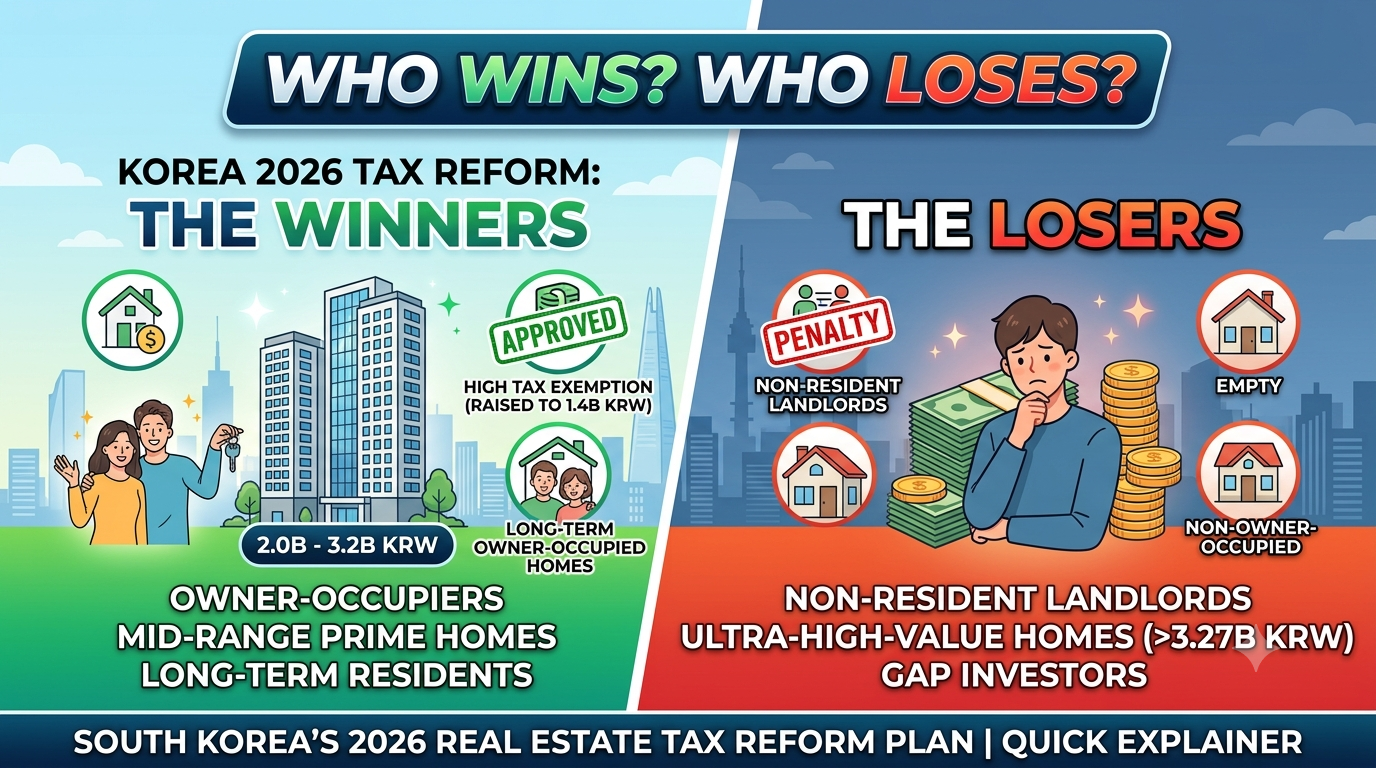
반응형South Korea's 2026 Real Estate Tax Reform Plan marks one of the most significant shifts in property taxation policy in recent years. At its core, the reform tightens the tax burden on non-resident and high-value property owners while concentrating benefits on single-home owners who actually live in their property. For anyone holding, buying, or analyzing Korean real estate assets, understanding who wins and who loses under this plan is essential.
Table of Contents
- Who Loses Under the Reform
- Who Benefits Under the Reform
- Comparison at a Glance
- Update: Official Confirmation and Legislative Timeline
- Bottom Line
Who Loses Under the Reform
1. Non-Resident Single-Home Owners (Gap Investors / Leased Properties)
Owner-occupiers will see their Comprehensive Real Estate Tax base deduction rise to 1.4 billion KRW. Non-resident single-home owners, by contrast, will see their deduction fall to 900 million KRW. Long-term holding special deductions on capital gains tax are also reduced or eliminated for owners who do not reside in the property, meaningfully increasing their overall tax burden.
Korea's New Property Tax Rules 2026 — Winners, Losers, and What It Means for Investors 반응형2. Long-Term Owners Without Actual Residency
Starting in 2029, the holding-period deduction (up to 40%) will be eliminated entirely, leaving only the residency-based deduction (up to 80%). Sellers of high-value homes with short residency periods will face steep reductions in available deductions. In the reform's own example calculation, capital gains tax on one such case rises from roughly 260 million KRW to about 446 million KRW.
3. Ultra-High-Value "Prime Single-Home" Owners
Homes with a market value above roughly 3.27 billion KRW (declared value near 2.26 billion KRW) face a tax rate increase of 0.3 percentage points, with the increase becoming steeper for properties valued above 4.6 billion KRW.
4. Renters and Tenants
Because the reform penalizes non-residency, many landlords are expected to move into their own properties rather than lease them out. With roughly 56% of Seoul housing currently non-owner-occupied, this shift could shrink rental supply, particularly in the 2.0–3.2 billion KRW market segment, raising the risk of a rental listing shortage.
5. Low-Income Elderly Owners of High-Value Single Homes
The combined cap on tax credits for senior citizens and long-term owners will be reduced to 6 million KRW by 2028, raising holding taxes for this group. Relief programs offering 30–50% capital gains tax reductions exist for seniors relocating to non-metropolitan areas, but practical barriers such as healthcare access and social ties often make local downsizing a more realistic outcome than relocation.
Who Benefits Under the Reform
1. Owner-Occupied Single Homes Valued at 2.0–3.2 Billion KRW
This group is widely seen as the biggest beneficiary of the reform. Owners gain from the raised Comprehensive Real Estate Tax exemption threshold (from 1.2 billion to 1.4 billion KRW) while staying below the 3.2 billion KRW mark that triggers the new rate hikes. Typical residential apartments in prime Seoul districts such as Mapo, Yongsan, and Seongdong fall cleanly into this bracket.
2. Newly Built, Standard-Sized (84m²), and Top-School-District Apartments
As tax benefits increasingly hinge on actual long-term residency, properties offering comfortable, sustainable living conditions — new builds, standard family-sized units, and strong school districts — are expected to see rising demand and value appreciation.
Comparison at a Glance
Non-resident single-home owners Negative Deduction drops to 900M KRW Long-term non-resident owners Negative Holding deduction eliminated by 2029 Prime single-homes (>3.27B KRW) Negative +0.3%p tax rate Renters/tenants Negative (indirect) Shrinking rental supply Elderly high-value owners Negative Lower combined tax credit cap Owner-occupiers, 2.0–3.2B KRW Positive Raised exemption threshold, no rate hike New/standard-size/school-district homes Positive Rising demand from residency incentives Update: Official Confirmation and Legislative Timeline (August 2026)
On August 3, 2026, Korea's Ministry of Economy and Finance officially confirmed this reform as part of its broader 2026 Tax Reform Package, presented under the framework "a home is a place to live, not an asset to trade." Deputy Prime Minister and Finance Minister Koo Yun-cheol stated that the reform aims to "normalize excessive benefits" by reducing base deductions for non-resident and multi-home properties.
Confirmed Numbers Behind the Framework
Independent government sources confirm and refine several figures from the original proposal:
- High-value threshold confirmed at 3.2 billion KRW: Properties valued above this level face escalating Comprehensive Real Estate Tax rates, consistent with the roughly 3.27 billion KRW figure cited in initial reporting. Officials specifically noted that typical apartments in Mapo, Yongsan, and Seongdong — Seoul's "Ma-Yong-Seong" corridor — fall below this threshold and are largely insulated from the increase.
- Multi-home owners gain a basic deduction for the first time: Under the confirmed plan, owners of multiple properties will receive a 400 million KRW base deduction — a category that previously had no deduction at all. This detail wasn't specified in earlier reporting on the framework.
- Tax credit caps are being phased down further than initially described: The combined senior citizen and long-term holding tax credit cap will fall from 8 million KRW in 2027 to 6 million KRW in 2028, a steeper near-term reduction than earlier estimates suggested.
- Fair market value ratio (공정시장가액비율) can rise to 80%: This ratio, which determines what share of a property's assessed value is subject to tax, is set to increase toward 80% — meaning the raised deduction thresholds don't automatically translate into lower tax bills for everyone, since this ratio increase works in the opposite direction.
- Temporary two-home grace period shortened: Separately, the grace period allowing owners to hold two homes temporarily (e.g., during a move) without capital gains tax penalty is being shortened from 3 years to 2 years, applicable to new acquisitions from August 4, 2026 onward.
This Is Still a Proposal, Not Law
A critical caveat missing from most early coverage: as of the August 3 announcement, this remains a government proposal, not enacted legislation. The reform is subject to a legislative pre-announcement period (August 4–20, 2026), followed by Cabinet review, before formal submission to Korea's National Assembly in early September 2026. The plan could still see amendments during this process before taking effect — most provisions are slated to phase in starting 2028, with some tightening further in 2029.
Why This Matters for the Original Analysis
The core conclusion of this piece — that a single, owner-occupied home under 3.2 billion KRW is the clearest beneficiary — holds up under the confirmed details. But the addition of a first-ever basic deduction for multi-home owners suggests the reform's treatment of that group is somewhat less punitive than initially framed, while the rising fair market value ratio is a partial offset to the benefits owner-occupiers might otherwise expect from the higher deduction threshold.
Bottom Line
A single, owner-occupied home valued under 3.2 billion KRW that is suitable for long-term residency emerges as the asset class benefiting most from this tax reform.
This article is for informational purposes only and does not constitute investment, tax, or legal advice. Readers should consult a licensed professional before making real estate or investment decisions.
반응형'Macro & Policy > Tax & Fiscal Policy' 카테고리의 다른 글
Korean Stock & Equity Research
Data-driven analysis of Korean listed companies, combining financial fundamentals with supply chain and operations insights. Not investment advice.