-
Global Markets/Supply Chain & Geopolitics
The Rare Earth Element China Can't Be Replaced On — And Who's Racing to Try
2026. 8. 13.
Table
반응형At an August 7, 2026 mining industry roundtable, MP Materials' CEO held up a palm-sized case containing two silver magnets and told Trump: "This is 100% American — mined in California, refined in California, made in Texas." It was a carefully staged moment in a much larger story: a three-way race between the US, Japan, and Australia to break China's near-total grip on heavy rare earth elements, centered on one element in particular — dysprosium.
Table of Contents
- Why Dysprosium Matters More Than Other Rare Earths
- China's Supply Dominance and Its Weaponization
- MP Materials: America's Bet, and Its Gap
- The Wildcard: Magnets With No Rare Earths At All
- Japan's Seafloor Solution
- Australia's Northern Minerals and a Corporate Ownership Fight
- The Real Bottleneck: Refining, Not Mining
- Price Floors and the FORGE Initiative
- Bottom Line
Why Dysprosium Matters More Than Other Rare Earths
Rare earths split into light and heavy categories. Light rare earths are abundant and relatively easy to mine, with supply available from multiple countries including the US. Heavy rare earths — particularly dysprosium, element 66, first isolated in France in 1886 after such a difficult separation process that its name derives from the Greek word for "hard to obtain" — are far more constrained.
Dysprosium's importance comes from a specific engineering problem: neodymium magnets, used in electric motors and generators, are roughly 10 times stronger than conventional magnets, allowing for much smaller components. But high-speed rotation generates heat that degrades neodymium magnet performance. Adding dysprosium preserves magnetic strength at high temperatures, making it essential for high-performance motors in EVs, defense systems, and aerospace applications.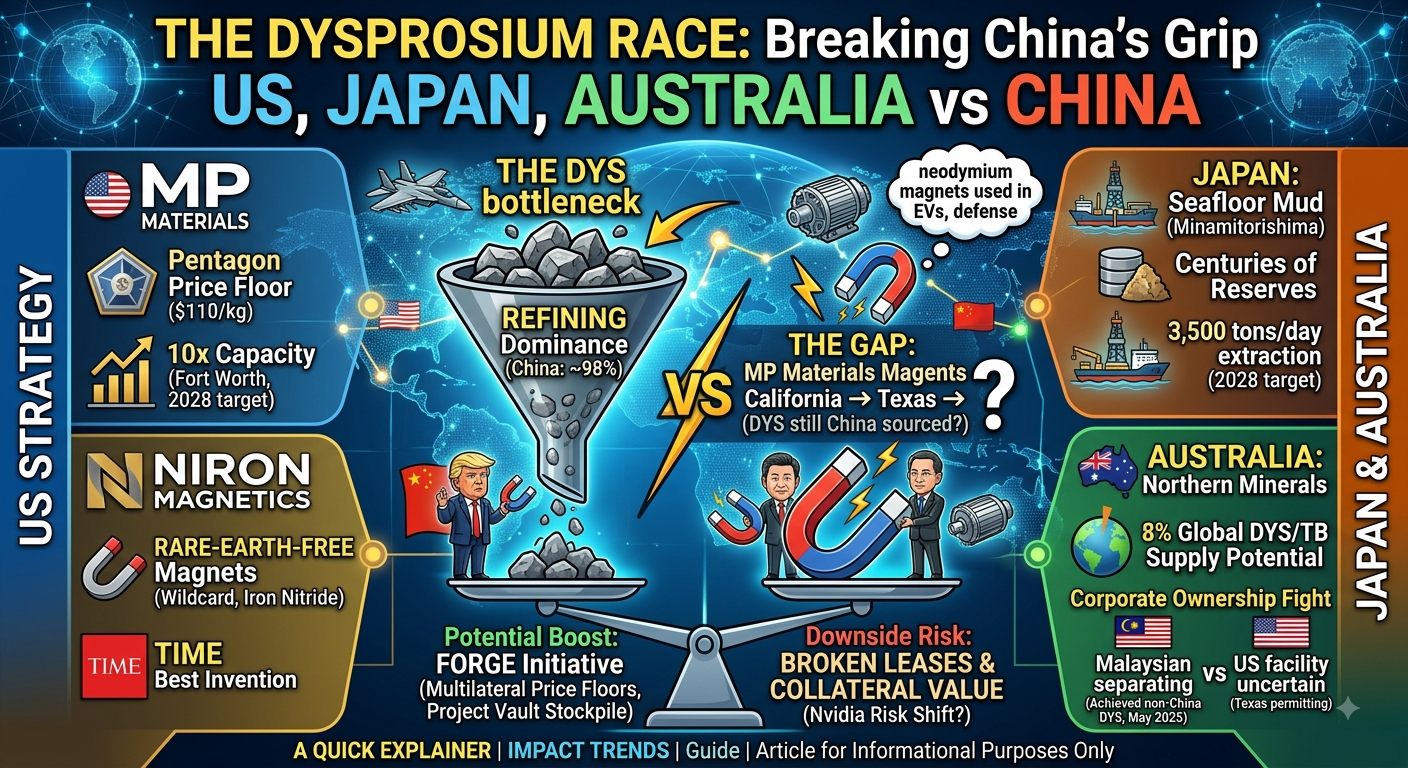 반응형
반응형China's Supply Dominance and Its Weaponization
Heavy rare earth mining is concentrated almost entirely in China and Myanmar, with roughly 65-70% of China's own dysprosium output actually sourced from Myanmar and imported. China maintains a domestic mining quota of just 20,000 tons annually, importing an additional roughly 41,700 tons to reach total production of 61,700 tons — a structural dependency that explains China's active interest in Myanmar's internal conflict, given that most of Myanmar's dysprosium-producing territory sits in rebel-controlled areas China has supported.
China has increasingly used this dominance as diplomatic leverage. Starting April 2025, China introduced export licensing requirements for seven heavy rare earths (dysprosium, samarium, gadolinium, terbium, lutetium, scandium, yttrium) and related magnets, and from December 2025 began denying licenses to any company with US military ties. After Japanese PM Sanae Takaichi stated in November 2025 that a Chinese invasion of Taiwan could threaten Japan's existence — legally significant language regarding Japan's Self-Defense Forces — China restricted exports of the same seven heavy rare earths to Japan starting January 6, 2026.MP Materials: America's Bet, and Its Gap
MP Materials operates the US's flagship rare earth supply chain effort, mining light rare earths at California's Mountain Pass and producing NdFeB permanent magnets at its Independence facility in Fort Worth, Texas — the facility's name a deliberate nod to breaking Chinese dependency. The company has qualified magnets for GM vehicles, plans Apple supply starting 2027, and is scaling capacity roughly tenfold.
The gap: MP's light rare earth supply is domestically sourced, but the dysprosium used in its magnets reportedly still originates from China. The US Department of Defense has backed MP aggressively to address this — taking a $400 million equity stake that made it the company's largest shareholder, and signing a Price Protection Agreement guaranteeing a $110/kg floor price for MP's core NdPr product through 2035, with the government covering the difference in cash if market prices fall below that level. This guarantee is widely credited with MP's EBITDA turnaround, from -$12.5 million in 2025 to +$28.5 million in Q2 2026, with $17.6 million in price-protection income recorded in that quarter alone. A new tenfold-capacity facility, coming online in 2028, carries the same price floor plus a 10-year, 100% purchase guarantee from the Pentagon before a single magnet has been produced. Even with this expansion, MP's projected 10,000-ton annual capacity by 2028 remains well short of the roughly 48,000 tons of neodymium magnets the US consumed in 2025 — and dysprosium sourcing remains unresolved.The Wildcard: Magnets With No Rare Earths At All
A parallel US strategy targets eliminating rare earth dependency entirely. Iron nitride (Fe₁₆N₂) has been known to have magnetic properties since the 1950s but was considered too difficult to reliably reproduce for commercial use, until research beginning in 2002 at the University of Minnesota led to Niron Magnetics' founding. On August 7, 2026, Trump announced $150 million in Defense Department funding for Niron. Because iron and nitrogen are abundant, low-cost materials, successful commercialization could be transformative — the technology was named a TIME Best Invention in 2023.
Real limitations remain: Niron's magnets currently perform well only below 200°C, ruling out high-heat applications like fighter jets or high-performance motors for now. Commercial rollout has started with lower-temperature applications like speakers and headphones, with industry estimates placing full EV motor adoption 3-7 years out. It remains, for now, a bet on future potential rather than a proven solution.Japan's Seafloor Solution
Japan's approach centers on Minamitorishima, a remote Pacific island roughly 1,800km from Tokyo, first surveyed by Spain in 1684 and incorporated into Japan in 1889. In 2011, University of Tokyo researchers discovered high concentrations of heavy rare earths in seafloor mud roughly 5,500-6,000 meters deep near the island, later estimated to hold dysprosium reserves sufficient for centuries of global consumption — with a critical advantage: unlike land-based rare earth deposits formed through magmatic activity, which co-concentrate radioactive thorium and uranium, these seafloor deposits form through a different process, as iron-rich hydrothermal fluid from underwater volcanic activity gradually adsorbs rare earths from seawater over long periods, largely without radioactive byproducts.
Japan's deep-sea research vessel Chikyu began test drilling in January 2026 and confirmed successful mud extraction by February 2026, with plans to scale to 3,500 tons of daily extraction by 2028 at a cost of roughly 140 billion yen (1.3 trillion Won), with breakeven projected within six years. Alongside this, Japan built resilience through diversification and stockpiling: reducing Chinese rare earth supply dependency from over 95% to roughly 60% by diversifying to sources including Vietnam, and maintaining a multi-year government stockpile that allowed Japan to weather China's 2026 export restrictions without the disruption seen after a similar 2010 dispute over the Senkaku Islands, when Japan had no comparable preparation.Australia's Northern Minerals and a Corporate Ownership Fight
Australia's Northern Minerals has run pilot-scale dysprosium and terbium mining at Browns Range since 2018, with a 2025 feasibility study confirming commercial viability and potential to supply roughly 8% of global dysprosium and terbium, targeting production from 2028. This effort has become entangled in an ownership dispute: a Singapore-registered, Chinese-owned entity called Yuxiao Fund attempted to raise its stake toward Australia's 19.9% foreign ownership cap starting in 2023, and after seeking to remove Northern Minerals' board chairman, Australia's Treasurer blocked the stake increase and ordered forced divestment in June 2024. When the fund attempted to route its holdings through a Hong Kong entity rather than sell on the open market, Australia's Federal Court imposed a $14 million fine. A subsequent investigation revealed six additional China-linked investment vehicles, routed partly through the British Virgin Islands, holding a combined 17.58% stake — all ordered to divest within 14 days as of May 2026, prompting formal Chinese diplomatic protest.
The Real Bottleneck: Refining, Not Mining
China's dominance extends well beyond mining — it controls roughly 98% of global heavy rare earth refining and separation, a process requiring over 200 chemical processing steps, significant environmental impact, and substantial technical infrastructure. This means that regardless of where raw material is mined — Greenland, Australia, Japan, or Myanmar — it has historically needed to go to China for processing.
Breaking this bottleneck is underway but slow. Australia's Lynas operates a concentration facility at Kalgoorlie but still sends separation work to Malaysia, where its facility achieved the first dysprosium production outside China in May 2025, making it currently the only non-China commercial dysprosium separator — though Malaysia's government has mandated Lynas eliminate radioactive waste generation from its process entirely by 2031. A separate Australian facility at Eneabba, targeting a 2027 commissioning for full neodymium/dysprosium/terbium separation, is currently progressing faster than a comparable US-funded Lynas facility in Texas, which faces uncertain wastewater permitting.Price Floors and the FORGE Initiative
Beyond company-specific support, the US has pursued multilateral frameworks to blunt Chinese pricing power. The FORGE Initiative, launched February 2026 with 55 countries and the EU (with Korea serving as inaugural chair through June 2026), aims to establish price floors for critical minerals specifically to counter Chinese below-cost dumping, which has historically been used to bankrupt Western rare earth competitors and consolidate market share. A parallel effort, Project Vault, is a US critical minerals stockpiling fund targeting 60 days of strategic reserves across rare earths, lithium, nickel, cobalt, gallium, and copper, with built-in price floor purchase guarantees.
Separately, new US legislation will bar defense contractors from using Chinese, Russian, Iranian, or North Korean rare earth magnets and metals in weapons systems starting January 1, 2027, with supply chain traceability requirements — tracking material back to its mining origin — taking effect June 30, 2027, closing loopholes where Chinese-mined material is processed in third countries to obscure its origin.Bottom Line
The US, Japan, and Australia are pursuing parallel strategies to break China's rare earth dominance — MP Materials backed by Pentagon price guarantees, Niron's rare-earth-free magnet technology as a longer-term wildcard, Japan's seafloor mining near Minamitorishima, and Australia's Northern Minerals navigating Chinese ownership disputes — but all face a common bottleneck: China's 98% control of heavy rare earth refining capacity means mining alone doesn't solve the supply chain problem until competing separation facilities in Australia and the US actually come online.
This article is for informational purposes only and does not constitute investment, tax, or legal advice. Readers should consult a licensed professional before making investment decisions.
반응형'Global Markets > Supply Chain & Geopolitics' 카테고리의 다른 글
Korean Stock & Equity Research
Data-driven analysis of Korean listed companies, combining financial fundamentals with supply chain and operations insights. Not investment advice.