In the late 1990s, the promise that "the internet would change everything" fueled a wave of fiber-optic cable buildout that ultimately buried 2 trillion dollars in telecom value and left 95% of laid cable dark for years. Today, a similar circular financing structure is emerging around AI infrastructure — this time centered on Nvidia, OpenAI, and Oracle. Understanding the parallels, and the differences, matters directly for Korean chipmakers like SK Hynix and Samsung Electronics sitting at the center of the AI hardware supply chain.
Table of Contents
- The Dot-Com Fiber Bubble: A Precedent
- Today's Circular Financing: Nvidia, OpenAI, and Oracle
- Why Nvidia Is Willing to Guarantee OpenAI's Debt
- OpenAI: The Weakest Link in the Chain
- Implications for Korean Chipmakers
- Bottom Line
The Dot-Com Fiber Bubble: A Precedent
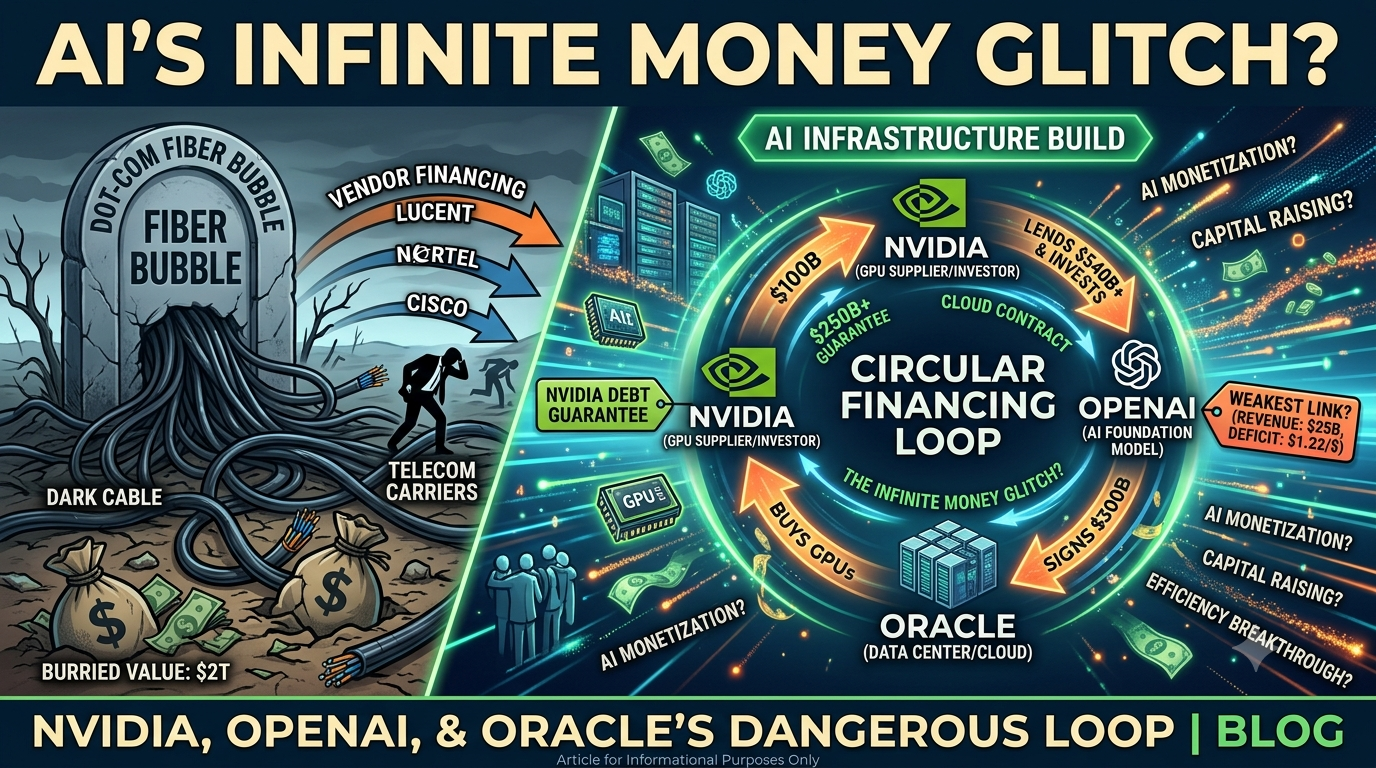
During the dot-com era, the belief that internet traffic would grow without limit drove telecom companies to lay fiber-optic cable at massive scale, even though most of these new carriers had little cash on hand. Equipment makers like Lucent, Nortel, and Cisco stepped in to finance the buildout themselves — lending telecom companies the money to buy their own equipment, with roughly $30 billion in such vendor financing extended in 2000 alone.
The bubble burst when new compression technologies and DWDM (dense wavelength-division multiplexing) allowed far more data to travel through existing cable, meaning the fiber already in the ground was more than sufficient to meet demand. Major carriers including WorldCom and Global Crossing collapsed, the Nasdaq fell 78% from its March 2000 peak of 5,048 through 2002, roughly $2 trillion in global telecom market value evaporated, and an estimated 95% of laid fiber sat completely unused, or "dark," for years afterward.
Today's Circular Financing: Nvidia, OpenAI, and Oracle
A structurally similar pattern is now visible in AI infrastructure spending. Reports indicate Nvidia is in discussions to guarantee $250 billion in financing for OpenAI's Ohio data center project, on top of a separate $350 billion in support to help OpenAI purchase Nvidia's own chips.
This is part of a broader pattern dating back to September 2025: Nvidia announced plans to invest up to $100 billion in OpenAI, while Oracle signed a five-year, $300 billion cloud computing contract with OpenAI. Because Oracle needs Nvidia chips to fill its data centers, the same capital effectively cycles from Nvidia to OpenAI to Oracle and back to Nvidia. Beyond OpenAI, Nvidia has invested in data center operators including CoreWeave, Nebius, and IREN, with combined commitments exceeding $540 billion. Critics of this structure have dubbed it an "infinite money glitch" — the same dollars circulating repeatedly while every participant's valuation rises.
Why Nvidia Is Willing to Guarantee OpenAI's Debt
The central question is why Nvidia would take on guarantee exposure rather than simply selling chips. The answer lies in OpenAI's credit profile: as an unprofitable private company, OpenAI carries a sub-investment-grade credit standing. When SoftBank's SB Energy, the contractor building the data center, seeks construction financing from banks, the tenant's — OpenAI's — creditworthiness becomes central to the deal, since long-term lease financing depends on the tenant's ability to keep paying rent.
Because OpenAI's credit alone is viewed skeptically, Nvidia's guarantee is what allows the financing to move forward at all — and effectively lets the project borrow against Nvidia's credit standing rather than OpenAI's, securing lower interest rates. From Nvidia's side, guaranteeing debt rather than lending directly also carries an accounting advantage: guarantees don't appear as liabilities on Nvidia's balance sheet.
OpenAI: The Weakest Link in the Chain
The financial fragility in this structure centers on OpenAI. The company reportedly spends $1.22 for every $1 of revenue it earns, with IPO-related filings pointing to a projected break-even around 2030. HSBC has estimated OpenAI will need to raise at least $207 billion in additional capital through 2030 to sustain its current trajectory — a company generating roughly $25 billion in revenue attempting to fund $80–100 billion in annual computing commitments over the next five years.
Because Nvidia, Oracle, and OpenAI simultaneously function as each other's investors, suppliers, and customers, financial stress in one part of the chain carries meaningful risk of spreading to the others. Nvidia's own balance sheet, backed by hundreds of billions in cash generation, appears well insulated. OpenAI and Oracle carry more direct exposure if the structure comes under strain.
Implications for Korean Chipmakers
SK Hynix and Samsung Electronics sit further upstream in this same AI infrastructure buildout, supplying the high-bandwidth memory (HBM) that feeds Nvidia's GPUs. Continued momentum in this circular financing structure has directly supported HBM demand and pricing over the past year. That also means Korean memory makers carry indirect exposure to the same open questions hanging over the structure — chiefly, how long OpenAI can continue raising capital to fund its compute commitments, and whether efficiency breakthroughs analogous to DWDM in the fiber era could reduce the sheer volume of GPU — and by extension HBM — capacity required going forward.
Bottom Line
The current AI infrastructure buildout centered on Nvidia, OpenAI, and Oracle shares real structural similarities with the dot-com era's fiber-optic financing boom, and the sustainability question ultimately comes down to three factors: whether AI monetization can eventually justify hundreds of billions in infrastructure spending, whether OpenAI can keep raising capital until that happens, and whether an efficiency breakthrough could reduce the need for GPU capacity the way compression technology did for fiber. The first question draws broad optimism; the second is where markets are currently focused; the third remains largely speculative for now.
This article is for informational purposes only and does not constitute investment, tax, or legal advice. Readers should consult a licensed professional before making investment decisions.


