-
Global Markets/Supply Chain & Geopolitics
Kumamoto's Earthquake and the Hidden Risk to Japan's Chip Supply Chain
2026. 8. 7.
Table
반응형On July 28, 2026, at around 4:27 PM local time, a magnitude 7.1 earthquake struck Kumamoto in Japan's Kyushu region, with a shallow focal depth of 10km and a maximum intensity of 7 — the highest level on Japan's seismic scale. Beyond the immediate human impact, the region carries outsized importance for the global semiconductor supply chain, as it hosts TSMC's Japanese subsidiary JASM, Sony's image sensor operations, and Fujifilm's semiconductor materials facilities.
Table of Contents
- Magnitude vs. Intensity: Understanding the Numbers
- Why Japan Sits at the Center of Global Seismic Activity
- An Active Fault Earthquake, Not a Subduction Zone Event
- Echoes of 2016, and the Risk of a Larger Aftershock
- Semiconductor Supply Chain Implications
- Bottom Line
Magnitude vs. Intensity: Understanding the Numbers
Earthquakes are measured two different ways. Magnitude represents the total energy released at the earthquake's origin point — comparable to the wattage of a light bulb, a single fixed value no matter where it's observed. The strongest earthquake ever recorded by modern seismometers was Chile's 1960 event, at magnitude 9.5, and magnitude has no theoretical upper limit.
Intensity, by contrast, measures how strongly the ground actually shook at a specific location, along with the resulting damage — the equivalent of how bright that same light bulb appears depending on how close you're standing to it. Japan uses a 10-level intensity scale (0, 1, 2, 3, 4, 5-lower, 5-upper, 6-lower, 6-upper, 7), and the Kumamoto earthquake registered at intensity 7, the maximum level. At this intensity, standing or crawling becomes physically difficult, furniture can be thrown across rooms, and buildings without adequate seismic reinforcement face a high risk of collapse. A shopping mall in the region partially collapsed following a gas explosion roughly an hour after the initial quake, with around 20 employees reported unaccounted for as of the latest updates.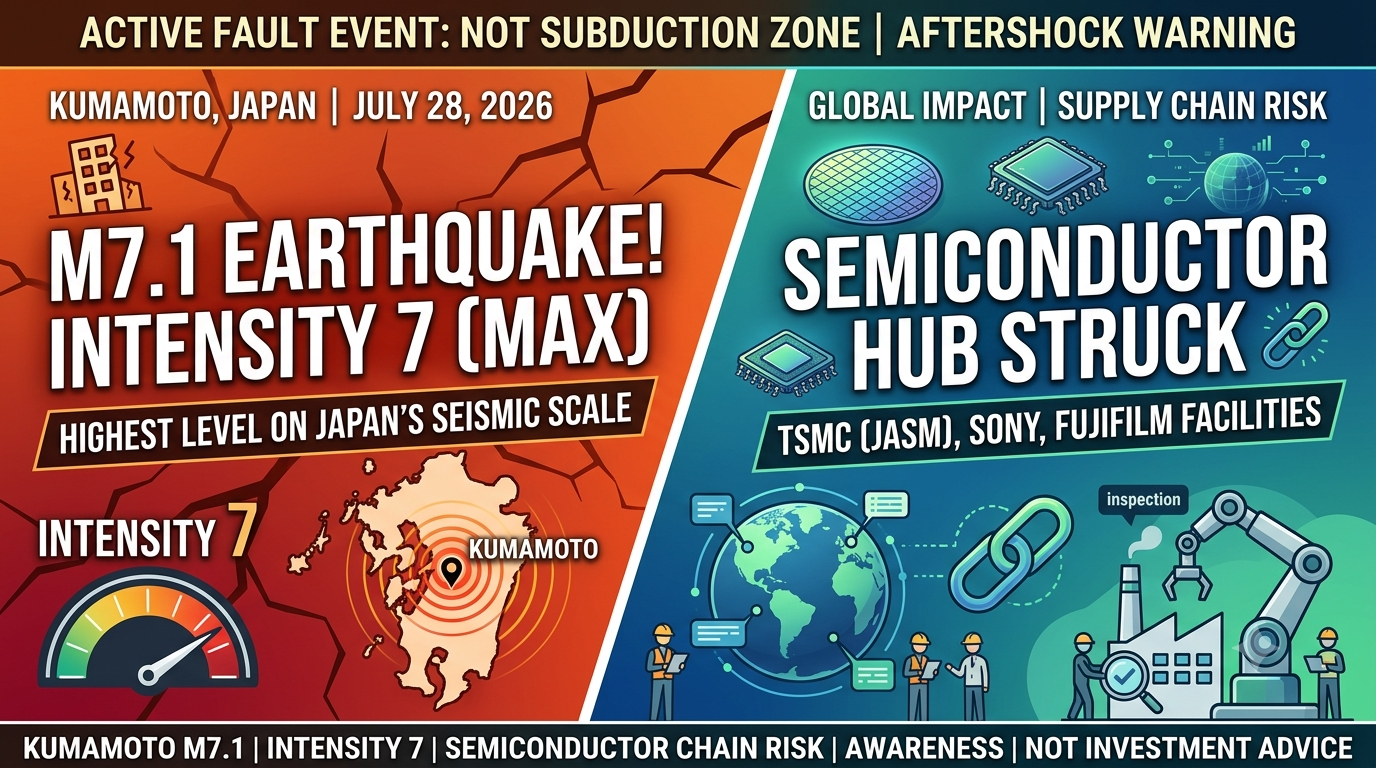
Magnitude 7.1 in Kumamoto: What It Means for JASM, Sony, and Global Chips 반응형Why Japan Sits at the Center of Global Seismic Activity
Earth's crust is constantly being created and destroyed. At mid-ocean ridges deep in the sea, molten magma rises and cools upon contact with seawater, forming new crust. This newly formed crust pushes older crust outward, causing tectonic plates to drift a few centimeters per year. When a plate that has traveled thousands of kilometers eventually collides with another, the heavier plate is forced beneath the lighter one in a process called subduction, pulling it back into the Earth's interior.
Roughly 90% of the world's earthquakes occur along these plate boundaries, and Japan sits at an unusually dangerous intersection where four separate tectonic plates — the Eurasian, North American, Pacific, and Philippine Sea plates — meet and grind against one another from different directions.An Active Fault Earthquake, Not a Subduction Zone Event
Unlike the large subduction zone earthquakes typically associated with major tsunamis, the Kumamoto earthquake originated from the Hinagu fault zone, an active fault system within Kyushu itself. In this region, the Philippine Sea plate subducts beneath the Eurasian plate at roughly 4–6cm per year, gradually building stress along the fault over centuries. When the fault can no longer withstand the accumulated pressure, it releases that energy in a sudden slip of several meters — similar to a balloon reaching its breaking point.
Echoes of 2016, and the Risk of a Larger Aftershock
Kumamoto experienced a similarly severe intensity-7 earthquake in April 2016. Notably, this year's epicenter sits about 20km south of that 2016 event, suggesting that while the 2016 earthquake released stress along the northern section of the Hinagu fault, this latest quake released stress that had been building along the southern section.
There is meaningful precedent for concern about further seismic activity. Major intensity-7 mainshocks are often followed by weeks or months of magnitude 5–6 aftershocks, and buildings already weakened by the initial quake face elevated risk of secondary collapse. Dozens of aftershocks, including one measuring magnitude 6.1, have already been recorded. Critically, in the 2016 Kumamoto sequence, what was initially assumed to be the main earthquake was followed two days later by an even larger event that turned out to be the true mainshock. Experts are urging heightened caution over the coming month given this precedent.Semiconductor Supply Chain Implications
Kumamoto functions as a key hub for Japan's semiconductor industry, hosting JASM (TSMC's Japanese manufacturing subsidiary), Sony's image sensor operations — the global leader in that segment — and Fujifilm's semiconductor materials production. Facilities in the region have reportedly evacuated staff and begun safety inspections, and ongoing aftershock risk means a full return to normal production timelines remains uncertain. For investors tracking global chip supply chains, this adds a fault-line risk factor — quite literally — alongside the more commonly discussed geopolitical and demand-side variables.
Bottom Line
Kumamoto's magnitude 7.1 earthquake originated from a distinct active fault rather than the subduction zones typically linked to major tsunamis, but the region's history — including a delayed, larger mainshock in 2016 — means elevated aftershock risk is expected to persist for weeks. With JASM, Sony, and Fujifilm all operating major facilities in the area, the earthquake adds a tail risk to global semiconductor supply chains that is worth monitoring alongside the more familiar drivers of chip sector volatility.
This article is for informational purposes only and does not constitute investment, tax, or legal advice. Casualty and damage figures reflect preliminary reports and may be updated as the situation develops. Readers should consult official sources for the latest safety information and a licensed professional before making investment decisions.
반응형'Global Markets > Supply Chain & Geopolitics' 카테고리의 다른 글
Korean Stock & Equity Research
Data-driven analysis of Korean listed companies, combining financial fundamentals with supply chain and operations insights. Not investment advice.