-
Korean Equities/Company Deep Dives
Nvidia's $500 Billion AI Financing Deal Has the Same Risk as a Korean Retail Ban
2026. 8. 12.
Table
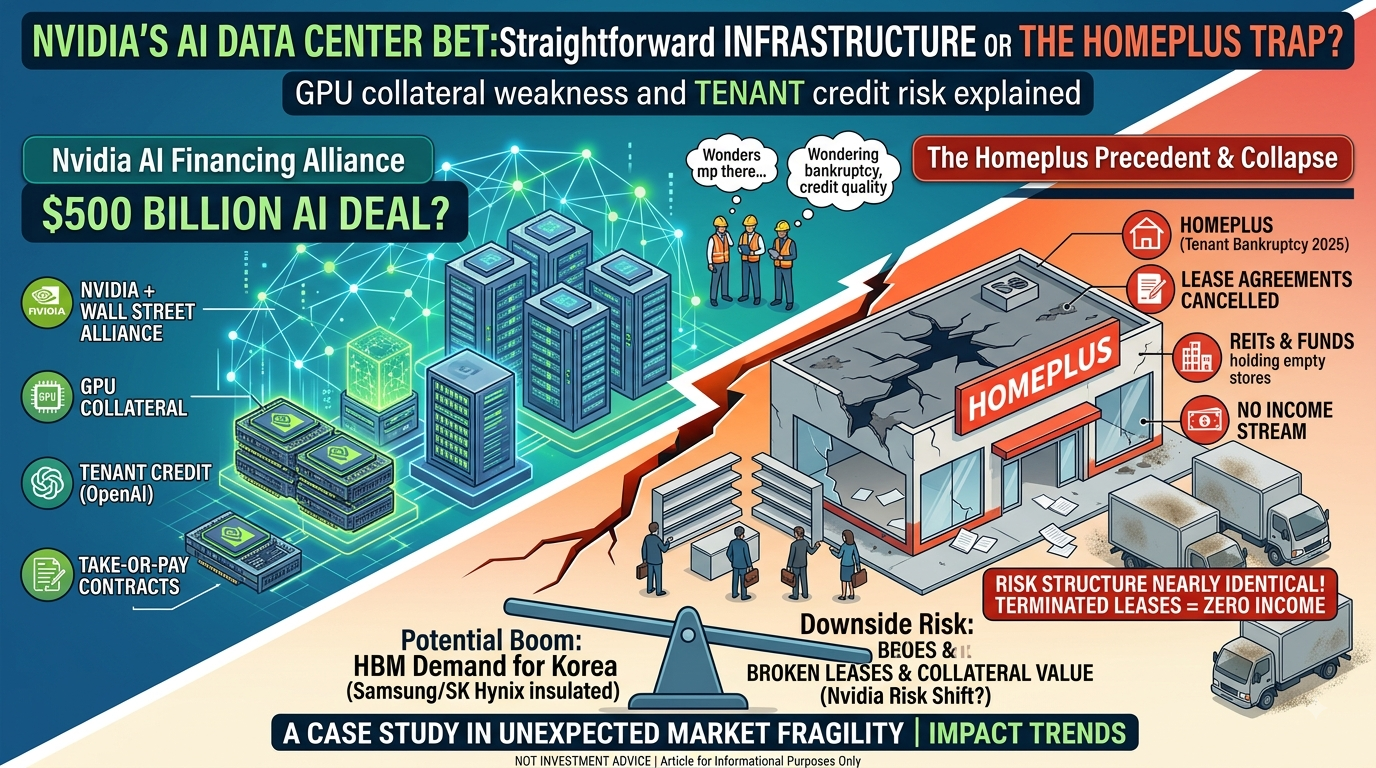
반응형Nvidia and six of Wall Street's largest financial firms are reportedly assembling a $500 billion financing alliance to fund AI data center buildouts. On paper, it looks like a straightforward infrastructure financing deal. Look closer, and the risk structure is nearly identical to a very different transaction that ended in bankruptcy: the sale-and-leaseback financing behind Korea's Homeplus retail chain, which collapsed in 2025 when its main tenant filed for court receivership.
Table of Contents
- The Homeplus Precedent: Sale-and-Leaseback, Explained
- How the Structure Broke
- Mapping Homeplus Onto Nvidia's AI Financing
- How the $500 Billion Deal Is Actually Structured
- Why GPU Collateral Is Weaker Than It Looks
- Take-or-Pay Contracts, and Their Limits
- Where Nvidia's Own Risk Could Emerge
- Implications for Samsung and SK Hynix
- Bottom Line
The Homeplus Precedent: Sale-and-Leaseback, Explained
After MBK Partners acquired Homeplus, Korea's major retail chain, in 2015, it sold roughly 20 of the company's best-performing stores and distribution centers for approximately 4 trillion Won, using most of the proceeds to pay down acquisition debt. This is a sale-and-leaseback: selling owned real estate for cash, then leasing it back long-term to continue operating from the same locations. The buyers in this case were real estate funds and REITs, which viewed Homeplus as a large, creditworthy tenant expected to pay stable, long-term rent. Those funds used the rental income to service bank loans and pay investor distributions — a structure that looks sound on paper, with one structural vulnerability: the value of the leased asset depends entirely on the tenant's ability and willingness to keep paying rent, not on the physical property itself.
 반응형
반응형How the Structure Broke
In March 2025, when MBK filed for Homeplus's court-supervised corporate rehabilitation, Korea's debtor rehabilitation law allowed the company to terminate its existing lease agreements. Once those leases were cancelled, rental payments stopped entirely, leaving the funds and REITs holding non-operating retail stores with no tenant and no income stream — the exact scenario their financing structure had been built to avoid.
Mapping Homeplus Onto Nvidia's AI Financing
The Nvidia-Wall Street AI financing alliance carries structurally similar risk, with the cast of characters simply swapped:
Retail stores GPU data centers Tenant: Homeplus AI compute buyer: OpenAI and similar firms Long-term lease agreement Long-term data center usage contract (take-or-pay) Property owners: REITs and funds Apollo, Blackstone, BlackRock, Brookfield, Goldman Sachs, KKR Banks financing the funds Pension funds and insurers financing the same institutions How the $500 Billion Deal Is Actually Structured
Nvidia itself isn't directly funding $500 billion. Instead, six major financial institutions are each raising capital from institutional investors to extend loans, which buyers like OpenAI then use to build data centers and purchase GPUs. In Homeplus terms, this is the equivalent of "we'll build you the store, you lease it long-term and just cover the rent."
Why GPU Collateral Is Weaker Than It Looks
The structure's central risk isn't the physical collateral (Homeplus stores, or Nvidia GPUs) — it's the creditworthiness of the end user and the durability of the underlying contract. Nvidia GPUs reportedly lose roughly half their resale value within three years, and the secondary market for used GPUs remains thin. In practice, this means GPU collateral functions more as a formality than genuine security; the real determinant of loan safety is the credit quality of the tenant, in this case AI compute buyers like OpenAI. This shows up directly in financing terms: a buyer with investment-grade credit, like Google, might borrow around 6%, while it remains genuinely uncertain whether OpenAI could secure financing even at 15%.
Take-or-Pay Contracts, and Their Limits
Contract durability in this structure is anchored by take-or-pay agreements — contracts requiring payment for a committed amount regardless of actual usage, the equivalent of a 10-year Homeplus lease requiring rent payments whether or not the store is profitable. But take-or-pay contracts have a known weakness: bankruptcy. Both Korean and US bankruptcy law allow a company entering bankruptcy proceedings to reject unfulfilled contracts. Even short of full bankruptcy, credit deterioration at a tenant like OpenAI could trigger contract renegotiation, since counterparties often prefer reduced terms to a fully broken lease and total loss of income — meaning take-or-pay protection is real, but not absolute, when the underlying buyer's credit quality deteriorates.
Where Nvidia's Own Risk Could Emerge
From Nvidia's perspective, this financing structure functions similarly to helping a customer secure a loan to buy Nvidia's own product — customers who want GPUs but lack sufficient capital get arranged financing to purchase them anyway. If Nvidia ends up guaranteeing GPU resale value as part of these arrangements, the underlying risk could shift meaningfully from the compute buyers onto Nvidia itself. As of now, this remains at the memorandum-of-understanding stage, with final structural details still to be worked out.
Implications for Samsung and SK Hynix
As covered in our earlier piece on the Nvidia-OpenAI-Oracle circular financing structure, this deal extends the same web of interconnected AI infrastructure financing that indirectly supports HBM demand from Samsung Electronics and SK Hynix. As long as Samsung and SK Hynix maintain a straightforward "pay for chips, receive chips" posture, they're relatively insulated from direct exposure to this financing structure's credit risk. That said, if a major compute buyer like OpenAI experiences a credit event, broader AI infrastructure investment could slow as a second-order effect, meaning Korean memory makers aren't in a fully risk-free position even without direct financing exposure.
Bottom Line
Nvidia's reported $500 billion AI financing alliance with major Wall Street institutions carries a risk structure nearly identical to the sale-and-leaseback financing behind Korea's Homeplus, which collapsed when its tenant entered bankruptcy and terminated its leases. With GPU collateral losing roughly half its value within three years and a thin resale market, the real determinant of this financing's safety is the credit quality of AI compute buyers like OpenAI and the durability of their take-or-pay contracts — both of which carry real, if partial, protection against a genuine credit event.
This article is for informational purposes only and does not constitute investment, tax, or legal advice. Readers should consult a licensed professional before making investment decisions.
반응형'Korean Equities > Company Deep Dives' 카테고리의 다른 글
Korean Stock & Equity Research
Data-driven analysis of Korean listed companies, combining financial fundamentals with supply chain and operations insights. Not investment advice.